

What a Brown Widow Egg Sac Looks Like — and What It Means
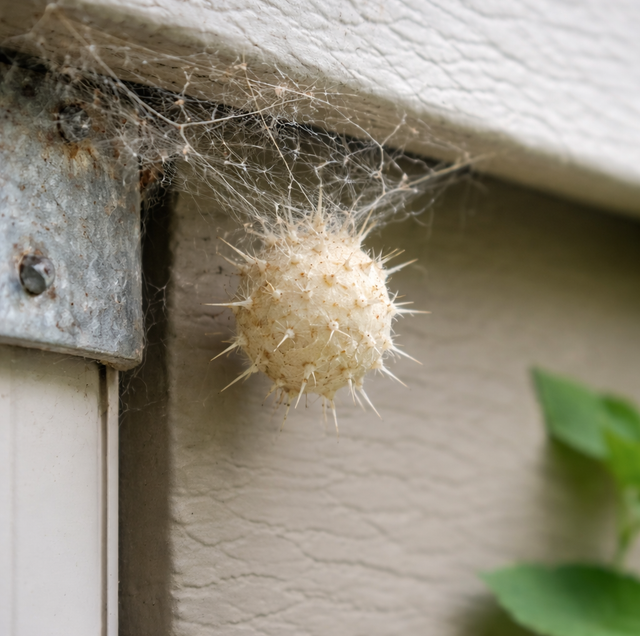
Quick Answer: A brown widow egg sac is a round, off-white sphere about the size of a pea, covered in blunt silk spikes. Each sac can hold well over a hundred eggs, and one female produces up to twenty over her lifetime.
A tan, burr-textured ball tucked into a screen track or wedged under a mailbox lip doesn't look like anything a spider made at first glance. It looks more like a dried seed pod or a piece of stuck-on debris, which is exactly why so many of these get brushed away with a gloveless hand before anyone realizes what they were looking at. That spiky ball is a brown widow egg sac, and it's worth slowing down for: what it looks like at every stage between hatch and adult, how many eggs a single female actually produces over her life, why South Florida never gives that reproduction a seasonal pause, and what finding even one sac really tells you about a property.
What Makes the Sac Itself So Recognizable
A brown widow egg sac is roughly the size of a pea, somewhere around eight to ten millimeters across, off-white to pale cream in color, and covered evenly in blunt silk spikes that give the whole surface a burr-like or tufted texture. Entomologists who study the species have compared the shape to a pollen grain or a World War II naval mine, both of which are built around the same idea: a round core with projections sticking out in every direction. That texture is the single most reliable identifying feature, more reliable than color alone, since a sac's shade can shift slightly with age and dust exposure, just as an old web does.
Compare that to what the other common household spiders leave behind. A black widow's sac is round or slightly pointed at the top, yellow to tan, and smooth. A common house spider's sac is a smooth, papery, tan-brown teardrop tucked into the corner of its cobweb. Nothing else regularly found around a South Florida home produces the spiked, globe-like texture a brown widow does, which is why the sac itself, not the spider guarding it, is often the fastest way to confirm what you're actually looking at. You'll typically find it suspended by multiple silk lines inside the spider's own loose, tangled web rather than sitting loose on a surface, anchored in the same tight, shaded voids the species already favors for nesting.
How the Spider Inside Changes Look as It Develops
Inside the sac: development takes roughly two weeks or longer depending on temperature, running faster through a warm South Florida summer and slower, though never stalled outright, during the coolest stretch of the year.
Freshly hatched spiderlings: the young that emerge are pale, almost translucent cream-white, with no visible pattern yet, and they typically stay clustered in or near the sac for a period of days to a couple of weeks before dispersing on their own.
Juveniles: across a series of molts, the coloring darkens and the geometric, mottled triangle pattern that gives the species its scientific name, *Latrodectus geometricus*, gradually fills in across the abdomen, along with faint banding on the legs.
Adults: the recognizable mottled tan-to-dark-brown body and the orange-to-yellow hourglass or paired-triangle markings on the underside only fully develop after several more molts. A pale, faintly marked spider found near a sac isn't a different, less concerning species. It's a brown widow that hasn't finished developing its adult markings.
The Real Numbers Behind One Egg Sac
Researchers typically put the count at around 120 to 150 eggs per sac. On its own, that's already a lot, but it's only part of the picture: a female brown widow can produce up to roughly twenty sacs over her lifetime, often several in quick succession from the same web. Even a conservative estimate, a dozen sacs at around 130 eggs apiece, puts one female's lifetime output well past 1,500 eggs. That reproductive volume is the entire reason a single found sac deserves more attention than a single found web.
Never crush or burn an egg sac to destroy it. Crushing scatters silk-wrapped eggs into cracks a vacuum can't reach afterward, and a scorched sac can still hold viable eggs underneath. Contain it sealed, then discard it.
Why South Florida Never Gives This a Single Hatch Window
There's no spring bottleneck here the way there is farther north, where a hard winter forces every unhatched sac to wait out the cold on the same rough schedule. South Florida's climate keeps brown widows active outdoors year-round, and egg production and hatching track that same rolling pattern rather than clustering around one season. A sac laid in January develops on close to the same timeline as one laid in July, just a little slower in the cooler stretch and a little faster in peak summer heat. What that means for a homeowner: there is no time of year when checking for a sac is unnecessary, and no season where a found sac can be written off as an early or late outlier.
What Finding One Sac Actually Signals About the Population
A web with no sac could belong to a young spider still maturing, or even a wandering male, which are smaller, rarely seen, and don't produce or guard sacs at all. A web with a sac confirms something different: an adult female has been living in that exact void long enough to reach maturity, mate, and start laying, which rules out a spider that's merely passing through. Because a single female typically produces her sacs close together rather than spread thin across a season, one found sac raises real odds that others, hers or an earlier batch that's already hatched, are sitting in the same or a nearby void. A single sac in a screen track or post corner is best read as a snapshot of an established, reproducing spider, not a one-time visitor that happened to leave something behind.
Handling and Removing a Sac Safely
Contain, don't knock loose: a shop vacuum with a sealable bag, or a jar you can close, pulls the sac (and the spider, if she's still nearby) away cleanly. Sweeping it loose with a broom or bare hand risks a stray bite from the female and scatters spikes and silk into the same gap you're trying to clear.
Check the sac's condition before assuming it's a fresh threat: a firm, bright sac with crisp spikes is active. A flattened, papery sac with a ragged tear or hole means the spiderlings already emerged and moved on, and that particular sac is no longer a concern, though the void that produced it likely still is.
Don't relocate the item it's attached to without a plan: a sac fixed to a stored grill cover, a folded cushion, or patio furniture will travel wherever that item goes next. If the item has to move, seal it in a bag or contain it outdoors rather than carrying it straight into a garage or living space.
What a Sac Tells You About the Rest of the Property
A sac confirms an established female was living in that exact void long enough to mature and lay, and that's worth carrying into the rest of the check rather than treating the one find as closed. Brown widows return to the same short list of tight, shaded voids around a typical South Florida property: lanai post corners and screen track channels, the underside of a mailbox, pool-cage frame joints and kick-plate seams, folded grill covers and stacked outdoor gear. A property that produced one sac in one of those spots is worth walking past the others on that list, since a female that settled into one favorable void has often found a second nearby rather than staying confined to the one you happened to spot. Contain what you found using the sac's own condition as your guide to urgency, then work outward through the rest of those voids before calling the property checked.
Frequently Asked Questions
Somewhat, though weathering is a better clue than a precise calendar. A newly spun sac is bright, off-white, and firm, with crisp, upright spikes. Over the next couple of weeks, that color mutes toward a duller tan or gray and the spikes flatten and mat down against the surface, well before there's any tear or opening to suggest the spiderlings are gone. That dulling stage tracks weather exposure more than it tracks age on its own: a sac tucked into a damp, heavily shaded screen track or soffit gap will dull and mat noticeably faster than one sitting in a drier, sun-exposed post corner, so two sacs laid around the same week can look ages apart just from where each one happens to sit. Sac condition is a useful rough guide to whether it's still worth containing as active, not a reliable way to pin down an exact week.
No, sac production and guarding are female-only behavior. Males run roughly half the size of females, wander farther in search of a mate rather than settling into one web, and are rarely encountered as a result. Like several other widow species, a male brown widow is sometimes eaten by the female after mating. However, this sexual cannibalism shows up less consistently in this species than in some of its relatives.
Don't leave it in place hoping the problem resolves itself; an intact sac left alone still hatches on its own schedule no matter how awkward it is to reach. If the fixture or item it's attached to can come out as a whole, a section of screen track or a stored item, remove that piece and contain it in a sealed bag or closed container outdoors rather than trying to pry the sac loose in place. If it's fixed to something structural that can't reasonably be pulled, or inside a soffit void or behind trim that's mounted for good, that's a case for a professional visit rather than DIY extraction, since reaching it safely may require opening part of the structure. Either way, the sac stays contained until it's actually dealt with; it's never left in place to hatch on its own.
Not by itself, and it helps to know what "more than one" typically looks like in practice. On a property with an established female, it's common to find two or three sacs in different stages within the same void or one nearby: one bright and firm, one already dulling, one flattened and empty from an earlier hatch, rather than a single sac sitting alone. A sac count on its own isn't the clearest sign of how established the population is, though. A better signal is whether webs turn up in more than one separate void around the same structure; that spread points to more than one mated female having settled in, while a single female, even one that's laid repeatedly, tends to keep all her sacs close together in the one web she built.
Yes, and often faster than it would outdoors, since indoor temperatures stay warmer and more stable than a shaded exterior void through the cooler months. Spiderlings that hatch indoors have far less natural prey available and are more likely to wander into living space looking for food and moisture than ones that hatch and disperse outdoors on their own schedule.
No. Spike coverage varies from sac to sac; some look denser and more uniformly covered than others, without any relationship to egg count or age. What actually matters for identification is that the spikes are present at all, since that texture is what separates a brown widow's sac from the smooth ones other common house spiders and black widows produce.
Get the void where that sac turned up identified and closed off — brown widow exclusion targets the shaded gaps a spray never reaches. Buggify Pest Solutions serves Boca Raton, West Boca, and communities across Palm Beach and northern Broward. Call Tyler: (561) 672-0200.
