

Are Rat Bait Stations Safe for Pets? What the Box Does
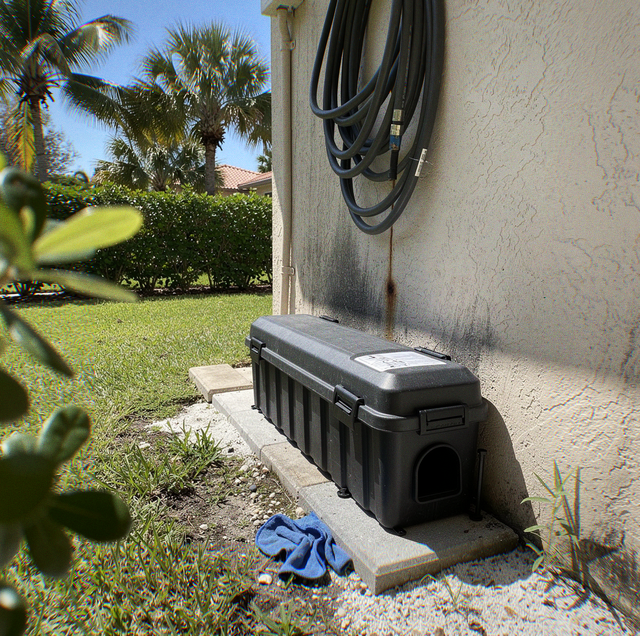
Quick Answer: A tamper-resistant station is built to resist being reached into, shaken out, or carried off. How well it does that depends on the lid being locked, the shell intact, and the station still anchored.
Somewhere along the outside wall, low against the foundation and easy to walk past, sits a black plastic box. It is hinged along one edge; it has a small opening at one end or both, and it does not shift when your shoe bumps it. If there is a dog in that yard, a cat that goes out, or a toddler in the grass nearby, the box is worth understanding as hardware first.
The Box Itself, Part by Part
A professional station is a rigid molded plastic shell with a hinged lid. Bell Labs stations are the common ones on residential exteriors here, and what puts any of them in the tamper-resistant category is not the name on the lid. It is the combination of a lock, an anchor point, and an interior that the opening does not lead straight into.
Inside, the path in is not a straight line to the bait, and the bait is secured inside rather than left loose. The base includes provisions for securing the station, which is the part most homeowners never look at and the part that determines whether the rest of the design still applies.
The Lock and the Key It Takes to Open It
The lid is held shut by a lock that opens with a dedicated key rather than by hand. That is the whole idea behind the category: the lid is designed not to come open under a thumb, a paw, a nose, or a stick, and getting it open is meant to take a deliberate act rather than an accident.
A lid that closed but was never re-secured looks identical, from a standing position, to a locked lid. The closure condition is confirmed at the service rather than judged from across the yard, which is one reason a station in a yard is not a set-and-forget object.
What Anchoring Is Doing Down There
An anchored station is staked into the ground, mounted to a weighted base, or tied to something fixed such as a fence post or a downspout bracket. Anchoring is not an accessory to tamper resistance. It is part of the definition.
A box that slides can be tipped, rolled, or picked up. A dog that gets a station moving can work the seam and the hinge line from angles the housing was never built to resist, and an anchored box gives a dog much less to work against. The lid and the interior only perform their functions in the orientation in which the station was designed to sit.
The Entry Opening and the Turn Behind It
The opening is sized for a rat or a mouse, and the bait does not sit directly behind it. The turn behind the opening is what does the work. In the two scenarios people picture, a paw pushed into the hole and a small hand doing the same, the geometry is intended to make a straight reach ineffective rather than to promise a result.
Securing bait inside is intended to keep it from tipping out if the station is batted, rolled, or nosed. One honest limit: a rodent that feeds inside can carry a fragment out through the opening, and crumbs at the entry are a normal finding rather than a sign of failure.
Tamper-resistant describes how a housing is built, not a promise about outcomes. A determined dog, a chewing puppy, or a station knocked loose from its anchor can change what that box is capable of holding back.
Outside Only, and Not Just Anywhere Outside
Placement carries more of the safety load than the housing does, and the first rule is simple: exterior only. Stations go on the outside face of the structure at ground level, not in an attic, a garage, a utility room, or anywhere inside an occupied home.
Outside, placement is still specific. Stations sit tight to the wall with the openings along the run line rodents already use, and away from the routes a household animal takes: the shaded strip under the hedge where the cat sleeps, the fence line the dog patrols, the play set, the spot by the hose bib where a toddler ends up every time the sprinkler runs. Where those overlap with a rodent run, the placement decision goes to the household, and that stretch of wall gets handled differently.
A station is placed on a run already in use rather than out in the open where it would create a new stop. Slab-on-grade construction across Boca Raton and West Boca leaves no basement to work, so the perimeter is the whole exterior story.
What a Dog or a Toddler Can Actually Reach
The housing is designed to work against specific things: the lid being opened by hand or mouth, the bait being reached through the opening, the bait being shaken free, and the station being carried off.
It is not designed to stop a dog licking or mouthing the outside of the shell, digging at the anchor point, or chewing a corner, because a puppy chews plastic objects on the ground. It does not stop a toddler picking up a crumb near the entrance. A locked, anchored, intact station in a good spot is a serious barrier, and a barrier is not a seal.
When the Housing Stops Being Tamper-Resistant
Every protection above is conditional on the shell being intact and the lid seating properly, and in South Florida that condition is under constant pressure. Direct sun, heat, and afternoon stormwater standing around a foundation age outdoor plastic faster here than in a cooler climate.
Most warning signs are visible from a standing position without touching anything: a lid sitting proud rather than flush, a gap along the hinge line, a station out of square against the wall, a station standing in water after rain. Any of those is worth a phone call to whoever placed it. A station that no longer closes the way it was built to close is not a tamper-resistant station, no matter what the label on the lid says.
Where Stations Sit in a Trapping-First Plan
None of this is an argument for putting bait out. For an occupied home with rodents in the attic or the walls, the work is exclusion plus trapping, because neither poison nor a locked box does anything about the gap that let the animal in. Snap traps trap and hold, so kills are removed during monitoring visits every seven to ten days rather than remaining in the structure. A roof rat trap-out typically runs four to six weeks, house mice two to three.
Bait in a locked exterior station is a secondary tool for pressure at the perimeter, not the thing that ends an interior infestation, and what the bait itself does to an animal that eats it is a separate subject covered on its own. The box does its job only while all of it is true at once: locked, anchored, intact, and set where nothing in the household has a reason to spend time.
Frequently Asked Questions
Theft is the obvious reason; the quieter one is measurement. Consumption at a fixed point tells you whether pressure on that run is rising or falling, and a station that has been moved since the last visit gives a reading that no longer aligns with the previous one. Anchoring method also varies with ground: loose sandy fill holds a stake poorly, so a weighted base or a paver mount often replaces driving something into soil that will not grip it.
Treat it as unanchored and unverified until someone who works on it says otherwise. A station pushed, floated, or blown off its spot may have taken a hit to the closure, may be holding water, and is no longer where the placement decision intended it to be. Keep people and animals clear of it and report where it ended up rather than carrying it back. It stays out of service until it has been re-secured.
Because indoors the box shares a room with the household instead of sitting on the outside face of the wall. A dog or a cat can come back to the same object unobserved, and an interior floor rarely offers anything to anchor to, so the station gets nudged under an appliance or into a closet and nobody sees it again. That removes both the anchoring and the plain visual check the rest of the system rests on, which is why exterior placement is a design condition rather than a preference.
It depends which failure it is. Gnaw damage around the entry opening enlarges the hole, which changes what can get in and usually indicates a rodent working the plastic rather than a dog. A crack at the hinge fold or a split where the lid seats is a closure failure: the lid may still look shut and no longer be held shut. Either one takes the station out of service, and a compromised shell gets swapped rather than patched, because a housing held together with tape is not tamper-resistant.
Move the animal away and keep it away, and do not open the station to look inside. Note which station it was and call whoever placed it, because the same housing can be holding a snap trap rather than bait. The person who services it can confirm which of the two it holds and whether anything is missing.
More than most people expect. A line trimmer or a mower deck striking a housing, week after week, is one of the most common causes of cracked plastic in a well-kept yard. Crews also lift stations to cut underneath and set them back off position, or forget to set them back at all. Telling the lawn service where the stations are, and leaving a small unmowed clearance around each one, prevents most of that.
Ask for a rodent inspection — get the entry points found and sealed so the plan never has to rest on a box in the yard. Buggify Pest Solutions serves Boca Raton, West Boca, and communities across Palm Beach and northern Broward. Call Tyler: (561) 672-0200.
