

Asian Cockroach or German? What That Flying Roach Means
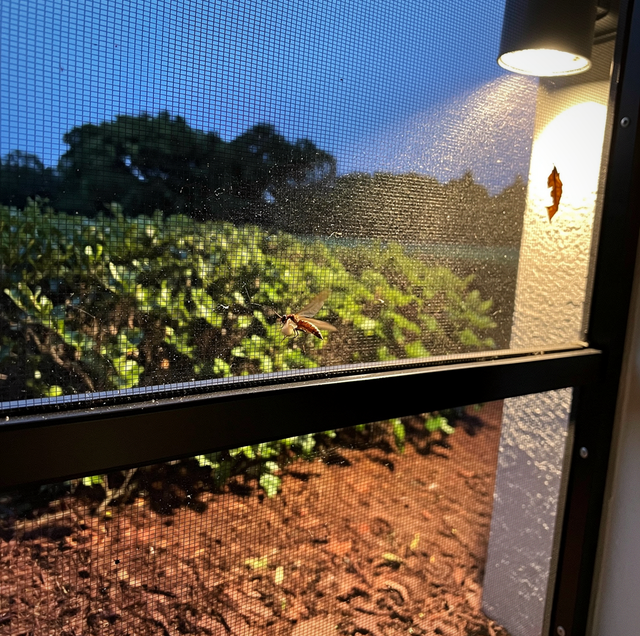
Quick Answer: A roach flying toward your porch light at dusk is almost always an Asian cockroach, not German. Asian roaches fly, love light, and live outdoors in mulch and leaf litter. German roaches avoid light and stay hidden indoors.
You're on the lanai after sunset, the porch light comes on, and a small tan roach buzzes straight at it and lands on the screen. Your first thought is the worst one: if that's a German cockroach, you've got an infestation working its way toward the kitchen. For most homeowners who see this exact scene, that assumption is wrong. What you likely just watched is an Asian cockroach, a close relative of the German roach that looks nearly identical up close but lives an entirely different life, one that has almost nothing to do with your kitchen cabinets.
Why It Looks Like the Same Roach
There's a reason this mix-up is so common: the two species really do look alike. Both are light tan to medium brown, both run about a half inch to five-eighths of an inch as adults, and both carry two dark parallel bands across the shield-shaped plate behind the head, the pronotum. Stand one next to the other and even a trained eye has to look twice.
The differences are real, just subtler than most people expect. The wings tell the story first: On a German cockroach, the wings end right about at the tip of the abdomen. On an Asian cockroach, the wings run a bit longer and extend past that tip, which is part of what makes sustained flight possible in the first place. The Asian roach's body also tends to read as slightly more slender and elongated than the German's stockier build, though that difference is hard to judge on a single roach glimpsed for two seconds in porch light. Color varies enough between the two species that it's not a reliable marker on its own.
Because the visual gap is this narrow, identifying which one you've got by sight alone, especially at night, is hard to do with confidence. Behavior is the marker that actually separates them.
The Tell Is in the Wings and the Light
Here is the difference that matters: German cockroaches have wings but rarely use them. Startle one, and it runs fast, disappearing into the nearest crack or gap the instant a light hits it. German roaches actively avoid light. That instinct is baked into how they survive: a roach that stays hidden in a dark void behind an appliance or inside a cabinet joint doesn't get stepped on or sprayed.
Asian cockroaches do the opposite. They fly readily and well, particularly in the hour or so after sunset, and they're drawn toward light sources rather than away from them: porch fixtures, windows with a lit room behind them, a television or computer screen glowing in a dark space, even a phone screen held up in the yard. Entomologists who track this species describe flight activity ramping up right around dusk and continuing into the evening as the roaches search for light rather than shelter.
So the single fastest field test is this: did it fly toward the light, or scatter away from it? A roach that beelines for your porch fixture or lands on a lit window screen is behaving like an Asian cockroach. A roach that bolts for the dark the second a light comes on is behaving like a German one. That single behavioral cue does more to separate the two species than size or color ever will.
The Habitat They Depend On
German cockroaches are an indoor species almost by definition. They need the steady warmth, humidity, and food residue of a kitchen or bathroom to reproduce, and a colony builds inside cabinet voids, behind a refrigerator's motor housing, or in a gap behind a baseboard, rarely more than a few feet from that food and water source.
Asian cockroaches don't share that need. Their actual home is outdoors: mulch beds, leaf litter, thick ground cover, and turf thatch, where they feed on decaying plant material rather than anything in your pantry. A screened lanai, a landscaped bed pushed up against the foundation, or a yard with a heavy layer of leaf litter gives them exactly the moisture and cover they want, and they never need to come inside to get it. When one lands on your screen or slips through a gap around a door at dusk, it isn't scouting your kitchen. It's chasing light, and your house happens to be in the flight path.
That's also why an Asian cockroach that does make it inside rarely stays. Without the humidity and food access that a German roach relies on, an indoor Asian roach typically doesn't establish a population. It either finds its way back out toward a light source or dies out within a short stretch, not because someone treated for it, but because the indoor environment was never built to support it.
When a Flying Visitor Actually Means Something Else
None of this means every roach you see is harmless outdoor traffic. If what you're finding is smaller, flightless, and scattering into dark cracks the moment a light comes on, especially inside the kitchen or bathroom on repeated nights, that pattern points toward a real German cockroach presence, not a porch-light visitor. Location and behavior together are what separate a one-off sighting from something worth addressing: a single flying roach at a lit window one evening is a very different signal than roaches running for cover every time you flip a switch near the sink.
It's also worth noting that a light-drawn flier at dusk in South Florida isn't automatically an Asian cockroach. Other species turn up at a lit screen too, which means the porch-light test reliably tells you what a roach is doing, not conclusively which species it is. Where you keep finding it carries just as much weight.
One Sighting, Two Different Follow-Ups
The porch-light roach and the kitchen-crack roach call for entirely different responses, and confusing them wastes effort in both directions. Treat a light-driven outdoor visitor like an indoor infestation, and you end up placing bait in cabinets that were never the source, while the actual driver, a mulch bed pushed against the wall or a bright fixture by the door, goes untouched. Treat an actual indoor colony like background outdoor activity, and it keeps building while you wait it out.
The good news is that the tell doesn't require an expert eye in most cases. Watch what it does when the light changes: fly toward it or run from it. Notice where you keep seeing it: at a window or fixture after dark, or inside a cabinet or under an appliance regardless of the hour. Those two observations, taken together, get you most of the way to the right answer before anyone shows up to confirm it.
Frequently Asked Questions
It's very unlikely. An Asian cockroach's egg case, the ootheca, needs direct contact with moist, decaying organic matter to develop; the same leaf-litter layer it breeds in outdoors doesn't provide that, and a tile floor or carpet doesn't either. Without it, an individual that wanders in typically doesn't reproduce at all; it just looks for the nearest light source and works its way back out.
Closely. Both belong to the same genus, Blattella, and researchers have found that the two can even produce hybrid offspring under lab conditions. In practice, this rarely happens outside a lab, because German roaches stay indoors and Asian roaches stay outside, so the two populations rarely meet.
Possibly a wood roach. Wood roaches, a different genus found around woodpiles, loose bark, and timber retaining walls, also fly toward light on warm evenings and get mistaken for Asian roaches. One distinguishing detail: many wood roach females have short, non-functional wings and can't fly at all, while males fly readily, so a pair sighted together can look mismatched in a way German or Asian roaches never do.
It can concentrate activity around your house rather than causing it. White LED and mercury-vapor fixtures attract more flying insects than warm-toned, amber "bug light" bulbs, so a porch or garage light left on a bright white setting every night tends to attract more roaches than the same fixture on a warmer bulb.
Generally yes, because it isn't living in your food-prep areas the way a German colony does. Even so, heavy outdoor activity near entry points can still track shed skins and droppings onto shoes or pet paws, which is enough to bother someone with roach-related allergies or asthma, even without an actual indoor colony.
Because a kitchen treatment gives an Asian cockroach nothing to interact with. Gel bait works by being found by a roach that forages where it's placed, and an Asian roach that slips inside isn't foraging at all; it's tracking a light source, and it will leave or die without ever crossing the placement. Meanwhile, the conditions producing it- dense turf thatch, a heavy leaf-litter layer, and a bright fixture that puts the flight path across your door- go untouched. Treating the wrong species not only wastes the visit; it also leaves you believing the treatment failed.
Have the species confirmed before anything gets treated — Tyler can identify what you're seeing on an inspection and match the response to it. Buggify Pest Solutions serves Boca Raton, West Boca, and communities across Palm Beach and northern Broward. Call Tyler: (561) 672-0200.
