

Mosquito Control in Broward and Palm Beach: Where a County Stops
Quick Answer: Public mosquito programs operate at the scale of a zone or county: trapping, larval control on public land, and area-wide response. Individual yards, including yours, sit outside that routine work no matter which county you're in.
Head far enough south from a base in West Boca Raton, and you leave Palm Beach County without any signage announcing it. Somewhere along that stretch, the same drive that started in one county's jurisdiction ends in another's. That other county is Broward, home to eight of the thirteen cities in this service area: Parkland, Coral Springs, Deerfield Beach, Pompano Beach, Coconut Creek, Margate, Lighthouse Point, and Hillsboro Beach, alongside the five Palm Beach County cities of Boca Raton, West Boca Raton, Delray Beach, Boynton Beach, and Ocean Ridge. A public mosquito program on one side of that line is not automatically the same program on the other. That's not a complaint about either county. It's a fact worth sitting with before deciding what a public program is likely to cover, and what it is not.
What a County-Level Program Is Built to Do
A public mosquito program, where a county runs one, is built to operate across an entire jurisdiction, not a single address. Its unit of work sits closer to a zone, a canal network, or a stretch of public right-of-way than it does to your backyard. The decisions made at that level come out of population trends across dozens of square miles, and not one of them begins with a walk around your patio.
That scale is the point. A program sized to cover a county prioritizes by area, by season, and by what surveillance shows across a wide footprint, which is a different question from how many mosquitoes met you at your back door on Thursday evening. The job it is built for sits at a different altitude than the job of making your property usable after five o'clock.
Programs also differ in scope, current focus, and structure, and any of these can change from one year to the next. What describes a program today may not describe it in five years. Treat any general description, including this one, as a starting point, and check the current details for the county where you actually live. Details borrowed from a neighboring county, or from a summary like this one, will not hold up.
The Surveillance Side, and What It Is Watching For
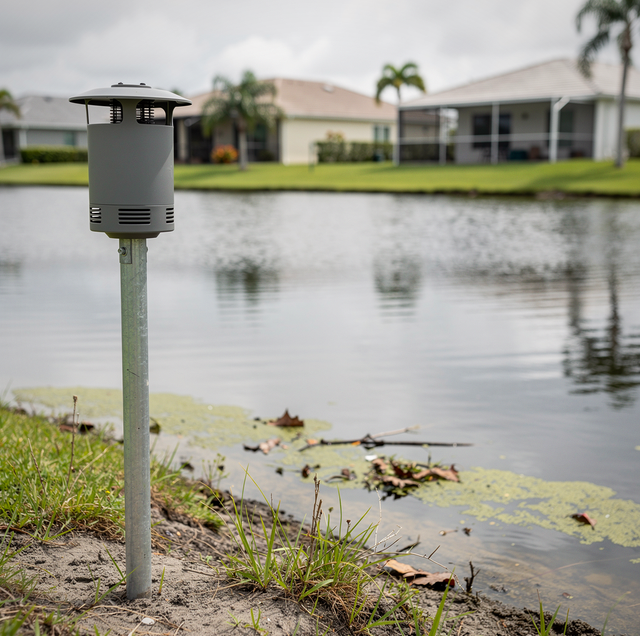
Underneath most public programs sits a surveillance function: trapping mosquitoes at fixed points across an area and tracking what those counts do over time. That is population monitoring, not an inspection of your yard. A trap showing a rising count in one part of a county tells you something about that part of the county in general. It tells you nothing about the plant saucer holding half an inch of water behind your side gate, which is all the container-breeding species in your yard needs.
Surveillance data also feeds into how a program responds to broader public health advisories. That role exists because mosquito populations get watched at scale. Your address plays no part in any of it. It is a program-level function tied to conditions across a wide area, and it runs the same whether your own street is having a quiet August or a miserable one.
Area-Wide Treatment Works in Zones, Not Yards
When a public program treats, whether that is managing larval habitat on public land or an area-wide response to adult populations, the unit of work is still a zone, not a lot line. A pass is built to cover a corridor, a retention system, or a section of a county. It is not calibrated to the breeding conditions sitting in your yard as it goes past the end of your street.
Whether an area-wide pass actually reaches the adults resting in your own foliage on a given afternoon is a different question with its own answer, and not the one this piece is answering. What matters here is scale: area-wide work is designed around a zone, and your property was never the unit it was drawn around.
The Hard Boundary at Private Property
In day-to-day practice, public programs work on public land. Whatever runs on rights-of-way, canal banks, retention areas, or public parkland stops at the edge of that land, not through oversight, but because routine public work is organized around the ground the public agency itself maintains. If your yard backs directly onto a canal or a preserve, that does not move the boundary. It only means the public land on the other side of your fence happens to sit closer to your patio than your neighbor's does to theirs.
Nobody at the county level is walking your yard checking bromeliad cups, gutters, or pool equipment for standing water. Address-by-address inspection is not part of routine county-wide work. It is a different piece of work entirely, and it sits on your side of the line.
What That Leaves You Holding
Everything on your side of that line is yours. The saucers under your potted plants. Your gutters. Your pool features, your dock lines, the low spot where your irrigation pools every Tuesday and Friday morning. A yard in this part of Florida typically carries five to ten of those micro-sites at once, and not one of them shows up on a county's radar, because the radar was never built to see anything that small. It takes about half an inch of standing water to produce the species that bites you in your own yard, which is why the list runs longer than most homeowners expect and why every item on it is something you own.
Adult mosquitoes also spend the overwhelming majority of their time at rest on foliage, roughly 23 of every 24 hours, so the work that actually changes your evenings concentrates on the vegetation around your house and not on the open air above your lawn. The cadence that work runs on is a separate decision. What matters here is that the decision is yours, because that is where public coverage stops and your property starts.
Your own count matters more here than any county figure. Ten minutes on your patio at dusk, three evenings running, tells you which corner of your yard is producing and when, which no area-wide number can.
Why Two Counties in One Service Area Don't Run the Same Program
Palm Beach County and Broward County are each large enough to run a public mosquito program, and there is no reason to expect one to mirror the other. Different jurisdictions set their own scope, priorities, and current focus, so what is true of one county's program this year is not a safe assumption about another's, let alone next year's.
That matters directly if you live in a service area split between the two. Boca Raton, West Boca Raton, Delray Beach, Boynton Beach, and Ocean Ridge sit in Palm Beach County, while Parkland, Coral Springs, Deerfield Beach, Pompano Beach, Coconut Creek, Margate, Lighthouse Point, and Hillsboro Beach sit in Broward. A description accurate on one side of that boundary does not transfer to the other, so you are better off checking what your own county's program currently covers than assuming it matches the one next door. The geography around you shapes what public infrastructure sits nearby, and canal-cut streets in Coral Springs and canal-built lots in Lighthouse Point are the obvious examples, but sitting near that infrastructure does not tell you what either county is doing with it this season.
Frequently Asked Questions
It is a small stationary unit, usually a fan-driven trap baited with light, carbon dioxide, or a steeped hay infusion, hung in a tree or fixed to a pole and emptied on a regular collection schedule. The placement stays put on purpose. A count only means something when you can set it against the same spot's count last week and last August, and shifting the trap toward wherever the complaints are coming from would wreck the comparison that makes the number worth anything. So the trap nearest your street is not there because of your street. It is there because it has been there long enough to have a history.
Because they are aimed at different stages, and the stages do not move on the same clock. Larval work follows water, so it tracks rainfall, tides, and habitat filling, and it occurs ahead of a population that has not yet emerged. Adult work responds to what is already flying, so it follows counts and complaints, landing after the fact.
It means your block can sit at the edge of two schedules at once, and an edge is where an area-wide design is least precise. Zone boundaries get drawn along roads, canals, and section lines because those read clearly on a map. Mosquitoes treat them as nothing at all. If you are on that line, the practical effect is that conditions a few hundred feet either side of your house may be managed on different timing, and neither timing was set with your lot in view. That is an ordinary position to be in, and what happens inside your fence is unchanged by it.
Easily, and the reason is that the two numbers were never on the same scale to begin with. A county figure is an average taken across habitats that have almost nothing in common with one another: tidal marsh, canal corridors, engineered retention systems, and residential blocks all fold into a single line. An average built that way can be pushed up or pulled down by one habitat type nobody in the county actually lives in, and it will move without anything moving on any particular street. Your own count is not a miniature of that figure. It is a different measurement of a different thing, taken at the only scale where you can act on the answer. Reading the two against each other is close to meaningless. Reading yours alone, week over week, tells you exactly what your evenings are doing.
Keep the parts a technician cannot see on a Tuesday afternoon: which corner you get hit in, what time it starts, whether it changed after the last storm, whether it is worse by the hedge or by the pool equipment. That is the input a property-level visit actually runs on, and it does not appear in any trap or area-wide report. Hand it over at the start of a visit. It decides where the thirty to sixty minutes on your lot get spent, and passing it along on the way out is too late to steer any of them.
Because every step ahead of it takes time. Traps get emptied on a set collection schedule, their contents have to be sorted and counted, and the counts have to be read against the same site's own history before anyone calls a change real. Only then does anything get issued. Put a rainfall event just before a collection date, and the lag stretches further still, because the mosquitoes that rain produced were only larvae the last time those traps were read. The practical consequence for you is that an advisory describes conditions that had already peaked, and had sometimes already eased, by the time you saw it. It is a poor trigger for anything on your own lot. What your yard is doing this week reaches your patio at dusk well before it reaches any bulletin.
Handle the half that was always going to be yours — knowing where the public program's job ends, and yours begins. Buggify Pest Solutions serves Boca Raton, West Boca, and communities across Palm Beach and northern Broward. Call Tyler: (561) 672-0200.
