
Dengue and West Nile in Palm Beach and Broward, year by year
Every year since 2022, the Florida Department of Health has put at least one of our two counties under a mosquito borne illness advisory or alert, and in four of those five years the trigger was dengue caught from a mosquito here, not abroad. This page keeps the official count for Palm Beach and Broward in one place: how many cases, which months, and exactly when each notice went out.1
When each county was under a notice
Each dot is one locally acquired dengue case. Advisories are the first level of public warning; alerts are the second. Hover a notice for the reason it was issued.2
The count, by county and year
Cases are counted by the county where the person was infected, not where they live, and include confirmed and probable cases by date of onset. The 2026 row is year to date through the September 12 report. Hover a notice for the reason it was issued; each links to the release. Travel associated chikungunya counts are in the CSV.
| County | Year | Local dengue | Travel dengue | Human West Nile | West Nile positive chickens | Notices issued | Status at year end | Source |
|---|---|---|---|---|---|---|---|---|
| Palm Beach | 2022 | 0 | 28 | 0 | 21 | Advisory, September 20, 2022 | None in effect | Week 52 |
| Palm Beach | 2023 | 1September | 32 | 0 | 11 | Advisory, Date not located | Advisory | Week 52 |
| Palm Beach | 2024 | 3August (2), September | 55 | 0 | 15 | Advisory, September 12, 2024 Advisory, September 26, 2024 Alert, October 10, 2024 | Alert | Week 52 |
| Palm Beach | 2025 | 0 | 13 | 0 | 36 | Advisory, October 1, 2025 | Advisory | Week 53 |
| Palm Beach | 2026 YTD | 1July | 11 | 0 | 3 | Advisory, August 3, 2026 | Advisory (as of August 29, 2026) | Week 36 |
| Broward | 2022 | 2October | 54 | 0 | not reported | Alert, October 21, 2022 | None in effect | Week 52 |
| Broward | 2023 | 4July (2), August, September | 55 | 0 | not reported | Alert, August 4, 2023 Advisory, September 25, 2023 | Alert | Week 52 |
| Broward | 2024 | 2August, September | 94 | 0 | not reported | Advisory, September 25, 2024 | Advisory | Week 52 |
| Broward | 2025 | 0 | 21 | 0 | not reported | None issued | None in effect | Week 53 |
| Broward | 2026 YTD | 0 | 17 | 0 | not reported | None issued | None (as of August 29, 2026) | Week 36 |
Source: Florida Department of Health, Florida Arbovirus Surveillance weekly reports, final report of each year and the Week 36 report for 2026, read September 20, 2026. Notice dates are from the linked press releases of the Department of Health in Palm Beach County and in Broward County. No locally acquired chikungunya, Zika or malaria has been reported in either county in this period. Broward County has no sentinel chicken flock in the state tables, so that column reads not reported. Download the data as CSV.
Florida as a whole, for scale
Locally acquired dengue is a South Florida story that has started to move north. The two counties on this page are a small share of the state total; Miami Dade carried most of it through 2024, Brevard in 2025 and Hillsborough in 2026.3
| Year | Locally acquired dengue, Florida | Travel associated dengue, Florida | Human West Nile, Florida | Source |
|---|---|---|---|---|
| 2019 | 18 | 413 | 7 | Annual table |
| 2020 | 77 | 50 | 44 | Annual table |
| 2021 | 0 | 37 | 15 | Annual table |
| 2022 | 68 | 929 | 11 | Annual table |
| 2023 | 199 | 621 | 12 | Annual table |
| 2024 | 93 | 1,022 | 4 | Annual table |
| 2025 | 62 | 417 | 6 | Week 53 report |
| 2026 YTD | 152 | 186 | 3 | Week 36 report, year to date |
How the advisory and alert system works
The Department of Health's response plan sets five levels. Two of them are public notices, and the county health department director decides when to issue them after consulting the county mosquito control program.4
Mosquito borne illness advisory
Declared when surveillance shows a rise in virus transmission and an increased chance of human infection, or when a single locally acquired human case is confirmed. Triggers in the plan include:
- One sporadic, locally acquired confirmed human case or blood donor
- Two or more confirmed horse cases in two weeks
- Sentinel chicken seroconversion running 10 points above baseline in a county over two weeks, or 50 percent in one flock in a week
Lifted when activity returns to background levels. This is what Palm Beach County was under in September 2022 (chickens), September 2024 (dengue), October 2025 (chickens) and August 2026 (dengue).
Mosquito borne illness alert
Declared when additional locally acquired cases suggest clustering, or when animal surveillance shows intense transmission. Triggers include:
- A cluster of two or more locally acquired confirmed human cases or blood donors
- Sentinel chicken seroconversion 50 points above baseline in a county over two weeks
Lifted only after a significant drop in animal activity and at least six weeks after the last human case. Broward County was under an alert after its second dengue case in October 2022 and again in 2023; Palm Beach moved from advisory to alert after its third case in October 2024.
Above the alert sits a mosquito borne illness threat, declared by the State Surgeon General under section 388.45, Florida Statutes, when widespread human cases are possible. It has not been declared for either county in this period.
Requesting county mosquito control service
Both counties run free mosquito control programs and both say the same thing: they rely on residents reporting activity, an inspector verifies the problem first, and a request does not always end in a spray. Details are read from the county pages on September 20, 2026.5
Palm Beach County Mosquito Control
Part of the county's Environmental Resources Management department. Uses ground larviciding in swales and drains, truck fogging at night, and aerial spraying west of Military Trail when disease indicators rise.
- Request service
- Online Report Mosquito Activity form, which also lets you check the status of a request
- Phone
- 561 967 6480
- Worth knowing
- Submitting the form gives the county permission to enter and treat the property. The county must verify and document a legitimate mosquito problem before treating.
Broward County Mosquito Control
A section of the county's Highway and Bridge Maintenance Division, serving all 31 municipalities. Treats storm drains, sprays neighborhoods by truck early in the morning, and follows a standard response procedure that starts with a field inspection.
- Request service
- Online Mosquito Service Request form
- Phone
- 311, or 954 765 4062 (TTY 954 831 3940)
- Worth knowing
- Requests are for your own property only. The program treats mosquitoes only, not sand flies, drain flies or no see ums, and truck spraying happens only where surveillance data meet the county's criteria.
What the pattern says
Two different diseases drive the notices, and they live in different mosquitoes. West Nile virus cycles between birds and Culex mosquitoes that bite at dusk and after dark; the county tracks it in sentinel chicken flocks, and Palm Beach's flocks have turned up positive every year on this page, peaking at 36 birds in 2025. Dengue moves between people and Aedes aegypti, a daytime biter that breeds in containers around houses and rarely flies more than a few hundred feet. It has no animal reservoir here, so the first sign is usually a sick person, which is why the dengue notices land in August, September and October, after the summer rains have filled every bromeliad, bucket and gutter.
The counties differ in where the pressure comes from. Broward's local cases have clustered in late summer and its travel associated count is far higher, 94 in 2024, reflecting the volume of travel between South Florida and Cuba, which accounted for more than half of Florida's travel associated dengue cases in every year on this page. Palm Beach has had fewer local cases but its 2022 advisory named west Delray Beach and west Boca Raton among the areas with activity, and its West Nile signal is the stronger of the two. Neither county has recorded a human West Nile case in five years, which says as much about the sentinel chicken program catching activity early as it does about the virus.
The practical calendar falls out of the dates. Every notice in either county with a known issue date, from 2022 to 2026, went out between August 3 and October 21. That window is the back half of the wet season, when Aedes aegypti populations are highest and the county programs are busiest with requests. Mosquito control that starts in May and runs through October is built around that curve rather than around the first bite of the year.
Questions about this data
If yours isn't here, call (561) 672-0200. Tyler answers directly.
What is the difference between locally acquired and travel associated dengue?
–A travel associated case is someone who was infected abroad, usually in the Caribbean or Latin America, and became ill after returning. A locally acquired case is someone who did not travel and was infected by a mosquito here, which means the virus was circulating in local Aedes aegypti mosquitoes. The health department investigates every case to make that determination, and only locally acquired cases trigger the advisory and alert system. Travel cases matter too: each one is a chance for a local mosquito to pick up the virus, and Broward County reported 94 of them in 2024.
Where do these numbers come from?
+Every count is from the Florida Department of Health's weekly arbovirus surveillance report, using the final report of each year (Week 52 or 53) and the most recent report for the current year. Cases are counted by county of exposure, not county of residence, and include confirmed and probable cases by date of onset. Advisory and alert dates come from the press releases issued by the Department of Health in Palm Beach County and in Broward County, linked in the table. Nothing is taken from news coverage.
Why do the year end figures differ slightly from the state's annual totals?
+The weekly report counts what had been reported by the last week of the year. Cases with onset in December are often confirmed in January, so the Department's final annual table is usually a little higher. For 2024 the Week 52 report showed 85 locally acquired dengue cases statewide and the annual table shows 93. County figures on this page are from the weekly reports because the annual table is not broken down by county; the statewide table uses the annual figures where they exist.
Has anyone in Palm Beach or Broward caught West Nile virus locally?
+Not in any of the five years on this page. West Nile virus has been detected in Palm Beach County's sentinel chickens every year, with 36 positive chickens in 2025, which is what prompted the October 2025 advisory and aerial spraying, but no human case acquired in either county has been reported from 2022 through the September 12, 2026 report. Broward County does not appear in the sentinel chicken tables, so its column reads not reported rather than zero.
Does a mosquito treatment protect against dengue?
+It reduces the number of biting Aedes aegypti around a home, which is the only mosquito that spreads dengue in Florida, and it targets the shaded resting places and container breeding sites where that species lives. It does not make anyone immune, and the county programs stress that draining standing water weekly matters as much as any spray. No treatment, by a county or a private company, is a substitute for repellent and screens during an advisory.
Can I use this data?
+Yes. It is compiled from public Florida Department of Health reports and the CSV linked below the table carries every figure with its source. Please credit the Florida Department of Health and link to this page.
Notes
- Sources and date. County figures are from the Florida Department of Health's Florida Arbovirus Surveillance weekly reports: Week 52 of 2022, Week 52 of 2023, Week 52 of 2024, Week 53 of 2025 and Week 36 of 2026, all linked in the table and read on September 20, 2026. Notice dates are from press releases published by the Department of Health in Palm Beach County and the Department of Health in Broward County, or by the state Department for 2022. The 2026 figures are year to date and will change; this page is scheduled for refresh each January when the final report of the previous year is posted.
- What the timeline shows. Dots are locally acquired dengue cases by county of exposure. Pills are notices as issued; a county can receive more than one in a year, and a notice issued late in one year can remain in effect into the next. Where a notice was in effect at year end but the issuing release could not be located (Palm Beach County, 2023), the timeline shows the status and the table says so.
- Statewide figures. Years 2019 to 2024 are from the Department's annual Human Mosquito Borne Disease Cases Reported table; 2025 and 2026 are from the weekly reports because the annual table had not been extended to those years on September 20, 2026. Human West Nile is neuroinvasive plus fever cases and excludes asymptomatic blood donors. Weekly year end counts run slightly below the annual table because December onset cases are confirmed in January.
- Advisory and alert criteria. Summarized from Chapter 11 of the Florida Mosquito Borne Disease Guide, the Florida Department of Health Response Plan for Mosquito Borne Diseases, last updated February 4, 2022. The county health department director decides, with mosquito control and the state office, whether a notice is warranted; the numeric thresholds are guidance, not automatic triggers, which is why some single case events produced an advisory and others did not.
- County programs. Contact details, request methods and service limits are read from pbc.gov/mosquitocontrol and broward.org/mosquito on September 20, 2026. Broward County lists 311 and a TTY number on its mosquito page and 954 765 4062 on its Highway and Bridge Maintenance page. Check the county page before relying on a number.
- Purpose. This page is published for general information. It reports what the Department of Health has published for two counties; it is not medical advice, a risk assessment for any property, and not a substitute for the Department's current notices. Anyone with fever, headache, joint pain or rash after mosquito bites should contact a health care provider. Figures may be reproduced with credit to the Florida Department of Health and a link to this page.
Every notice since 2022 came in August, September or October.
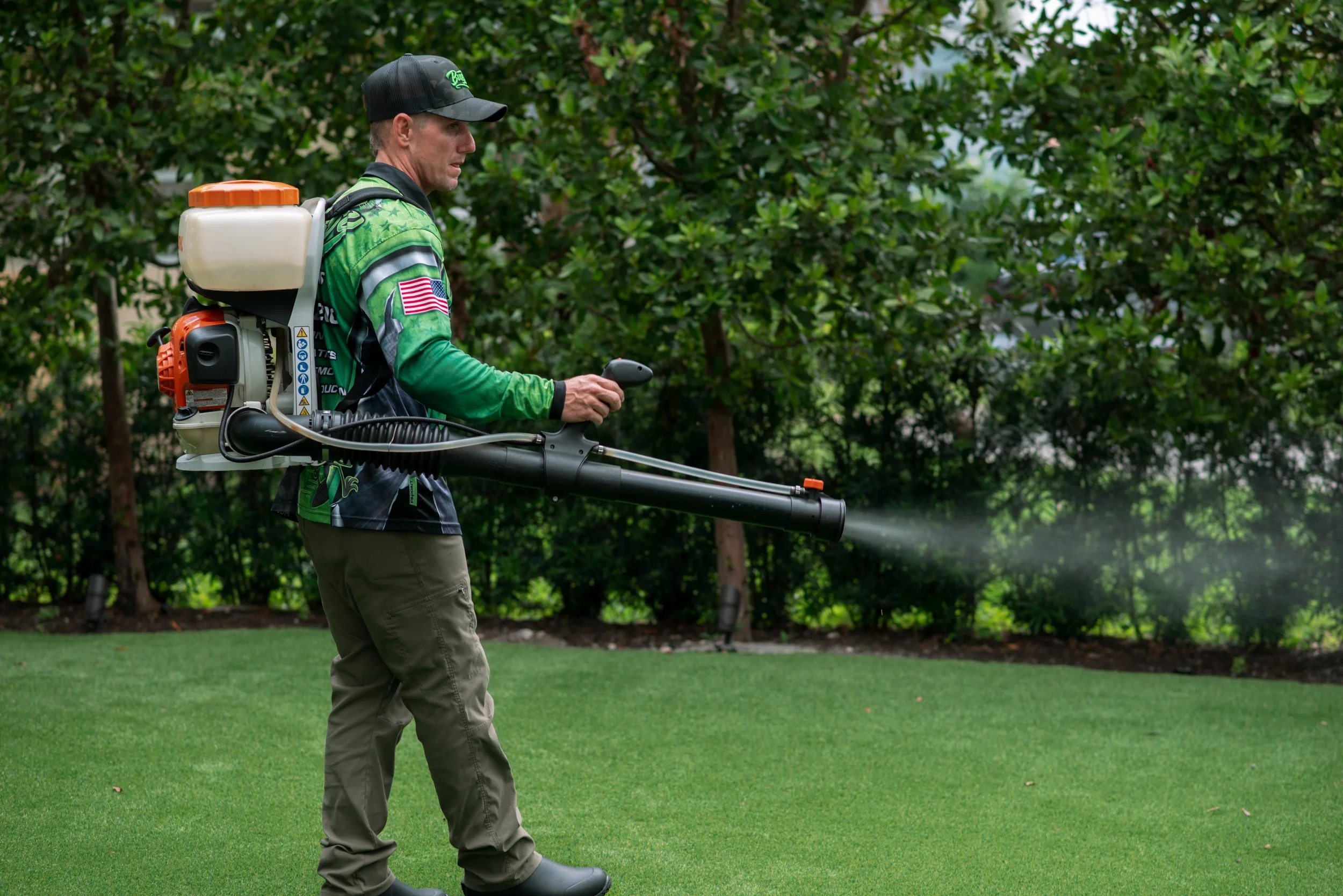
Buggify's monthly mosquito service runs May through October, targets the shaded resting spots and container sites where Aedes aegypti lives, and starts with a breeding source audit of the yard. Same technician every visit, across all 13 cities.