
Mosquito Control and Spiders: Is the Overlap Real?
Quick Answer: Yes, partly, in two ways. A mosquito yard-barrier treatment is broad-spectrum: it thins some of the insects spiders eat, and some research finds it can also affect spiders directly on contact. Neither effect is total, so web activity can drop without disappearing.
If you are already on a mosquito treatment plan and you've noticed fewer webs going up around the lanai or the eaves, you're not imagining a connection. The two services aren't the same treatment, and one was never designed to replace the other, but they do overlap at one specific point: the food supply. A yard-barrier mosquito application doesn't just target mosquitoes by name; it's applied broadly enough to affect a wider slice of the small flying insects living in the same shrub line, and some of those insects are exactly what a web-building spider is waiting around to catch.
Where the Two Services Actually Overlap
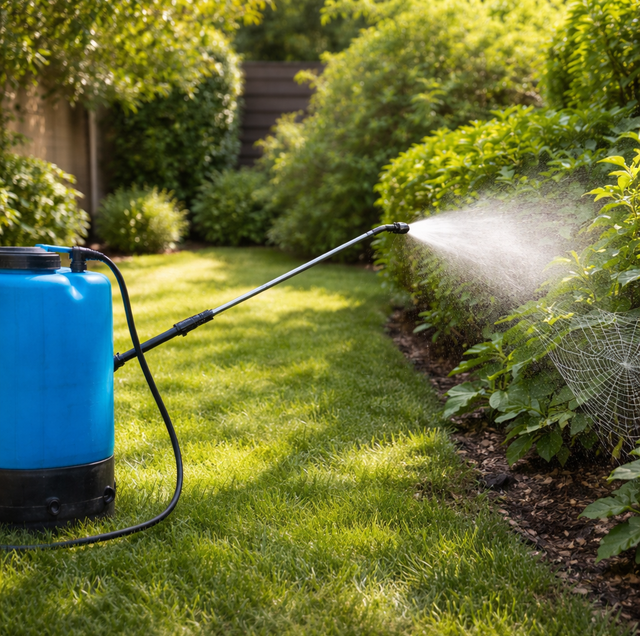
A mosquito yard barrier isn't a mosquito-only product. It's typically a residual insecticide applied to the foliage, mulch beds, and shaded resting spots where mosquitoes hide during the day, and that kind of broad-spectrum application affects most small insects that land on or move through the treated leaf surface, not a single species picked out from the rest. Reviews of pesticide effects on non-target arthropods, including ecotoxicological work covering spiders specifically, describe this cross-over as a recognized characteristic of residual barrier treatments generally: the same chemistry that keeps working on mosquitoes between visits keeps working on gnats, small moths, midges, and other soft-bodied flying insects that happen to rest on the same foliage.
The prey-reduction mechanism, stated plainly: fewer small flying insects surviving in the treated zone means less for a web-building spider to catch there, which over a few weeks can translate into fewer new webs going up in that same area and existing webs sitting emptier between rebuilds.
That overlap shows up consistently in the pest-control and entomological literature, and it's also why a property already on mosquito service sometimes reports lighter spider activity as an unplanned side effect long before anyone requested spider work specifically.
The Overlap Runs a Second Way: Direct Contact
Prey reduction isn't the only mechanism at work, and treating it as the whole story understates the overlap. Pyrethroid-based residuals, the active-ingredient class most yard mosquito barriers rely on, don't only affect the insects a spider would otherwise eat. Some research, including entomological reviews of pesticide exposure across the order Araneae, has found that these residues can also be directly toxic to spiders that walk across or rest on treated foliage, independent of any effects on their prey. Groups that track non-target pesticide impacts, including the Xerces Society's published work on mosquito-spray drift, have found that broad-spectrum adulticides and residuals reach a wide range of non-target arthropods on contact, including beneficial insects and spiders, not only the mosquitoes the product is labeled for.
This doesn't mean every mosquito treatment is killing spiders outright, and the effect isn't uniform across species or exposure levels; a spider anchored well outside the treated zone, or one that never physically contacts sprayed foliage, isn't exposed to this mechanism at all. But the honest account of the overlap has two parts, not one: less available prey in the treated zone, and for spiders that do make direct contact with treated leaf surfaces, a chemical exposure risk of its own. Both point the same direction, toward less web activity in the specific zone a mosquito barrier reaches, for two different reasons rather than one.
What This Overlap Doesn't Cover
Here's where the claim needs a hard edge, because it's easy to overstate. A spider's diet isn't limited to mosquitoes and mosquito-sized insects. House spiders, orb weavers, and the wolf spiders that show up on garage floors also take moths, houseflies, beetles, roaches, other spiders, and larger prey that a mosquito-focused barrier was never formulated or positioned to reach. Mosquito treatments concentrate on the shaded, low-lying resting sites mosquitoes prefer: damp shrub beds, mulch lines, the underside of foliage, not the porch light, the eave line, or the screen seam where a lot of spider webs actually go up to intercept insects drawn by light rather than shade.
Coverage zone matters as much as the product itself: a mosquito barrier applied to yard vegetation doesn't reach a web anchored eight feet up at a soffit corner, so a property can see real prey reduction and direct-contact exposure at ground level and almost no change at the rooflines and light fixtures where spider activity tends to concentrate.
So the honest version of this claim is partial. Mosquito service thins part of the outdoor insect population that spiders rely on and, for spiders that contact treated foliage directly, adds a chemical exposure of its own; it doesn't eliminate the food supply, and it isn't scoped, timed, or applied to reach the specific structural points where spiders actually build.
[NOTE: A mosquito barrier's residual breaks down over roughly three to four weeks in South Florida humidity, faster on porous surfaces like raw stucco. Both the prey-reduction and direct-contact effects on spider activity fade on that same timeline, not a permanent one.]
Why This Isn't a Substitute for Spider-Specific Service
A spider problem worth addressing usually isn't a prey-availability problem alone; it's an entry-and-harborage problem, too. Brown widows favor dry, undisturbed voids: lanai screen corners, pool equipment housings, the underside of patio furniture. Orb weavers stake out light fixtures and eave lines specifically because that's where flying insects concentrate at night, mosquito-treated shrub bed or not. None of those specific structural points get addressed by a treatment scoped to mosquito breeding sites and resting foliage.
That's the practical case for treating the two as complementary rather than one standing in for the other. A property that's already thinning outdoor insect volume through mosquito service, and then adds a source-first spider treatment aimed at the actual harborage points, sealed screen seams, treated eave lines, cleared voids, addresses both halves of what's keeping web activity up: the food and the shelter. Doing only the mosquito side leaves the shelter untouched; doing only the spider side without addressing nearby insect volume means new prey keeps showing up, drawing web-builders back to the same lit corners.
What a Property on Both Services Typically Reports
Properties already running mosquito service on the standard cadence for this area tend to describe a gradual thinning rather than a sudden drop, and that timeline itself is a local factor: canal corridors and freshwater edges around Coral Springs and Lighthouse Point keep breeding conditions active in every month rather than easing off in a single season the way they would farther north. Fewer small webs rebuilding in the shrub line near the yard-barrier zone is the change most commonly reported first, whether that traces to the prey-reduction effect, the direct-contact effect, or both working together in the treated foliage. Webs at porch lights, soffits, and screen corners, areas a mosquito barrier doesn't reach at all, usually don't change on their own; a homeowner who's satisfied with the shrub-bed improvement but still seeing activity at the rooflines is describing the coverage gap accurately, not a treatment that failed.
That gap is the whole point of treating mosquito and spider service as related but separate. A mosquito barrier is formulated, applied, and scoped for mosquito breeding sites and resting foliage, and everything it does to spider prey or spider exposure in that zone is a byproduct of doing that job well, not a second service layered in on the side. A property that wants the full picture, less prey pressure in the yard along with fewer entry points and harborage sites at the structure itself, ends up asking for both services rather than assuming one covers the other. That's not a sales pitch; it's just where the two treatments' actual coverage zones stop and start, and knowing that boundary is what lets a homeowner read their own results correctly instead of assuming one visit should have done a second job it was never scoped for.
Frequently Asked Questions
Accidental on both counts. Mosquito yard-barrier products are labeled and applied specifically for mosquito control; any reduction in spider prey and any direct exposure a spider gets from walking across treated foliage are downstream effects of the product's broad-spectrum contact and residual action on small arthropods generally, not a targeted spider treatment. A technician applying mosquito service isn't inspecting for web locations, brown widow harborage, or spider entry points during that visit.
Two reasons, and neither means the treatment failed. First, coverage: mosquito service doesn't reach vertical surfaces like porch lights, screens, and rooflines, so spiders anchored there aren't affected either way. Second, biology: an adult spider that's already established a web can go a couple of weeks without a fresh meal by living off stored reserves, so an existing spider doesn't disappear the moment its local prey thins out; it takes a full cadence cycle or two before reduced prey volume shows up as fewer webs rather than just quieter activity on the webs already there.
Not meaningfully, and it's not a recommended trade-off. Standard mosquito cadence in this area runs roughly monthly during the active season, timed to mosquito breeding cycles rather than spider activity, and compressing that interval doesn't address the structural harborage points driving most spider complaints on its own. A source-first spider inspection addresses those directly instead.
It depends more on hunting style than on species identity. A web-building spider like an orb weaver spends most of its time on the web itself rather than walking across treated leaf surfaces, so its direct-contact exposure to a foliage-applied residual stays lower even when the web is anchored close to a treated shrub line. A wandering hunter like a wolf spider, which actively patrols mulch beds and low groundcover rather than staying anchored to one web, has more physical contact with sprayed foliage and mulch, so it sits at higher direct-exposure risk from the same application. Brown widows fall somewhere in between: they don't range far from a chosen void, but a void near ground-level plantings puts them closer to the treated zone than one at eave height.
It depends heavily on the yard's layout. A property with dense shrub beds, mulch lines, and shaded groundcover close to the house sees more overlap on both counts, since that's exactly where a mosquito barrier concentrates and where prey insects and direct foliage contact would otherwise be most likely near web sites. A property with mostly open lawn, hardscape, or raised pool decking sees less overlap simply because there's less treated vegetation near where spiders tend to build in the first place.
Not really. If web activity is already minimal, adding spider-specific treatment mainly adds a harborage inspection and preventive coverage at entry points and eaves rather than solving a visible problem. Most homeowners add spider service only after activity becomes noticeable, rather than preemptively, since mosquito service alone already covers part of the prey side by then.
Ask about pairing mosquito and spider service for your yard — Tyler can assess whether your property's layout and prey pressure call for both. Buggify Pest Solutions serves Boca Raton, West Boca, and communities across Palm Beach and northern Broward. Call Tyler: (561) 672-0200.
