

Do Brown Widows Push Out Black Widows? What the Trials Found
A brown widow on the patio furniture reads as bad news, and there is a version of that read which is exactly backwards. Wherever the species has settled around buildings, black widow numbers at those sites have fallen, in some places to nothing at all. Researchers have watched that happen for roughly two decades and explained it mostly by assumption. A 2023 study put the two species side by side and recorded what they did, and the explanation that survived is far more direct than the one most people reach for.
The Count That Turned an Impression Into a Number
Displacement was a field impression long before anyone published a figure on it. A survey of urban and parkland structures supplied one: 223 brown widows against 10 southern black widows, a ratio of roughly twenty to one. The black widows that did turn up were found only on parkland structures. Around homes and other built-up structures people use daily, native species had effectively disappeared.
Separating the two at a glance is quick: a brown widow is mottled tan to dark brown with banded legs and an orange rather than red hourglass, and adult females run roughly three-eighths to half an inch in body length. When the spider itself is nowhere in view, the pea-sized, off-white, spiky egg sac names the resident on its own.
What a twenty-to-one count cannot do is explain itself. A lopsided ratio is consistent with several stories, and the same survey that produced the number also provided the reason the researchers looked for a mechanism rather than stopping at the tally.
What Happened When the Two Were Put Together
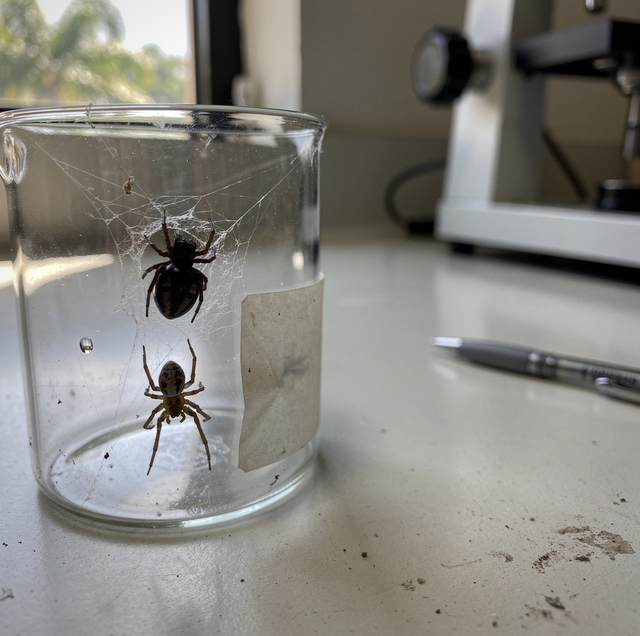
The lab work paired individual spiders and let the encounter run. Among sub-adult females, the brown widow killed and consumed the black widow in about 80 percent of pairings. Among adults, the rate came down, but the direction held: the brown widow killed the black widow in roughly 40 percent of trials, the black widow killed the brown widow in about 30 percent, and the remainder cohabited without a fatal outcome.
The 30 percent figure clarifies who is doing what. Those black widow wins came only after the black widow defended itself against a brown widow that had already moved on it. The brown widow was the one closing distance in essentially every encounter that turned violent, which is why the researchers describe this as predation rather than a boundary dispute between neighbors. The black widow is not being crowded out of a room. It is being treated as food.
Two widow species can occupy one property at once, and the sighting you get is rarely the whole census. A web with an orange hourglass in it says nothing about what is living six feet away in the next recess.
Brown widows also proved selective about it. Against unrelated cobweb spiders of similar size, the same brown widows were far likelier to settle into coexistence than to attack. The aggression is aimed, not general, and it lands hardest on the one species being displaced.
Competition for Food Was Ruled Out, Not Assumed
Here the intuitive answer and the supported one part company. Two similar spiders wanting the same recesses and the same insects sounds like a resource fight, and that is the explanation most summaries reach for. The paper tested it and threw it out.
The authors built a model of maternal risk management, asking what actually kills the offspring of each species. Predation risk came back near-total for both. Starvation risk came back at a small fraction of one percent. Their conclusion is stated plainly: competition for scarce prey was not a significant cause of offspring mortality for either widow, and neither species is preying on the other because prey is short. Whatever is emptying these structures of black widows, it is not a shortage of food or space being settled by attrition.
That distinction matters more than it looks. Crowding is slow, reversible, and sensitive to the amount of available habitat. Predation is none of those things. It also means adding harborage or thinning insect pressure would not be expected to slow the exchange, because the exchange was never running on scarcity in the first place.
The Head Start That Comes Before the Fight
Predation is the mechanism, but the brown widow arrives at each encounter already ahead. The same work found brown widows carrying roughly twice the fertility potential of southern black widows, and sub-adult brown widows growing faster and reaching maturity earlier than their counterparts. A species that produces more offspring and gets them to fighting size sooner will, on any given structure, tend to meet a rival that is smaller and younger than it is.
Temperament compounds that. The paper frames the pairing as a bold species against a shy one, and the trial records bear it out: brown widows ventured into contact, black widows reacted. A reproductive edge, a developmental edge, and a willingness to initiate stack into an outcome that looks inevitable in hindsight, even though nothing about it required competition to explain.
Why a Brown Widow Find Is Not Automatically Worse News
A property producing brown widows has not simply gotten worse. In many cases it is a property where the species capable of the more serious envenomation has been pushed out of the recesses it used to hold, and the arithmetic of that swap is worth stating without overselling it.
Drop for drop, the two venoms measure close, but the brown widow does not appear to inject as much, and reported bites run correspondingly mild. A typical brown widow bite stays where it started: redness, a firm warm patch, and an ache that peaks inside a day before easing over the next two or three. What comes with the trade is exposure, since brown widows settle in more open, more reachable positions than black widows choose, which is the whole reason they end up on structures hands touch.
A reaction that spreads, brings muscle cramping or rigidity, or involves trouble breathing needs a doctor, not observation, and so does a suspected bite on a child or older adult. Wash it, cool it, get it looked at if it worsens.
None of this is a promise about a specific yard. The twenty-to-one ratio is a population-level pattern read across many sites, and one property can easily run against it, holding both species or neither. The reframe is about what a find means, not a guarantee about what else is present.
Contact Frequency Is the Actual Reason to Clear Them
The case for clearing brown widows off a property never rested on the severity of a typical bite, and it does not rest on the displacement finding either. It rests on where the spider chooses to sit. A species that favors reachable, semi-exposed positions ends up sharing the surfaces people grip, lift, and step on, and a usually mild bite stops reading as a comfortable statistic once the web keeps reappearing inches from a rail a child grabs.
Read the swap correctly, and it changes the diagnosis rather than the response. Finding brown widows tells you which species you are dealing with and roughly what a bite from it would do. Clearing the recesses it keeps choosing is still the work.
Frequently Asked Questions
The aggression is pointed. In the same cohabitation trials, brown widows were about 6.6 times more likely to kill and consume southern black widows than they were to kill similarly sized cobweb spiders, and roughly three times more likely to settle into shared occupancy with those cobweb spiders than with a black widow. A brown widow moving into a mixed population is not clearing every neighbor it meets, which is part of why the black widow decline stands out against a fairly stable background of other web spiders.
Yes, and more often than the headline suggests. Among adult pairings, roughly 30 percent ended in cohabitation with neither spider killed, and another 30 percent ended with the black widow killing the brown widow after defending itself. Only about 40 percent went the way the displacement pattern implies. The trend across many structures is lopsided; any individual encounter is not, which is why displacement plays out over seasons rather than in a single confrontation.
By modeling what actually kills the young of each species rather than inferring it from behavior. Their maternal risk-management model returned a near-total mortality risk from predation for both widows and a starvation risk of well under one percent, which is the opposite of what a food-limited population looks like. Species under real resource pressure show meaningful starvation mortality; these did not, so the authors concluded neither widow was attacking the other because prey was scarce.
It matters, but as a multiplier rather than a cause. Brown widows in this work carried roughly twice the fertility potential of southern black widows, and their sub-adults grew larger faster and reached maturity sooner. That results in more brown widows encountering fewer, smaller black widows on any given structure. The model still puts the killing itself as what removes the black widows, with the reproductive and developmental edge determining how quickly the encounters accumulate.
The paper reports the same displacement following the brown widow's range expansion, affecting the southern black widow in the areas it colonized first and the western black widow as it spread. The controlled trials were run against the southern black widow specifically, so the mechanism was tested for that pairing rather than shown separately for the western one, which the authors treat as a parallel case rather than a tested result.
Possibly, and the researchers are careful about this. A survey showing one species present and another absent establishes correlation, not cause, and the trials establish that brown widows will kill black widows without establishing that this is what emptied any particular structure. The authors present the work as the first to suggest that aggressive predation is a significant contributor to these local extinctions, phrased as a likely explanation rather than a closed case, and note that other factors acting alongside it are not excluded.
Get the widow population on your property identified and cleared — which species is actually there, where it is nesting, and what closes the recess. Buggify Pest Solutions serves Boca Raton, West Boca, and communities across Palm Beach and northern Broward. Call Tyler: (561) 672-0200.
