

Carpenter Bee vs. Bumble Bee: What the Hole Reveals
A carpenter bee the size of a large chestnut can hang in the air a foot from someone's face, hold position, drift a few inches sideways, and hold again, as if it is deciding whether to attack. It isn't. That standoff by a porch post or an eave is one of the most common ways people first notice a carpenter bee, and it's also a big part of why carpenter bees and bumble bees get confused so often: both are large, both are loud in flight, and up close their front halves can look almost identical. The question that actually matters isn't which one looks scarier hovering nearby. It's which one is chewing into the wood.
Flight and Territorial Behavior Around People
Carpenter bees are the ones people describe as aggressive, mostly because of a specific behavior: a male will hover directly in front of an active gallery entrance, drift out to intercept anything that approaches, and occasionally dive at a face or a hand. It looks like a threat display, and it is meant to. A female working the same gallery is less showy about it; she flies in and out with purpose and generally does not confront anyone unless handled directly.
Bumble bees forage. Watch one for a minute, and it is moving from flower to flower with a heavy, deliberate buzz, largely indifferent to people standing or walking nearby. They are not patrolling territory the way a male carpenter bee patrols a gallery entrance. The exception is the colony entrance itself: disturb the site directly, and defensive behavior follows.
In both cases, the behavior that reads as aggression is really about protecting a specific point, a hole in one case and a ground entrance in the other, rather than a general hostility toward people in the yard.
That behavioral split lines up with a longer set of physical differences, laid out here for a quick side-by-side comparison:
| Trait | Carpenter Bee | Bumble Bee |
|---|---|---|
| Abdomen | Shiny, black, mostly hairless | Densely fuzzy, banded yellow and black |
| Body covering | Fuzzy thorax, bare abdomen | Fuzzy from head to tail |
| Nest site | Bored tunnel in bare or weathered wood | Ground-level cavity or existing hollow |
| Entrance | Round, chewed hole with frass below | No chewed hole; uses an existing gap |
| Can it sting | Only females; males cannot | Only females; males cannot |
| Wood risk | Galleries can expand and get reused | None; not a wood-boring species |
The Abdomen: Shiny and Bare Versus Fuzzy and Banded
The fastest way to tell these two apart does not require getting close enough to risk a sting. Carpenter bee: the abdomen is bare and glossy black, with no hair on the last several segments. The thorax, just behind the head, is often covered in yellow or gold fuzz, which is part of why people mistake the front half of the bee for a bumble bee at a glance.
Bumble bee: the entire body, abdomen included, is covered in dense fuzz arranged in distinct bands, typically yellow and black, sometimes with orange or white depending on the species. There is no bare segment anywhere on a bumble bee.
From a few feet away, in good light, that bare shiny abdomen versus a solid wall of fuzz is the single most reliable field mark. Size and general shape are close enough between the two that they are not worth relying on.
Where Each One Nests: A Bored Tunnel Versus a Ground or Cavity Colony
A female carpenter bee excavates a tunnel directly into wood, boring straight in against the grain for a short distance before turning sharply to continue parallel to the wood fibers. Wood grain acts like a rail once that turn happens: the fibers offer far less resistance running lengthwise than crosswise, so the tunnel bends toward the path of least resistance and follows the grain rather than boring straight through the board. The result is a short entrance shaft feeding a longer main gallery, often branching into side tunnels as it is extended or reused.
Carpenter bees favor bare or weathered softwood: unfinished fascia, soffits, deck rails, pergola beams, fence caps, eaves, and trim. Painted or stained softwood is less inviting but not immune, particularly once a finish has worn thin, cracked, or chipped at a seam or end grain.
A bumble bee does none of this and never chews into structural wood. A colony forms in an existing cavity at or near ground level: a hollow beneath a shed, a dense clump of grass, an old compost pile, or another pre-existing void offering cover. The bee moves in; it does not excavate a way in. That is the core distinction beneath everything else: one is a structural-wood question; the other is a ground-or-cavity-colony question that usually has nothing to do with the building.
The Entrance Hole and the Frass Beneath It
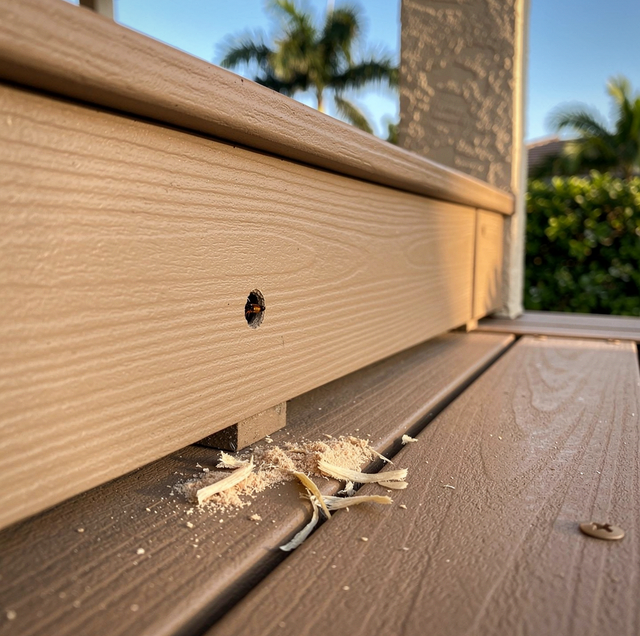
The hole itself carries information worth reading first. A carpenter bee's entrance is close to a perfect circle, chewed straight into the surface, and is frequently found on the underside of a horizontal board rather than a top or front face, likely because that side is more sheltered from direct rain.
Below an active hole, look for coarse, granular sawdust, more like small pellets than fine dust, collecting on deck boards, a sill, or the ground. Fresh frass tends to be pale and light in color; older accumulations weather to gray or brown. Yellow-brown staining around the opening, from pollen and general activity, sometimes shows up as well.
A bumble bee entrance looks nothing like this. If a colony has moved into an existing gap under siding or a mulch bed, there is no chewed opening and no wood shavings anywhere near it, because nothing was chewed to get there. A round hole with frass beneath indicates carpenter bee activity in the wood. No hole, no frass, just bees coming and going from a gap at ground level, points to a bumble bee colony that has nothing to do with the wood at all.
Sex Differences: Which One Can Actually Sting
The dive-bombing male carpenter bee patrolling a gallery entrance cannot sting at all. Like males of nearly every bee species, he does not carry a stinger, because the stinger is a modified egg-laying structure that only exists in females. A female carpenter bee, working inside the gallery, can sting, but she is not aggressive about it; most people who get stung by a female were handling her directly.
Female bumble bees can sting, and unlike a honeybee, a bumble bee does not lose her stinger after use, so she can sting more than once if the colony feels threatened. Male bumble bees, again, cannot sting under any circumstance, no matter how close they fly.
Anyone with a known bee-sting allergy should stay well away from an active gallery or a ground colony rather than moving in for a closer look. A reaction can escalate fast, and distance is the safer way to identify either insect.
The practical takeaway is the same for both species: the bee that looks the most threatening while flying at you is usually the one least capable of actually stinging.
The Structural Damage Question: Galleries, Reuse, and Woodpecker Damage
A single season's gallery in a piece of trim usually is not severe on its own. The bigger issue is that carpenter bees tend to reuse and extend an existing gallery rather than start fresh each year, so the same board can end up hosting a tunnel network that branches farther into the wood over multiple seasons. Bees also overwinter inside old galleries, sheltering there through the colder months before becoming active again.
Woodpeckers complicate this further, drawn to the sound and scent of larvae inside an active gallery, pecking through the surrounding wood to reach them. A contained round hole can turn into a much larger, ragged opening, and the woodpecker damage often ends up more visible than the original gallery ever was.
An active gallery should never be plugged, caulked, dusted, or sprayed. Sealing it traps bees inside, and they often chew a new exit rather than leave; treating the wood is licensed work that requires knowing how deep the gallery runs.
None of this applies to a bumble bee colony, since there is no wood bored into and no gallery to expand; its impact is behavioral, tied to defending the entrance, not structural. The goal of a carpenter bee gallery is to protect the wood, not eliminate a pollinator, and a bumble bee colony away from a walkway is typically left in place. Both insects do real pollination work; the wood is the only thing actually at risk, and only from one of them.
What a Professional Inspection Actually Looks For
A professional inspection starts with the hole itself: shape, placement, and whether the frass below it looks fresh or weathered. Fresh, light-colored shavings point to current activity; grayed, packed-down frass suggests an older, possibly vacated gallery. From there, the inspection follows the grain direction to gauge how far a gallery likely runs and whether it branches, without unnecessarily disturbing an occupant still inside.
Wood condition matters too: bare versus painted, softwood versus a denser species, whether moisture at a seam has already softened the surface, and whether the gallery is a fresh excavation or a reused one from a prior season.
If the activity turns out to be a ground or cavity-nesting bumble bee colony instead, the inspection shifts entirely to location relative to foot traffic and entrances, since there is no structural question to evaluate.
That inspection ends with a clear answer rather than a guess: an active gallery that needs attention, an old one that's safe to leave alone, or a ground colony with nothing structural at stake.
Frequently Asked Questions
Yes. Male carpenter bees have a pale, whitish-yellow patch on the face, while females have a solid black face with no marking. It is a fast way to know which one is hovering at a gallery without waiting to see which one can sting.
Only when the gallery sits somewhere already reachable at a standing height, like a deck rail or a fence cap, does a faint rasping or chewing sound near the hole mean excavation or feeding is happening inside. A gallery in a fascia board, soffit, or anywhere overhead is left to a ladder inspection by the technician, not a listening check from below. A silent hole with old, weathered frass is more likely vacated than currently occupied.
No. Bumble bees have a corbicula, a smooth pollen basket on the hind leg where collected pollen compacts into a visible packed ball. Carpenter bees lack a true corbicula; they carry pollen on dense hairs, called a scopa, on the hind legs and underside of the abdomen, so the load looks looser and less like a solid ball.
Density is the deciding factor more than finish. Naturally dense or oil-rich hardwoods, like teak or ipe, are difficult to excavate at all, so bees rarely choose them even bare and unpainted. Common construction lumber, including pine, fir, cedar, and redwood, reads as a candidate at almost any softness level, which is why so much fascia and trim ends up targeted regardless of the species name on the original invoice.
No. A bumble bee colony runs for a single season; only a newly mated queen survives through the colder months, typically sheltered in soil or leaf litter, and she starts an entirely new nest elsewhere the following spring rather than reusing the old site.
Bumble bees are especially known for buzz pollination, gripping a flower and vibrating their flight muscles at a pitch that shakes loose pollen that certain flowers, like tomatoes, do not release through touch or wind alone. It is a foraging behavior tied to their fuzzy build, distinct from a carpenter bee's wood-boring habit.
Send a photo of the hole and the sawdust below it — Tyler can tell you in minutes whether it's an active gallery or a colony better left alone. Buggify Pest Solutions serves Boca Raton, West Boca, and communities across Palm Beach and northern Broward. Call Tyler: (561) 672-0200.
