

Brown-Banded Cockroaches: The Bedroom and Closet Roach
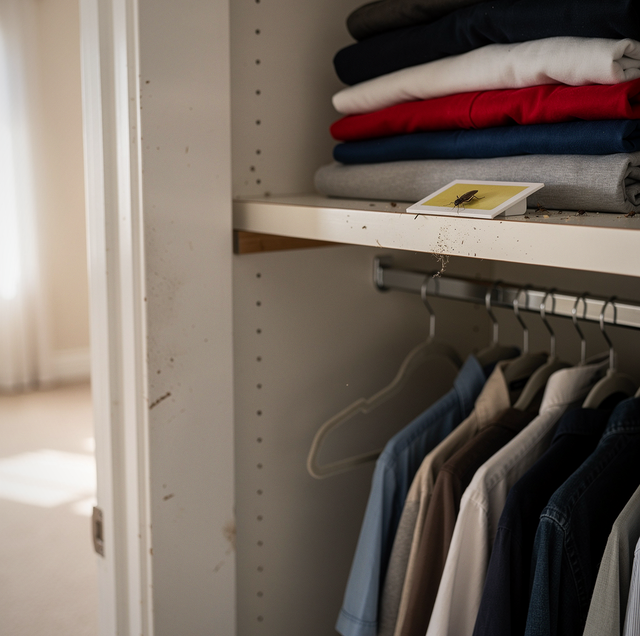
You see a small roach on your bedroom ceiling at two in the morning, or one drops off a closet shelf onto your folded shirts. Your kitchen is clean. Nothing sits under your sink, nothing behind the dishwasher, and the last technician who walked the house checked all of those places and found nothing.
The room itself is the clue you have been handed. What you are looking at is most likely a different species from the one your inspection was built around, and it does not live where you were told to look. It lives high, dry, and away from water, in the rooms where you sleep and where you dress.
The Two Bands That Separate This Roach From a German Roach
A German cockroach has two dark stripes that run lengthwise along the shield behind its head, from front to back. The mark on this species runs the other way. Both adults and nymphs are distinguished by two brownish, broad bands across the body, one at the base of the abdomen and one at mid-abdomen. Across, not down, and on the abdomen instead of the shield.
Sex changes what you see next. That guidance puts the adult male at about half an inch long, light brown, with fully developed wings, and notes that adult females are shorter and stouter than males, and that their wings do not cover the entire abdomen. So a stubby, wide roach on a closet shelf and a slimmer winged one on the ceiling above it can be the same species.
The banding is easiest to read on a young one. Find a wingless, banded roach in a dresser drawer, and you are looking at a nymph, and a nymph in a drawer means the population is breeding in that room, not passing through on the way to your kitchen.
What Draws a Roach to a Bedroom or a Closet?
Water is the wrong thing to look for. This species prefers starchy foods and has lower water requirements than other cockroaches. The wet room that anchors a German inspection has no pull here.
Warmth and dry storage are the draw. Brown-banded cockroaches prefer warm, dry locations, such as near refrigerator motor housings, on the upper walls of cabinets, and inside pantries, closets, dressers, and furniture. Those are storage rooms.
Ceilings, Upper Walls, Furniture: Where They Actually Sit
The list of places is specific enough to work from. Nymphs and adults frequently are found on ceilings in dark or dimly lit rooms, behind picture frames, in light switches, in upper walls of cabinets and closets, or on the underside of furniture and inside upholstered furniture. Every location on that list sits above waist height or inside something, and none of it is in a kitchen.
It is common to find them hiding closer to the ceiling than to the floor and away from water sources. Their size is the reason those spaces work at all. The same guidance notes that brown-banded cockroaches can conceal themselves in many places that are inaccessible to larger species. A gap too tight for an American cockroach will hold a colony of these, above where you are looking.
A sticky trap set flat on a closet shelf or the top of an upper cabinet catches this species; the same trap on the kitchen floor, where German roaches run, catches nothing at all.
Why a Kitchen-Anchored Inspection Misses This Species
A harborage-first inspection for German roaches is a crack-and-crevice walk: under sinks, behind dishwashers, refrigerator motor housings, outlet boxes, and plumbing penetrations through cabinet backs, all within about five feet of food and water. That is the correct search for the species it was built for. Run the same walk in a house holding brown-banded cockroaches, and it comes back empty, because every point on it sits low and near plumbing instead of high and dry.
The reflex response makes it worse. Residual insecticidal sprays or aerosol foggers used within a structure are of little value in controlling brown-banded cockroaches, and in fact these applications can disperse the cockroaches, making control difficult and lengthy. A can aimed at a closet shelf does not shrink the population; it scatters it into the wall void, the doorframe, and the next room.
What Changes in the Inspection Itself
What changes first is the axis. A brown-banded inspection runs from eye level up rather than from the floor up, and it moves through parts of a house that a kitchen-anchored walk never reaches. Upper cabinet walls and the top shelf of a linen closet. The underside of shelf edges, where a lip creates a covered ledge. The backs of picture frames and the gap behind a doorframe casing. Light switch plates and clock and radio housings. The underside of tables and chairs, and the seams of an upholstered chair or headboard. Dresser interiors, and the void behind a dresser pushed against a warm interior wall. None of those points appear on a kitchen list, and all of them appear on this one.
The building type matters as much as the room. The species is more apt to be found in homes, apartments, hotels, motels, nursing homes and hospitals than in restaurants, grocery stores and other commercial establishments. So the search is residential, and the same guidance records that keeping cockroaches out of homes via boxes, grocery bags and suitcases is difficult.
Species identification is the step everything downstream depends on. Treatment starts with on-site identification, then places professional gel bait at the actual harborage points and adds an insect growth regulator to interrupt the reproductive cycle. Bait placement changes with the species because the harborage does, and nothing about that is optional.
Cockroach Allergen in Rooms Where People Sleep
The reason bedrooms matter here is not sentimental. Federal guidance on asthma triggers states it directly: certain proteins found in cockroach feces and saliva can cause allergic reactions or trigger asthma symptoms in some individuals. The same guidance names droppings and body parts of cockroaches and other pests as asthma triggers. Whether anyone in a given household is sensitized is a question for their physician, not for a pest technician.
Where those proteins collect varies with the species. A kitchen-anchored population leaves them under a sink and behind an appliance. A brown-banded population leaves them in a closet, in a dresser, inside an upholstered chair, and on the ceiling of the room where you sleep eight hours a night. The same guidance also records that cockroach allergens likely play a significant role in asthma in many urban areas.
Opening and treating a closet cavity or an upholstered seam where this species harbors is work for the FDACS-certified applicator, because disturbing a harborage lofts allergen-bearing droppings straight into the air of the room where an occupant then sleeps every night.
Reading a Sticky-Trap Survey Before Any Treatment
Before anything is placed, the survey comes first. Ten sites is the floor, not the target.
Where those traps go is the whole difference. That same guidance directs treatment to the areas where cockroaches have been collected in the traps, so a trap line run along kitchen baseboards produces a plan for kitchen baseboards. A trap set flat on a closet shelf and on top of an upper cabinet produces a different plan entirely.
The animal's size is why it hides so completely. An adult body is at one half to five eighths of an inch in length, small enough to sit inside a light switch plate, behind a picture frame, or in the seam of an upholstered chair without crossing a floor.
Frequently Asked Questions
Adult males can. Both males and females are quite active, and adult males fly readily when disturbed. Females cannot, because their wings are shorter. So if something lifts out of your closet when you open it and lands on you, you saw a male.
Feeding on glue or paste, on starch, and on certain color dyes, which puts stamps, envelopes, and the bindings of older books on the menu. The same guidance notes chewing on nylon stockings, for the residues of body oils and skin flakes. A closet holding your clothes, your shoes, and a stack of your mail is a food supply, and you can keep your kitchen spotless and still have a population two rooms away.
The nymphal stage lasts 8 to 31 weeks, and an adult female's lifespan is 13 to 45 weeks; estimates suggest that each female produces about 600 descendants per year. What that means for you is that a population in your closet that you first noticed last month may already be two generations deep by the time you look.
Bacteria and protozoa that cause illnesses such as gastroenteritis and diarrhea can be carried on the legs and bodies of cockroaches and deposited onto food and utensils. Living in your bedroom does not remove that; it relocates it onto the surfaces in that room, including your bedding. Anything you want assessed medically belongs with your physician.
It is part of the work, not an alternative. Structural modification such as caulking in cracks, crevices, around ducts and molding is necessary in bedrooms, bathrooms, and dining rooms, which is a longer list of rooms than you would expect in your own house. Sealing a crack in your bedroom wall is the ordinary step here, not an odd one.
Because the harborage sits somewhere else, and the material follows the harborage. Control strategies built for other cockroaches will not be effective on brown-banded cockroaches. The same guidance places accurate identification ahead of any control choice. That means the species is identified on-site before a protocol is chosen for your house; the survey establishes which rooms and heights are holding the population; professional gel bait is applied at those points; and an insect growth regulator interrupts the reproductive cycle. A protocol built for your sink cabinet does not reach your closet ceiling, and repeating it will not change what you see.
Send a photo of the shelf and the ceiling above it — Tyler can tell you which species you have before anything is placed in the room. Buggify Pest Solutions serves Boca Raton, West Boca, and communities across Palm Beach and northern Broward. Call Tyler: (561) 672-0200.
