

Why Spider Webs Keep Coming Back in Coral Springs Canal Homes
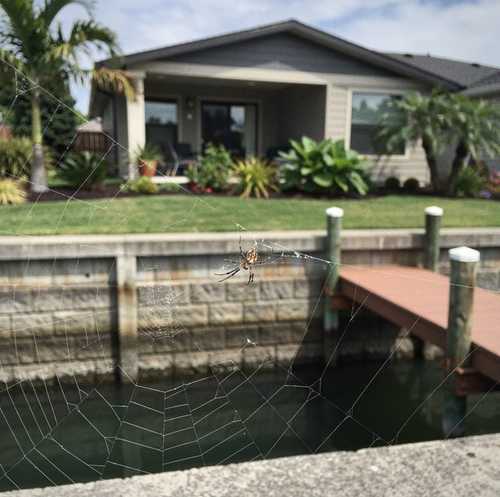
Quick Answer: Coral Springs' extensive canal network, commonly estimated at around 165 miles, and Lighthouse Point's finger-canal lots keep prey insects active at the waterline year-round. That steady traffic, not chance, fills seawalls, docks, and lanai screens with webs faster than inland yards.
A canal-front lot in Coral Springs and an inland yard ten minutes away in West Boca can get the same every-8-weeks service and still end up with a completely different web load by the second week. The seawall, the dock, and the lanai screen facing the water fill back in fast; the inland patio barely refills at all. That gap isn't random, and it isn't about which house gets sprayed more carefully. It comes down to what's living at the waterline behind the seawall, and how much of it a spider can reach without leaving its anchor point.
Why Canal Corridors Support Insect Life All Year
Coral Springs' canal network, an extensive system commonly cited as around 165 miles, plus the finger-canal system that runs through Lighthouse Point, keeps a permanent body of slow-moving freshwater within a few hundred feet of thousands of lots. Unlike a retention pond that can draw down during the dry season, a maintained canal system holds its water depth year-round, so the insects that depend on standing or slow-moving water don't lose their breeding habitat the way they would around a seasonal wet spot. South Florida's climate compounds this. Entomologists tracking Florida mosquito populations describe activity easing, not stopping, through the cooler months, since the state's mild winters don't bring the hard freeze-driven die-off that ends breeding farther north. That lines up with what a canal-front property actually sees: web activity thins out somewhat in winter, but a seawall or dock corner rarely goes fully empty the way an inland patio's corner can.
What Actually Feeds a Web at the Waterline
A spider doesn't live in the water; it anchors near it because that's where flying-insect density is highest. Canal edges support more than mosquitoes specifically. Mosquito species that lay eggs in slow or stagnant edge water are part of the mix, but so are midges and other short-lived, water-associated insects that hatch near the surface and move to the nearest solid vertical structure at dawn or dusk. A seawall cap, a dock piling, or a screened lanai panel facing the canal is often the first rigid surface those insects reach after leaving the water. Orb weavers in particular need a wide, largely open flight corridor for their web to intercept enough of that traffic, which is why an unobstructed seawall run or an open dock slip, rather than a fenced or heavily planted stretch, tends to be the most consistently active spot on a canal lot.
Lighthouse Point's Canal-Built Geography Adds More Surface Area
Lighthouse Point isn't just near canals; it's built around them: much of the city's residential footprint sits on a finger canal, with a private dock, a seawall, and often a boat lift or davit system as standard features rather than upgrades. That changes a property's structural geometry compared to a typical inland Coral Springs lot. An inland lot's spider-relevant surfaces are mostly the house itself: eaves, a lanai screen, maybe a mailbox post. A Lighthouse Point canal lot adds a second structure zone entirely. The seawall cap: a continuous rigid run along the full width of the property, close enough to the water to catch nearly everything moving along it. The dock deck and pilings: stable, shaded, and rarely disturbed. A boat lift frame or davit brackets: crossbeams and motor housings that sit only a few feet above the water surface. Each of those is a stable anchor within easy reach of the water, which is exactly the combination a web-builder needs. Finger canals are also narrower and more enclosed than Coral Springs' wider primary canal segments, so insect traffic moving along the water's edge has less open room to disperse before it reaches a dock or seawall pressed close on either side.
Why This Differs From the Rest of the Service Area
Not every lot in the service area sits on water. Most of Boca Raton, West Boca, Parkland, and Deerfield Beach is set back from any permanent water body, so spider pressure there is driven by different factors covered elsewhere: irrigation overspray, mulch beds, and porch lighting, without the added, constant insect draw a canal produces right at its edge. A canal- or lake-adjacent lot anywhere in the broader service area sees some version of this same effect, but Coral Springs' canal density and Lighthouse Point's near-universal canal-lot design make the pattern the most consistent, and the most pronounced, in those two specific areas.
What a Canal-Lot Homeowner Can Watch For
A few structures on a canal-adjacent lot are worth checking on a regular rhythm, separate from the usual eave and screen check every South Florida homeowner already does.
Seawall cap corners and expansion joints: the corner where the cap meets a dock or the property line sits close enough to the water for splash-zone insects and dry enough to hold a stable web.
Dock box compartments and boat lift motor housings: enclosed, shaded, and rarely opened, which makes them a preferred spot for a web that never needs rebuilding.
Davit brackets and crossbeams: narrow, rigid gaps that hold a web out of direct wind coming off open water.
Canal-facing lanai screening: check the panel or corner that faces the water, not just the side facing the street or a neighboring wall.
Check dock boxes and boat lift motor housings on a regular rhythm, not just the seawall cap. These enclosed compartments remain undisturbed for weeks, making them a preferred spot for a brown widow's egg sac in particular.
What Actually Helps on a Canal Lot
Because the insect draw here comes from the water itself, a treatment limited to the house's exterior walls misses the corridor generating the pressure. A source-first spider inspection on a canal lot extends the walk to the dock, the seawall cap, and the lift structure, not just the eaves and screens, and addresses what's found there the same way it would anywhere else on the property: reducing the harborage those structures offer and clearing any egg sacs found in dock boxes or lift housings during the visit. This still falls within Spider Control's scope, not a separate canal or mosquito service. The difference on a canal lot is where the inspection walks, not what's included in it. A homeowner whose mosquito pressure at the same water's edge is the bigger concern would look at mosquito control specifically, which runs on its own monthly cadence through the warmer months and targets the biting adult population and breeding sites rather than web-building spiders.
What the Waterline Adds to the Picture
The canal isn't a seasonal factor that shows up for a few months and fades; it's a fixed structural feature of the lot, generating some level of insect traffic at the water's edge every week of the year. That's the real distinction between a canal-front property and an inland one: not that canal lots are treated less carefully, but that they have an entire second set of structures- seawall, dock, lift- sitting a few feet from a permanent, year-round insect source that an inland yard simply doesn't have. Routine coverage that includes that corridor, rather than stopping at the house's exterior wall, is what actually keeps pace with it.
Frequently Asked Questions
There's a real but partial overlap, and it runs through more than one channel. Mosquito treatment reduces some of the small flying insects spiders feed on near the water's edge, and broad-spectrum residuals used in yard-barrier applications can also affect spiders directly if they're resting in treated shrub-line vegetation, not just through the insects those spiders eat. It's not a substitute for spider-specific treatment, since it doesn't reach the seawall cap, dock box, or lift housing where most canal-lot webs actually anchor. A homeowner weighing both services for the same stretch of water can find the more detailed mechanism-by-mechanism breakdown in Buggify's mosquito-and-spider overlap article; this one focuses on why the canal itself drives the pressure.
Not always. Coral Springs and Lighthouse Point canal lots see a heavier presence of golden silk and other large orb weavers than a typical inland patio does, since the open water gives their large webs room to hang without a fence or hedge cutting across the flight path. Their webs also tend to sit higher and at more of an angle over a dock slip or seawall corner than the flatter, lower webs an inland eave produces. Brown widows on a canal lot show a different pattern too: because dock structures rarely need to be opened or cleaned the way a house exterior does, an egg sac in a dock box or lift housing can go unnoticed through multiple breeding cycles in a way it wouldn't on a frequently-used porch or garage.
There's a reasonable case that it can, though this is general insect behavior rather than Coral Springs-specific data. A concrete or rip-rap seawall holds daytime heat and reflects evening light differently than a vegetated bank, which can concentrate insect activity right at the cap line around dusk. A grass- or mangrove-lined bank without a hard seawall tends to spread that same insect draw across more vegetation instead of concentrating it at one hard edge.
Often, though, the geometry is only part of the reason. Many finger canals are dead-end or single-outlet configurations with limited tidal exchange, so organic debris and algae accumulate along the seawall base more than they do in a primary canal with continuous through-flow. That slower flushing means more standing water for decomposition at the waterline, which is its own draw for midges and other short-lived insects, independent of the funneling effect. A wider primary canal segment, by contrast, usually has a second connection point that keeps water moving and carries loose organic matter through rather than letting it settle against a single stretch of seawall.
Yes, on a canal lot it's worth including specifically, since a standard exterior walk that stops at the house misses those structures entirely. A source-first inspection extends to the dock box, lift motor housing, and davit brackets to assess where prey insects are collecting, not just where webs are visibly hanging. Dock and seawall structural issues themselves (loose pilings, deck rot) fall outside pest control and are a separate marine-contractor matter.
It shifts location more than it shifts intensity. In summer, the highest insect density sits right at the open seawall cap and dock edge, so that's where new webs concentrate. In winter, some of that same insect activity moves into more sheltered spots, a dock box seam, the underside of a lift motor housing, the lee side of a seawall corner out of the wind, since fewer insects are moving through open air on cooler nights. A canal lot that looks quieter at the seawall cap in January can still have active webs tucked into those sheltered structures, which is why a winter inspection on a canal lot checks the enclosed spots first rather than assuming low seawall activity means low activity overall.
Have a canal-front lot in Coral Springs or Lighthouse Point where the webs keep coming back — get a source-first spider inspection that covers the dock, seawall, and lift structure, not just the house. Buggify Pest Solutions serves Boca Raton, West Boca, and communities across Palm Beach and northern Broward. Call Tyler: (561) 672-0200.
