

How to Get Rid of Spiders by Reading Your Web Map
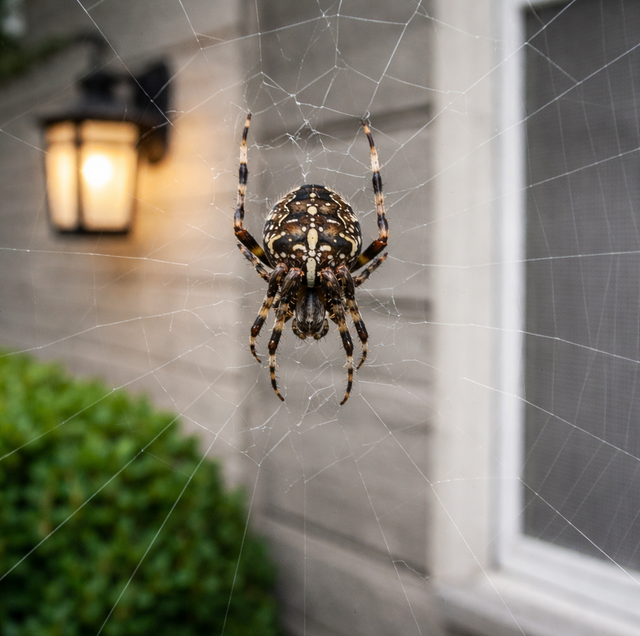
Quick Answer: Spider webs aren't placed at random: cluster locations mark reliable prey routes, near lights, along foliage edges, at screens. Read where the silk keeps returning, and you find the insect source actually feeding the spiders.
Walk your property at dusk with a flashlight, and you'll likely find the same three or four spots holding a web, week after week: a corner of the eave under the porch light, a gap at the top of a window screen, the hedge line along the side yard. That repetition is data. A spider doesn't build in a random location and hope; it anchors where the odds of an insect flying, crawling, or drifting past are highest. Once you know how to read that pattern, the web itself stops being the story and becomes a map pointing at whatever is actually feeding the spider.
Why Web Location Isn't Random
A web-building spider needs two conditions in the same spot: a stable anchor (a corner, a frame, a branch fork that doesn't sway much in the wind) and a reliable path of insect traffic close enough for the web to intercept it. Neither one alone is enough. A perfectly stable corner with no insect flow nearby stays empty, and a heavy insect flow with nothing rigid to anchor to just gets a web strung between two flexible plant stems that tears out in the next storm. Where both line up is where a web appears and keeps appearing, because a new spider (or the same one) reads the same conditions the same way. Orb weavers, the classic wheel-shaped web builders, often take down and rebuild their web fresh most nights, so an active corner can look freshly spun even though nothing else about it changed. House spiders are more sedentary and tend to hold the same tangled web in place for weeks, extending it rather than starting over.
Step One: Walk the Property and Mark the Clusters
Do a slow pass around the exterior at dusk, two or three evenings over a week or two, and note which spots hold a web on more than one visit. A few zones account for most residential clusters:
Eaves and soffit corners near a light fixture: The corner closest to a porch or garage light almost always fills in first.
Window and door screen frames: Especially the upper corners and the seam where the screen meets the track.
Foliage lines and hedge edges: The outer face of a hedge or shrub bed that borders a walkway or the base of exterior lighting.
Lanai and pool-cage framing: Support posts and screen panels facing a light fixture or the water.
Gutter corners and downspout elbows: Tucked, dry, and usually undisturbed for months at a time.
Mark which of these keep refilling within days of being cleared, versus those that only ever hold a single one-off web. The repeat spots are the ones worth reading further.
What Light-Adjacent Webs Are Telling You
Spiders themselves aren't strongly drawn to light the way moths and midges are. What draws the spider is the insect traffic the light itself creates: night-flying moths, midges, and small beetles are strongly phototactic and collect against the nearest solid surface after dark, which is often a soffit corner, a screen panel, or a porch column a few feet from the bulb. A spider that anchors at the edge of that light throw is positioned to catch whatever the fixture pulls in, not the light itself. A study on grass spiders (Agelenopsis pennsylvanica), a common outdoor web-builder, found that web placement tracked the artificial light source more closely than it tracked prey density, suggesting the light cue alone may be doing more of the work than assumed. Either way, the practical takeaway holds: change what the light draws, and the web activity around it tends to follow.
Check the same cluster spot on two or three nights, not just one. A web that's rebuilt within 24-48 hours marks an active, reliable prey route; a corner that stays empty for a week is a lower priority.
Not every fixture pulls the same insects. Standard cool-white LED and older mercury-vapor bulbs sit closer to the wavelengths that draw moths and midges most strongly; warmer, amber-toned bulbs draw noticeably fewer of them, according to bulb manufacturers and several pest-control field comparisons, though the difference is a reduction, not an elimination. Mosquitoes are a separate case: they home in on carbon dioxide, body heat, and scent rather than light, so a bulb swap does little for them. That matters more in canal-adjacent stretches of Coral Springs and Lighthouse Point, where standing and slow-moving water keeps mosquito numbers higher near the waterline most of the year, feeding a different set of webs than the ones clustered purely around a porch light.
What Foliage-Line and Hedge Webs Are Telling You
A hedge or shrub bed does two things a bare wall doesn't: it holds daytime humidity that gnats and small moths rest in, and it gives insects a physical bridge from the mulch bed up to eye level, where a web across the outer branches intercepts them on the way past. Irrigation overspray or a sprinkler head that mists the same bed every cycle adds a steady moisture source that keeps gnat activity higher right at that spot than in a drier bed ten feet away. A web low in a hedge, close to the ground and half-hidden rather than strung across an open gap, is also the more likely spot to find a brown widow, a species that avoids open, exposed webs in favor of tucked, low, undisturbed voids.
What Screen and Frame Webs Are Telling You
Screen mesh itself acts as a net for whatever is already flying nearby, so a web at a screen corner is reading the same light or foliage draw covered above, filtered through a nearby frame. But the shape of the web at a frame is worth a second look, because it can tell you which spider is using the spot before you ever see it. An open, near-vertical spiral strung across a full screen panel is typically an orb weaver's work and gets rebuilt often. A loose, irregular, cobweb-style tangle pushed into the upper corner or the track seam, gritty-looking rather than clean, is more often a house spider or, in a darker and more tucked corner, a brown widow, which favors gaps it can occupy for weeks without disturbance rather than an open panel it has to rebuild nightly.
Putting the Pattern to Use
Once a cluster spot is marked as active, the map points to a specific check rather than a general spray. A light-adjacent corner points to the fixture: bulb type, whether it's on a timer or dusk-to-dawn sensor, and whether it's aimed at a wall the insects pile against. A foliage-line web points to the planting bed: how close it sits to the structure, whether irrigation is wetting the same spot every cycle, and whether it's been trimmed back from the wall in the last season. A screen or frame cluster points to the seam and the light or vegetation feeding it, not the screen material itself. Clearing the silk resets the visible symptom for a day or two, but it doesn't affect the fixture, the irrigation head, or the planting bed, which is still drawing insects to that exact spot, which is why the same corner tends to refill.
Reading the Map Season to Season
The specific insects filling any one cluster shift over the year: love bugs move through South Florida in heavier passages at certain points in spring and fall, mosquito pressure near canal edges runs highest through the wetter months, and moth activity at porch lights holds fairly steady year-round given the region's mild winters. What doesn't change is the method. The same eave corner, screen seam, or hedge line stays the reliable spot because the anchor and the prey path are structural, not seasonal, so checking those same few zones on a regular rhythm works whether the current draw is love bugs, moths, or something else entirely. Once you've read a property's map once, you know where to look every time after.
Frequently Asked Questions
Shape alone mostly repeats what the species-specific sections above already cover, but there's a more useful tell most people miss: whether the web looks actively worked or abandoned, which matters more day-to-day than pinning down the exact builder. An active web is taut, with unbroken spiral or tangle threads and little accumulated debris; one that's sagging, has gaps torn into the strands, or has gone matted and dull gray rather than showing fresh silk's faint sheen has most likely been vacated, regardless of which spider built it first, and can be cleared without expecting it back the next night. The one shape detail worth flagging on its own, separate from active-versus-abandoned: a tan, spiky-textured egg sac woven into the strands is a brown widow signature specifically, and it's reason enough to clear that web with a tool rather than bare hands.
Warm, moist air drafts do the same job light does for a different set of insects. Attic and dryer vents, AC condensate lines, and exterior utility penetrations push out warm air that draws drain flies and fungus gnats even at night, with no fixture involved. A web positioned near one of those vents is reading a thermal and moisture draft rather than a light one.
Often, yes, if nothing about the fixture, the bed, or the vent has changed. The spider using that spot, or another one that finds the same conditions, frequently rebuilds within 24 to 48 hours in the identical corner. Some species will shift a few inches within the same gap if disturbed repeatedly, rather than abandoning the spot for another part of the property, which is another sign that the location itself, not the individual spider, is the constant.
It's amber specifically that makes the difference, not warm-white in general. Bulb manufacturers and field comparisons report fewer insects drawn to true amber and yellow-filtered light than to cool-white LED or older mercury-vapor bulbs, but a standard warm-white LED, the kind rated around 2700K to 3000K on the package, still emits enough blue-spectrum light to keep drawing insects at close to the same rate as a cool-white bulb. Effects from an actual amber swap usually show up within 1 to 2 weeks, as insects already using the old light disperse and aren't replenished as quickly. A bright fixture on a neighboring property or a lit pool can still pull insects across a yard regardless of what your own bulb is doing, which limits how much one swap accomplishes on its own.
Often, yes, and there's a way to tell whether a given cluster is actually the canal talking rather than just a nearby porch light. A mosquito-driven cluster tends to sit closest to the waterline, dock, or seawall rather than centered on a fixture, and it typically refills fastest in the hour or two around dawn and dusk, when mosquito activity peaks, rather than in the first hour or two after dark, which is when a light-driven cluster near a porch fixture fills in fastest. The pressure isn't flat across the year either: canal-adjacent mosquito breeding runs highest through the region's wetter months, roughly June through October, and eases in the drier winter stretch without disappearing, so a water-line cluster that thins out in January is a seasonal shift, not a sign anything nearby changed.
Yes, and it usually points somewhere different. An indoor cluster near a garage utility sink, a laundry drain, or a slow leak under a cabinet is almost always tracking a moisture-driven insect source, such as drain flies or fungus gnats, rather than a light-driven one. That distinction matters: an indoor web points to a plumbing or moisture check, not a lighting fix.
Found your property's recurring web spots but can't pin down what's feeding them — get a source-first spider inspection that traces the pattern to the actual prey draw. Buggify Pest Solutions serves Boca Raton, West Boca, and communities across Palm Beach and northern Broward. Call Tyler: (561) 672-0200.
