

"Daddy Long Legs": 3 Different Bugs, One Bite Myth
Quick Answer: "Daddy long legs" isn't one animal. It covers cellar spiders, harvestmen, and crane flies, only one of which is a true spider. The "world's most venomous but can't bite you" claim has no real scientific basis behind either half of it.
You have probably said the words "daddy long legs" about three completely different creatures without ever noticing the switch. The pale, thread-legged thing hanging in a loose web in the garage corner. The rounder, single-blob-bodied one picking its way across the patio pavers at dusk. The flying insect that looks like an oversized mosquito bumping against the porch light. South Florida homes host all three, and homeowners lump them under one name and one piece of folklore: that it's the most venomous spider on Earth, saved only by fangs too small to break human skin.
That story is a decades-old playground legend, repeated so often on nature documentaries, in classrooms, and across the internet that most people assume it's settled fact. The show MythBusters actually put it to the test rather than starting it: a host let a cellar spider bite him on camera and reported only a mild burning sensation, evidence that undercuts the myth rather than backing it. It sounds satisfying because it explains away the fear in one tidy sentence. It also happens to get almost everything about the underlying biology wrong, starting with the fact that "daddy long legs" was never describing a single species to begin with.
Three Unrelated Animals, One Nickname
Cellar spiders (family Pholcidae): This is the only one of the three that's an actual spider. Two body segments (a fused head-thorax and a separate abdomen), typically eight eyes though some genera have six, silk-producing spinnerets, and true venom glands connected to a pair of fangs. Cellar spiders build loose, irregular, cobweb-style webs in dark, undisturbed corners: garage rafters, shed interiors, under eaves, the underside of patio furniture, and closet ceiling corners. They hang upside down in the web with their long thin legs splayed out, which is the classic image most people picture when they hear the name.
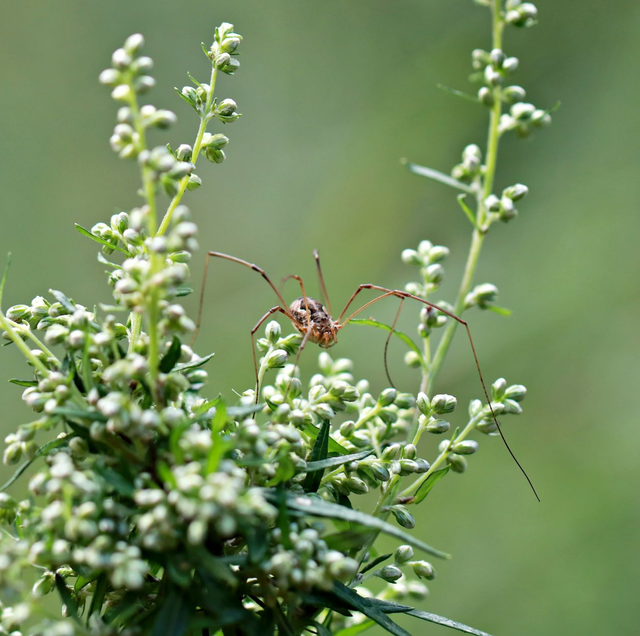
Harvestmen (order Opiliones): Despite the resemblance, these aren't spiders at all, and they're not even that closely related to spiders within the arachnid group. A harvestman has a single oval body segment instead of two, only two eyes instead of eight, no silk glands, and critically, no venom glands and no fangs. What it has instead are small pincer-like mouthparts built for tearing at decaying plant matter, fungi, and small dead insects, since harvestmen scavenge more than they hunt. Outdoors on patios, mulch beds, and exterior walls after dusk is where South Florida homeowners run into these most.
Crane flies (family Tipulidae): These aren't arachnids at all; they're flies, in the same broad insect group as house flies and mosquitoes. Six legs, not eight, and a single pair of wings. Many adult crane flies have reduced, non-functional mouthparts and don't feed at all in their short adult stage, so the idea of a crane fly biting anyone is close to physically impossible for most species. They're drawn to porch and pool-deck lighting at night, which is usually where they get noticed and mistaken for a huge, leggy spider.
Correcting the Venom Myth: What Actually Happens
The popular version of the myth has two parts, and both need fixing, not just softening.
"Most venomous spider in the world": unsupported. The claim is a much older playground legend, not something that originated with any TV show or study. No rigorous toxicology testing has established that cellar spider venom is unusually potent, and researchers who've looked for a published study backing the claim haven't found one. A 2019 study that directly compared venom potency found black widow venom far more toxic to test subjects than cellar spider venom, the opposite of what the myth claims. There's no real scientific basis for ranking cellar spiders anywhere near the top of spider venom potency, let alone at the very top.
"Fangs can't pierce human skin": also wrong, and this is the part most retellings get backward. Cellar spider fangs are small, but they are not physically incapable of penetrating human skin. The clearest evidence for this is the MythBusters test itself: a host was bitten on camera, and the fangs broke skin without issue. What's true is that bites are rare, because cellar spiders aren't aggressive toward people and tend to stay put in their web rather than confront anything the size of a hand. When a bite does happen, it's typically described as a mild pinprick with little to no lasting effect, not because the fangs failed to break the skin, but because the venom isn't medically significant to a human. The real story isn't "can't bite you." It's "rarely bites, and it barely matters when it does."
What This Means for a South Florida Home
Cellar spiders showing up in a garage, lanai, or storage closet is common and, on its own, not a significant pest problem. They're broadly considered beneficial: a cellar spider's diet includes mosquitoes, flies, and even other, more concerning spiders it invades and preys on in their own webs, including brown widows in some cases. A handful in an undisturbed corner isn't something that needs urgent attention.
Cellar spider webs cluster where prey concentrates: garage rafters, lanai screen tracks, and storage areas with steady humidity. Clearing webs without cutting the insect supply behind them means new ones reappear within days.
Where it's worth a closer look is when the population builds up fast, when webs are stacking up across multiple rooms rather than a single forgotten corner, or when a homeowner truly can't tell whether what's actually in the house is a cellar spider or something with more medical relevance, like a brown widow. That's an identification question first and a treatment question second, and it's part of what a general spider inspection addresses: confirming which species is actually present, then reducing prey and harborage, drawing them in rather than just knocking down the visible webs.
Why the Name Keeps Causing Confusion
Part of why this myth has survived so long is that the name "daddy long legs" was never assigned by anyone with a reason to be precise about it. Regional folk names for arthropods tend to group animals by a shared visual trait, in this case, absurdly long, thin legs relative to body size, rather than by actual taxonomy. Cellar spiders, harvestmen, and crane flies share almost nothing else in common: different number of eyes, different diet, different presence or absence of venom, different classes of animal entirely in the case of the crane fly. The leg shape did all the work of grouping them, and the venom rumor got attached to whichever one people pictured first, which was usually the actual spider hanging in the corner.
Frequently Asked Questions
No, and there's no bite risk to worry about at all: harvestmen have no venom glands and no fangs, so a bite in the medically relevant sense isn't physically possible. Their one defense is a foul-smelling secretion released from stink glands on the sides of the body when they're grabbed or threatened, which can irritate skin briefly but isn't toxic. A harvestman that loses a leg to a predator or a curious pet also can't regrow it, unlike some other arthropods, so a missing leg on one you see repeatedly just means it's the same individual surviving with fewer legs.
Yes, and it's one of the more useful things they do around a home. Cellar spiders will invade another spider's web, mimic the vibration pattern of trapped prey to lure the resident spider close, then attack it directly, a hunting behavior called aggressive mimicry. Recorded prey includes house spiders and, in some cases, brown widows, which is part of why pest professionals don't automatically treat a cellar spider population as something to eliminate on sight.
Adult crane flies are drawn to light the same way moths are, through a navigation response called phototaxis, but they're short-lived: most species survive only a few days to two weeks as adults, with the bulk of their life cycle spent as larvae in damp soil or leaf litter feeding on plant roots and organic matter. A sudden cluster around a pool cage light is usually a short-term emergence event tied to recent rain and soil moisture, not an ongoing infestation, and it typically clears on its own within days.
That specific claim, that the venom would be lethal or medically serious if a person were somehow injected with a larger dose, is also unsupported. It appears to be an extension of the original myth rather than anything tested in a lab. No published toxicology work has established cellar spider venom as dangerous to humans under any exposure scenario, injected or otherwise; the consistent finding is that it's mild and not medically significant.
Body shape and leg proportion. A cellar spider has a small, elongated, pale tan to gray body with extremely long, thin, pale legs, several times the body length. A brown widow has a rounder, larger abdomen relative to its legs, is darker with a mottled pattern and an orange-to-yellow hourglass marking underneath, and its legs are noticeably shorter and thicker in proportion to the body. Web shape differs too: a cellar spider's web is a loose, sparse tangle, while a brown widow's web is denser and often built lower, closer to ground level in items like patio furniture, planters, or stored outdoor gear.
It's a common mix-up because of the size and the long legs, but adult crane flies don't feed on blood at all, so there's no bite risk in the way there is with an actual mosquito. What limited energy they need as adults comes from fat reserves built up during the larval stage, not from feeding, which is also part of why an adult crane fly's life is so short. The nickname "mosquito hawk" that sticks to them in some regions is misleading too: crane flies don't hunt or eat mosquitoes as adults, despite the name suggesting otherwise. The larval stage itself has its own name in lawn-care circles, "leatherjackets," a reference to the tough, worm-like leathery skin that lets the larvae survive in wet soil while feeding on grass roots and thatch.
Not sure whether what's hanging in the garage is a harmless cellar spider or something worth a closer look — get it identified and the real entry points and harborage addressed. Buggify Pest Solutions serves Boca Raton, West Boca, and communities across Palm Beach and northern Broward. Call Tyler: (561) 672-0200.
