

Types of Mosquitoes in Florida: The Four That Reach You
Quick Answer: Boca Raton yards see three mosquito groups regularly: container-breeding Aedes that bite by day, Culex house mosquitoes active after dark, and floodwater gallinippers after heavy rain. A fourth, the salt-marsh mosquito, reaches yards near the coast.
Florida has more than eighty recorded mosquito species, more than almost any other state in the country. A handful of specialists could sort every one of them apart under a microscope. Standing on your own patio at dusk, you don't need eighty. You need four.
Every one of those eighty-plus species has its own preferred water, its own resting habits, and its own reason for turning up in your grass or under your eaves. Only four show up often enough near Boca Raton homes to matter. Knowing which one you're looking at tells you exactly where to start looking for the water behind it.
Container Aedes Mosquitoes Bite in Daylight
Two species share this container-breeding habit closely enough that you can treat them the same way in your own yard: the yellow fever mosquito (*Aedes aegypti*) and the Asian tiger mosquito (*Aedes albopictus*). Both are compact and dark-bodied, with crisp white or silvery banding across the legs that catches the light when one lands on your ankle. The Asian tiger mosquito carries a single pale stripe down the center of its back; the yellow fever mosquito carries a pair of curved, silvery lines down the top of the thorax. Neither is easy to confuse with the larger, plainer mosquitoes you meet after sunset.
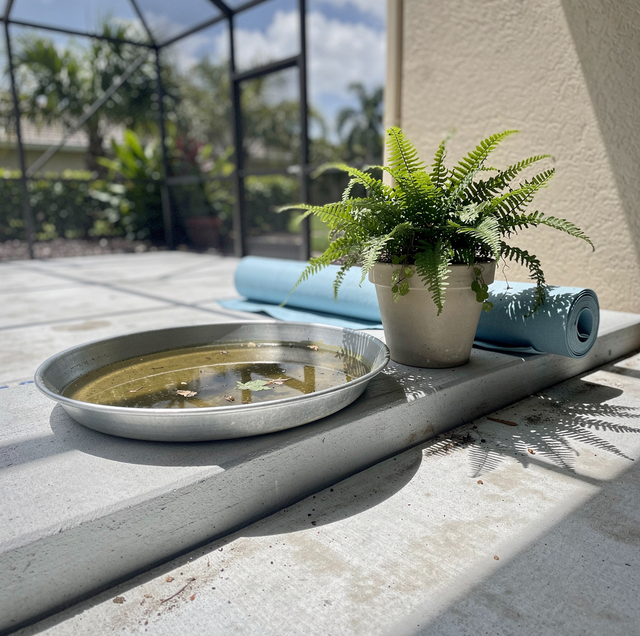
Where the water comes from: These are container breeders. They don't need a pond or a ditch. A bromeliad cup, a plant saucer, a clogged gutter, or the puddle sitting on a folded pool cover holds enough water to finish their life cycle. In Boca Raton's summer heat, that cycle from egg to biting adult can run seven to ten days, which is why a yard that looked clear one week can have an active brood the next.
What it means for biting: Container Aedes bite during daylight hours, often low around the ankles and in shaded corners of a patio or garage where they rest between meals. Bites while gardening at noon or grilling in the late afternoon almost always trace back to this group.
What it means for finding it: Because this group breeds in small, contained pockets of water, an inspection here means checking anything on your property that can hold water and sits close to where your bites are happening, instead of scanning the whole yard for standing water in general.
Culex House Mosquitoes Come Out at Night
*Culex quinquefasciatus*, the southern house mosquito, is the plain, brownish mosquito you swat off a porch light after sunset. It lacks the crisp banding of the container Aedes group. The body reads as a uniform tan to brown, a touch longer in the leg and slightly larger overall, without the high-contrast markings that make its daytime cousins easy for you to spot at a glance.
Where the water comes from: Culex prefers organically loaded water: the edge of a retention pond, a stagnant canal margin, buckets, catch basins, a birdbath gone green, and standing water under your shed. That's a richer, dirtier pool than the clean rainwater sitting in a plant saucer. In neighborhoods built around canals, including Coral Springs and Lighthouse Point, that kind of water sits close to your back fence, which explains how often this group turns up there. Given summer heat, the egg-to-adult cycle for Culex runs longer than the container Aedes group, closer to ten to fourteen days.
What it means for biting: Culex bites you after dark. If your bites start once the sun is down, especially near a porch light or a pond edge, this is the group to suspect.
What it means for finding it: Because Culex needs a larger, more established body of water, checking your own containers won't reveal the source. The water behind it is as often just off your property line as on it: a canal, a pond edge, a low spot that never fully drains.
The Floodwater Gallinipper Follows Heavy Rain
The gallinipper, *Psorophora ciliata*, is the one you describe as enormous the first time you meet it. It's noticeably larger and heavier-bodied than the container Aedes or the house mosquito, with long, mottled legs and a rough, bristled look under close inspection. Once you've seen one land next to an ordinary yard mosquito, you won't mistake it again.
Everything about this group traces back to a single mechanism: it breeds in ground that dries out and then floods. The eggs sit in the soil of a swale, a low corner of your yard, or a ditch that fills after a heavy summer storm, and they wait there through dry stretches without hatching. One big rain event can bring an entire population up within a few days, all at once, which is why gallinippers arrive in bursts tied to weather instead of as a steady summer presence.
That same mechanism explains what you feel and where an inspection goes. The bite registers more than an ordinary mosquito's largely because the insect is bigger and its mouthparts are proportionally larger. And because the whole emergence traces to one flooding event, a gallinipper spike sends attention to drainage and low, flood-prone ground on and near your property. The containers that explain a daytime Aedes problem have nothing to do with this group at all.
The Salt-Marsh Mosquito Breeds in Coastal Marsh
*Aedes taeniorhynchus*, the black salt-marsh mosquito, is dark-bodied with narrow white banding on the legs, similar at a glance to the container Aedes group but slightly larger and often more persistent once it lands on you. The giveaway here is origin. This species breeds along the salt-tolerant marsh and mangrove edges of the coast, where its eggs sit in the mud of tidal flats until tide or rain floods that ground. That is a water source you will never turn up on an inland lot, no matter how carefully you walk it.
Because the breeding habitat is fixed and coastal, this is the one group of the four whose water may not sit on the property at all. Away from tidal marsh, this species is a much less likely explanation for your yard bites than the other three, which is why most inland yards are really working with three groups and only coastal ones with four.
Getting the Species Right Changes Where an Inspection Starts
| Group | Typically bites | Breeds in | What that tells an inspection |
|---|---|---|---|
| Container Aedes | Daytime | Small containers: saucers, gutters, pool covers | Check anything on the property holding water |
| Culex house mosquito | After dark | Larger, organic water: ponds, canal edges | Check organically loaded water, on the lot and off it |
| Floodwater gallinipper | Bursts after rain | Low ground that floods and dries | Look at drainage and low spots |
| Salt-marsh Aedes | Persistent once it lands | Coastal marsh and mangrove mud | Often nothing on-property to find |
A mosquito that lands on you at midday in full sun, away from shade, is unlikely to be a Culex house mosquito. That species rests in vegetation during the day and only becomes active as the light fades.
A mosquito swarm looks the same to most people no matter which of these four groups is responsible, but the water behind it is completely different in each case. Treating every yard mosquito complaint as one problem misses that container water, pond-adjacent water, flood-prone ground, and coastal marsh water have nothing in common except that they're wet. Naming which mosquito is actually biting you turns a vague sense that "the yard has mosquitoes" into a specific answer about which water is producing them.
Frequently Asked Questions
A mosquito larva, often called a wriggler, hangs just under the surface of whatever is holding water in your yard and breathes through a short tube it holds up to the air. Disturb it, and it snaps into a tight curl and sinks, then wriggles back up a moment later. You are unlikely to catch one on a casual glance, since wrigglers are thin and pale enough to blend with the debris already floating on the surface.
Wriggler and tumbler are the older common names for the two stages a mosquito passes through in water before it can fly. The wriggler is the larva, feeding just under the surface for days or weeks depending on the species. The tumbler is the next stage, the pupa, named for the way it flips and rolls through the water instead of swimming in a straight line. If you find both in the same saucer, that container has been running for a while.
No. A mosquito pupa does not feed at all. It is a resting stage, comma-shaped and dark, tumbling near the surface between two trumpet-shaped breathing tubes. It takes no blood meal until well after it has emerged as a flying adult, so the container of tumblers on your patio is not biting you yet. It is a few days away.
Often not. The large, spindly-legged insect you find inside and take for a giant mosquito is usually a crane fly, sometimes called a mosquito hawk, which does not bite and is not closely related beyond a passing resemblance. A true gallinipper is bigger than an ordinary yard mosquito and still built like one. Anything with legs several times its body length and a slow, clumsy flight around your ceiling is worth a second look before you assume the worst.
Often, if your photo captures the right three things. Leg banding is the single most useful feature, and it disappears at any real distance, so a shot you take from a few inches away carries far more information than one from across your patio. The top of the thorax comes next because the pale striping there is what separates the two container species, and it has to be in focus to read at all. Scale is the third, and it is the one most photos miss entirely: with nothing beside the mosquito in your frame, a gallinipper and an ordinary yard mosquito look identical on a screen, so a fingertip or the edge of a leaf in the same shot does real work. A sharp, close photo of a landed mosquito on a plain surface will usually get you to a group name. A blurry silhouette against your bright window rarely gets anywhere.
Not quite. Larvae from different groups hang at slightly different angles from the surface depending on how their breathing tube is positioned, and some cluster in tight groups while others spread out across the water. The differences are subtle enough that you're unlikely to sort them out by eye, which is one reason the species found in a water source and the species biting you in the yard aren't assumed to be the same thing without a closer look.
Get the species named before anything gets treated — walk your yard with someone who knows the difference between a container breeder and a coastal drifter. Buggify Pest Solutions serves Boca Raton, West Boca, and communities across Palm Beach and northern Broward. Call Tyler: (561) 672-0200.
