

Rodent Mites in the Attic after the Rodents Are Gone
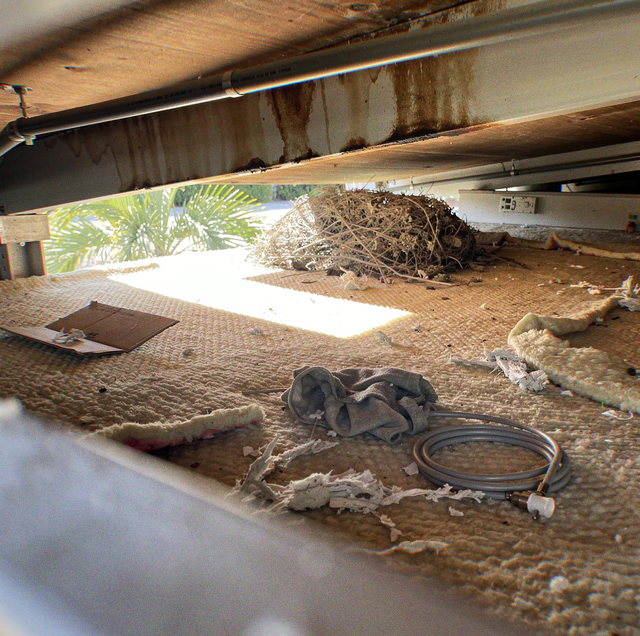
Quick Answer: Rats and mice carry their own fleas and mites, and those organisms live mostly in the nest rather than on the animal. When the rodent population is removed, extension sources describe the parasites left behind as seeking other blood sources.
The traps came out, the openings were closed, and the attic went quiet. Some time after that, the complaint changes. Nobody hears anything overhead anymore, but somebody in the house is getting bitten, often in a room with no connection to the attic, and the call sounds like a new pest problem entirely. It rarely is. What has surfaced is the back half of the job that just finished, and Texas A&M's urban entomology program describes the pattern in plain terms.
Passengers That Travel in on a Rat or a Mouse
A rodent that moves into a roofline brings passengers with it, and the nest is where they concentrate. Public health guidance groups them under indirect contact. The CDC writes that certain diseases "can spread from rodents to people through indirect contact," and that this "can occur when people are bitten by ticks, mites, fleas, and mosquitoes that have fed on infected rodents." The pathogen half of that sentence is handled separately in the article on attic droppings and health risk. What matters for a house that has just finished a rodent job is the organisms themselves, which stay behind whether or not they carry anything.
The mite most commonly associated with rats is the tropical rat mite, Ornithonyssus bacoti. University of California's urban entomology writers describe it as a blood-sucking nest parasite, and one "often associated with the nests and runways of roof rats and other commensal rodents."
Ticks, Fleas, and Mites Do Not Behave the Same Indoors
Grouping the three together names what can arrive. It is a poor guide to what becomes a household problem afterward.
Ticks appear on the CDC's indirect-contact list and do feed on rodents, but most species that do spend their off-host stages outdoors in vegetation and ground cover, which is a poor description of a tile roof void. The tick most associated with structures is the brown dog tick, and the CDC states that "dogs are the primary host for the brown dog tick in each of its life stages, but the tick may also bite humans or other mammals." A tick found points to the dog indoors more often than to the attic, even though fleas and ticks both sit inside general household pest work.
Mites sit at the other end: nest organisms first, and the group extension sources name specifically in connection with post-control complaints. Fleas carry properties of both.
Where These Organisms Sit While the Host Is Still There
While a rodent population is active, its parasites have no reason to go anywhere. Feeding happens on the animal, and the rest of the time is spent in nest material and along the runs the rodents use. A household living under an active population usually never encounters any of it.
Fleas make the split obvious. The eggs are smooth and fall off the animal rather than sticking to it, and the larval stage develops in protected, humid places out of the open. The immature population is in the debris, not on the rodent. The center of gravity of the parasite population is the nest, so removing the animal does not remove the population.
Do not enter the attic to look for nesting material or organisms. A Florida attic runs hot, footing is limited to exposed joists, and disturbing nest debris is the opposite of what public health guidance advises.
What Changes When the Rodent Population Is Removed
This is the part that gets skipped, and it is why a second complaint can still follow a well-run rodent job.
Texas A&M's urban entomology program states it directly: mite "infestations are sometimes first noticed following extermination, or after the natural hosts have died or left the structure." University of California's writers describe successful rat control programs leaving rat mites wandering nearby areas in search of blood, and note that where rats had been nesting in wall voids or living spaces, the mites left behind are drawn toward the people in the structure. The CDC describes the same behavior in another context, writing of plague epizootics that "many rodents die, causing hungry fleas to seek other sources of blood."
People are incidental in this. Rodent mites are not human parasites, and sources report that they bite people when their usual hosts are unavailable. Washington State University's extension fact sheet on tropical rat mites offers insight into how long the problem can persist, stating that once the host problem has been solved, rat mites can remain a problem for up to 2 months after the rats are removed. The practical consequence is that the parasite side of a rodent problem tends to outlast the rodent side instead of ending with it.
None of which argues against doing rodent work. It argues for expecting a second stage rather than treating a quiet attic as the last event in the sequence, and the same dispersal trigger applies to any host that stops being a host somewhere nobody can reach it.
How a Mite Complaint Gets Confirmed
A complaint about biting is not an identification, and the university sources here treat confirmation as a step separate from control. Mites are identified from a collected specimen under magnification rather than from what somebody is feeling, which is why extension guidance treats a captured specimen, not a description of the sensation, as the starting point for confirming a biting-mite complaint. What a bite means is a question for a clinician, not for a pest company.
What the Follow-on Work Actually Covers
Fleas and ticks are listed household pests on the service side, so that part of the follow-on is ordinary pest work. A confirmed rodent-mite complaint is scoped on a case-by-case basis once the host side is closed out, since the source is the nest rather than the room. Either way, the work is aimed at the living areas where people are being bitten and at the exterior conditions feeding the property.
Order is the whole point. Texas A&M puts the rule plainly, stating that the primary mite host must be eliminated before rodent or bird mite control can succeed. Treatment applied while rodents are still active is applied around a live source, which is why the rodent side is closed out first.
Sanitizing, insulation removal, and ductwork are not part of a pest control scope. Those go to a remediation or HVAC contractor, and anything showing rodent damage is a gloves-and-containment job for whoever holds that scope rather than a bare-handed one for the homeowner.
When you call about biting after rodent work, say so up front. A flea or mite complaint that arrives with a recent rodent history gets scoped differently than one that arrives with no history.
The useful details are all observable from living space: which rooms, what time of day, whether a pet is in the house, and when the rodent work finished.
Frequently Asked Questions
Flea development finishes inside the cocoon, and the University of California's guidance notes that "warm temperatures and mechanical pressure caused by walking on or vacuuming carpet stimulate emergence from the cocoon." Whoever opens a closed-up house and walks across the floor supplies it, which is why activity at a vacant property can arrive all at once on the day somebody returns.
Because the route these organisms take is the building's interior pathways rather than the shortest path. Washington State University's fact sheet on tropical rat mites sets the precondition first: it is when their normal hosts are killed that these mites travel long distances, often along pipes and wires in walls, or from tree branches to the outside of homes. A plumbing chase or a wiring run can start at a roofline void and end at a fixture well away from anything a rodent ever used. The room where biting gets noticed is often just the room where somebody sits still the longest.
It changes what the flea side can do. Extension sources identify the cat flea, Ctenocephalides felis, as the most common ectoparasite on domestic cats and dogs, and it also bites people. A pet is a host that can support a flea population on its own terms, so fleas arriving by way of a rodent nest have somewhere to go that people alone would not provide. A pet in the house changes what the flea side has to account for, which is why household makeup matters when scoping the complaint.
It closes the resupply. Once entry points are shut, no additional rodents arrive, and no additional parasite load comes in with them, which turns an open-ended problem into a bounded one. What it does not do is contain what is already inside. Exclusion closures are built for rodents, and copper mesh packed with polyurethane sealant is chosen because it resists gnawing, not because it is an insect-tight seal. A closure sized to stop a rat is not sized to stop something far smaller.
Because what triggers scheduling is the trap line going quiet, not a date on a calendar. A roof rat trap-out generally runs four to six weeks from the start of trapping, and the point at which catches stop across consecutive checks indicates the host population is gone. Follow-on treatment booked before that point is applied to a source that is still producing.
The mechanism is the same, and the named organism can differ. The house mouse mite, Liponyssoides sanguineus, is the species associated with house mouse infestations, while the tropical rat mite is associated with roof rats and other commensal rodents, so neither species belongs exclusively to a single rodent. Read the species as an indication of what is likely rather than as a rule. The practical difference is the window: a house mouse trap-out generally runs two to three weeks, so the point at which follow-on work is worth scheduling arrives sooner than it does on the roof rat side.
Have the rodent side and the parasite side handled as one sequence — the entry points closed, the population trapped out, and the flea and tick work run once the line is quiet. Buggify Pest Solutions serves Boca Raton, West Boca, and communities across Palm Beach and northern Broward. Call Tyler: (561) 672-0200.
