

What a Roach Exterminator Visit Includes, Start to Finish
You booked a roach treatment, and now there is a date on the calendar with no real idea what happens when the technician shows up. Does every baseboard in the house get sprayed? Do you need to empty the pantry? Is one visit going to fix a German roach problem that has been building behind the dishwasher for months? The first thing to know is that a roach job is not a single appointment. It is a three-visit sequence spread across roughly six weeks, and each visit exists to answer something the one before it could not yet settle. What follows is that sequence in order: what gets checked before anything is applied, where the bait actually goes, what the two return visits are looking for, and why having the same person on all three changes what those visits are worth.
What Gets Checked Before Anything Is Applied
A roach job does not start with a sprayer. It starts with figuring out which species is actually in your house, because a German roach infestation and an American roach infestation get treated differently, and treating the wrong one wastes your visit.
German cockroaches are small, light tan to brown, with two dark parallel stripes running down behind the head. They live indoors, in kitchens and bathrooms, and they reproduce quickly: a single female carries an egg case (an ootheca) containing roughly 30 to 40 eggs until just before they hatch. American cockroaches are larger, reddish-brown, and usually come from outside the house, entering through drains, gaps in the garage, or a cracked slab expansion joint.
The screening that separates the two happens before any product comes out:
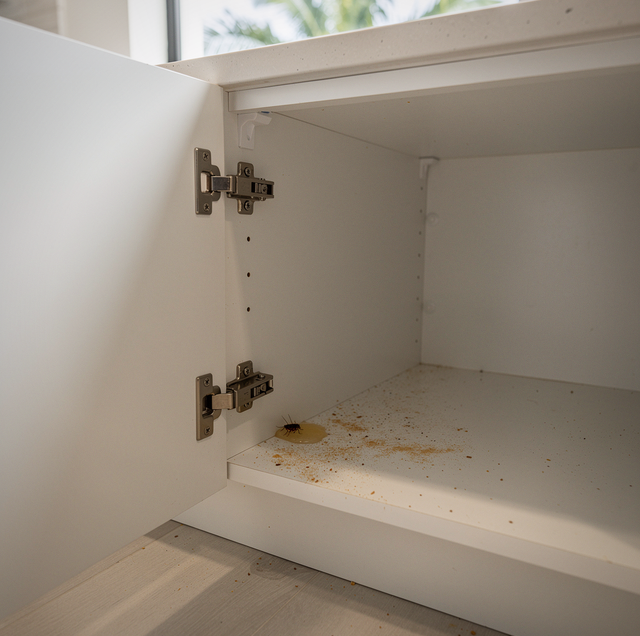
Frass in the corners: Pepper-fine droppings collected in cabinet hinges and along baseboard seams point to an active indoor German colony, not a single wandering roach.
Egg cases tucked behind appliances: Finding oothecae wedged behind the dishwasher kickplate or under the stove tells you the colony has been established long enough to reproduce there, not just passing through.
Live sightings in daylight: German roaches are nocturnal by default; seeing them moving in daylight usually means the harborage is overcrowded and roaches are being pushed out to forage in the open.
That screening determines where the crack-and-crevice work goes and whether outdoor perimeter work needs to be done during the same visit, instead of guessing and treating the whole kitchen the same way.
Before the visit, put pet food and water bowls away and clear kitchen counters. You do not need to bag pantry items or leave the home. Crack-and-crevice application keeps bait out of open, walkable spaces.
The Crack-and-Crevice Work and Where Bait Goes
Once the harborage is mapped, the placements follow the map. Professional gel bait goes into the cracks, hinges, and voids roaches are already using in your kitchen: behind the refrigerator compressor housing, inside cabinet corner hinges, under the sink where the P-trap meets the wall, and along the expansion joint where a slab garage meets the house. Each dab is small and sits down inside the void rather than on a surface, which is what makes the placement list from visit one something the technician can go back and read against reality two weeks later.
An IGR (insect growth regulator) goes down alongside the bait, into those same voids. Between the two, nothing about this job resolves on the day it is done. Bait moves through a colony over days rather than minutes, carried back by roaches that feed and then groom each other, and the growth regulator only becomes visible in what does not happen: nymphs that were present at treatment reaching the size where they should be producing egg cases, and not producing them. Both of those clocks run well past the first visit, which is why there are two more.
What the Week-Two Return Is Actually Checking
The second visit, roughly two weeks out, is not a fresh inspection. Your technician is checking the same placements made two weeks earlier: has the bait been fed on (a disturbed, partly consumed matrix versus an untouched one), and has activity concentrated in a spot that was not part of the original harborage map.
This is also the visit where you may notice more roaches, not fewer, in the days right after the first treatment. That is expected, not a sign the treatment failed. Roaches that would normally stay hidden get flushed out of harborage as bait and IGR disrupt the colony, so a brief uptick in sightings in the first week is a sign that the bait is working, not a new infestation starting.
At the two-week mark, placements get adjusted based on what actually happened, not what the original inspection predicted. If activity has moved to a cabinet that showed no frass on visit one, that cabinet gets bait now. If a spot is clearly dead, that placement gets left alone rather than re-treated for no reason.
The Four-to-Six-Week Confirmation and What Comes After
The third visit, typically four to six weeks after the first, is the confirmation check on your home: no fresh frass, no new oothecae, no live sightings in the previously active harborage. Because South Florida's humidity shortens a residual application's effective life to roughly three to four weeks, this window also aligns with when a lingering low-level colony would start showing up again if the first two visits missed something.
If activity has actually cleared, this visit is short: a walk-through of the same spots, confirmation, and a conversation about what the home's ongoing bi-monthly service will cover going forward, since South Florida does not have a real pest off-season and the recurring plan is what keeps a resolved roach problem from rebuilding. If activity is still present at this stage, rather than just the occasional straggler, it triggers a free re-service before the home moves to the standard 8-week cadence, handled as unfinished work on the original job rather than as a new problem.
Why the Same Technician on All Three Visits Changes the Result
The whole sequence works by comparing three snapshots of the same handful of harborage points, and that comparison is only as good as the memory behind it. A work order can record that bait went into a cabinet hinge. It cannot record that the hinge was already dusty on visit one, that the egg case was wedged in the left corner rather than the right, or that one particular spot never showed frass to begin with, which means an untouched dab there proves nothing.
A technician reading someone else's notes has the placement list and none of that context. The one who knelt in front of the crack has both, and that is the difference between "this placement was not fed on, move it" and "this placement was never going to be fed on, leave it." It is a fair thing to ask about when you book: whether the same person handles all three visits, or whether the week-six confirmation is made by whoever the route assigns that day, who compares your kitchen to a written summary of it.
Frequently Asked Questions
For an average single-family kitchen and bathroom footprint, the first visit runs about 30 to 45 minutes. A larger home, a multi-story layout, or a kitchen with heavy clutter around appliances adds time, since most of the visit is spent locating harborage rather than applying product.
No. Because the application is crack-and-crevice gel bait rather than a broadcast spray or fogging, there is no forced evacuation period, and normal household activity can carry on while the technician works in another room. Placements go down into cracks, hinges, and voids rather than onto open floors or countertops, so there is nothing sitting on a walkable surface to wait out; ask the technician whether any single placement is somewhere a curious pet can actually reach before the technician leaves.
A single nymph or two in the two weeks after confirmation is usually a leftover from an egg case that finished hatching after the adults were already gone; a German roach ootheca keeps developing on its own timeline once it is laid, even after the female carrying it is no longer active. What is not normal is finding a fresh ootheca again in a spot that had already tested clear. That is the specific marker that reopens the job for a free re-service, rather than a general "still seeing roaches" complaint.
They run as one continuous sequence rather than two separate schedules. The first visit, the week-two return, and the four-to-six-week confirmation address the existing colony; once that's confirmed clear, the home rolls onto the standard every-8-weeks schedule to keep new activity from establishing, since outdoor harborage sources never fully go away in this climate.
Turn off the aquarium's air pump or cover the tank opening while the technician is working nearby, as a precaution. Crack-and-crevice gel carries far less drift risk than a fogger or aerosol would, but it costs nothing to keep the tank's air intake closed for the few minutes the kitchen is being worked.
Two habits undo the work. The first is deep-cleaning the exact surfaces that were treated: scrubbing out cabinet interiors, hinge gaps, and the void behind an appliance strips the bait back out before the colony has finished passing it around. Ordinary counter and floor cleaning is fine; the hinges and voids should be left alone. The second is reaching for a store-bought aerosol when you see one and spraying near a placement. Most consumer sprays are repellent, so roaches that would have fed on that dab now route around the whole area, and the placement sits untouched while the colony shifts into a void nobody has mapped.
If you want one thing to watch on your own between visits, watch the placements rather than the floor. A dab that has visibly shrunk two weeks on means the colony found it and is carrying it. A dab still crisp and untouched in a spot that had frass on day one is the single most useful thing you can point out when the technician comes back, because it usually means the harborage moved, and it moved somewhere nobody has looked yet.
Schedule your roach inspection — Tyler will map the harborage and walk you through the full visit sequence before any product goes down. Buggify Pest Solutions serves Boca Raton, West Boca, and communities across Palm Beach and northern Broward. Call Tyler: (561) 672-0200.
