

Wasp Nest by Your Front Door? Do This Before You Get Stung
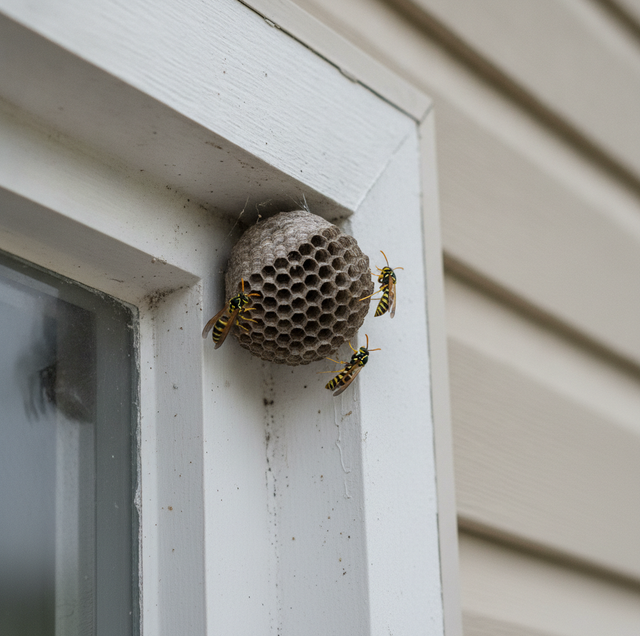
You reach for the handle and notice the movement first: a few wasps drifting in and out of a papery gray comb tucked up in the door frame, or worked into the corner of the eave right above where everyone walks in. Maybe two of them, maybe a dozen, crawling over a nest the size of a golf ball or a fist. It is inches from the door you use fifty times a day, and every trip in and out now feels like a gamble.
A nest by an entry is usually manageable if you slow down. The wrong move, swatting it, blasting it with a can, or bumping it on your way past, is what triggers a defensive swarm. What to do depends on which wasp built it and where. Start with the steps below, then match the nest to the species table.
What to Do Right Now
- Keep the door area clear and use another way in: For a day or two, route foot traffic to the garage or a side door, and tell everyone in the house the nest is there, so no one fumbles with keys directly under it.
- Do not swat, spray blindly, or knock it: A single squashed wasp releases an alarm scent that tells the rest of the nest to defend it. Waving your arms, slamming the door, or hitting the nest with a broom reads as an attack. Move calmly and give it a wide berth.
- Note the nest type and location from a safe distance: Stand back several feet and look. Is the comb open and umbrella-shaped with the cells showing, or a closed gray ball? Is it hanging in the open, or are wasps streaming into a gap, a weep hole, or a soffit vent? Those details determine everything, and they are the first thing a pro will ask about.
- Keep kids and pets well away: Children reaching up and dogs snapping at low fliers are the most common way a calm nest turns into stings. If the nest is low or near a walkway, block the area off until it is handled.
- Plan the removal for dusk, or call a pro: Wasps are least active and most of the colony is home after dark, the only sensible time to handle a nest yourself. If it is enclosed, hidden in a void, high on a ladder, or you have any reason to worry about a reaction, skip the DIY and have it removed.
Before You Try to Handle It Yourself
A nest by the front door carries real risk, and it is worth knowing where the danger actually sits before you decide to take it on.
Wasp and hornet stings send people to emergency rooms every year, and you do not have to be a known allergic to be at risk. If anyone stung develops hives away from the sting site, swelling of the lips or throat, trouble breathing, dizziness, or a rapid heartbeat, treat it as a medical emergency and call for help immediately. If someone in the home carries an epinephrine auto-injector for insect stings, know where it is before you go near the nest.
Two more hazards catch people off guard. The first is the ladder: many serious wasp injuries near a doorway are not the stings, they are the fall that follows when someone gets hit while balancing over the porch steps. Spraying overhead one-handed from a ladder is how a manageable nest becomes a hospital trip. The second is the urge to seal the opening. If wasps are going into a wall void, a soffit, or a weep hole, do not caulk or foam it shut. Trapped wasps chew toward the light and cooler air, which often means chewing through into your living space, so you end up with wasps in the hallway instead of on the porch.
Which Wasp Is It, and What Does That Mean
The single most useful thing you can do is figure out what built the nest, because the four common culprits behave very differently. Look from a distance and match the nest and the behavior.
| Wasp | Where it nests | How defensive | What it means for you |
|---|---|---|---|
| Paper wasp | Open, umbrella-shaped comb with visible cells, under eaves, door frames, porch ceilings, and patio furniture | Moderate; defends the nest if you get within a few feet or disturb it | The most common front-door nest. A small one can be removed at dusk with care, but its spot right over the door is what makes it a problem |
| Yellow jacket | Hidden: a hole in the ground, a wall void, or a gap where you see a steady stream of wasps coming and going | High; stings repeatedly and recruits the colony fast when disturbed | The one to respect most. If wasps pour into a gap rather than tending an open comb, do not treat it yourself |
| Bald-faced hornet | Large, closed gray football or teardrop nest with a papery shell, in shrubs, trees, or against an eave | High; very protective and defends a wide radius | An enclosed aerial nest near an entry is a professional job. Its size and defensiveness make DIY a bad bet |
| Mud dauber | Slender mud tubes or a lumpy mud blob stuck to a wall, ceiling corner, or eave | Very low; solitary and rarely stings even up close | Mostly harmless and actually hunts spiders. If it is truly a mud nest, you can usually scrape it off once it is empty |
The practical dividing line is open comb versus hidden colony. A paper wasp tending an exposed comb is a known quantity. Wasps disappearing into a void or the ground means a colony you cannot see the size of, and those produce the coordinated stinging people picture when they imagine a wasp attack. Guessing wrong is how a quick evening job turns into a swarm, which is why a hidden or enclosed nest by a doorway is worth handing to a pro.
After It Is Handled, and Keeping the Next One Away
Once a nest is gone, knock down the empty comb or scrape off the old mud tube and wipe the spot. Wasps do not reuse an old paper nest, but a leftover comb marks a proven sheltered site, and a new queen may build within a few inches of it.
Preventing the next nest is mostly the calendar and the caulk gun. New queens look for sheltered nooks to start a comb, and a recessed door frame, a porch ceiling, or a soffit corner is prime real estate. Check those spots every few weeks and knock down any nest while it is still the size of a nickel and holds one lone queen, a far easier job than a mature colony. When activity is low, seal the gaps that let yellow jackets into wall voids and soffits, but confirm the space is empty first so you are not trapping a colony inside. Warm weather drives the heaviest nesting, yet in a mild climate, wasps stay active well beyond summer, so a doorway nest is not strictly a hot-weather problem. Cover trash cans and clean up fallen fruit and sugary spills near the entry, too, since those food sources pull scavenging yellow jackets toward the door.
Frequently Asked Questions
Look at the material and the traffic. Wasps build from chewed wood pulp, so the nest looks like gray or tan paper, either an open comb or a smooth closed shell. Honey bees build waxy combs inside a cavity, such as a wall or hollow tree, with hundreds of fuzzy, rounded bodies in a dense cluster. Wasps look sleeker and shinier with a pinched waist. It matters because honey bees are protected pollinators handled by live removal rather than knockdown, so if it looks like a bee colony, do not treat it as a wasp nest.
By an interior wall or a back fence, often yes, especially a mud dauber or a small paper wasp comb. Directly over the front door is the exception. A nest everyone passes within arm's reach of, day and night, is far more likely to be bumped, and it only grows and gets more defensive as the colony builds through the season. The location, not the current size, is what makes a front-door nest worth dealing with early.
After dark or in the first light of dawn, when temperatures are cooler and nearly the whole colony is inside and sluggish. Midday is the worst time, because foragers are out and the ones you do not treat come home to a disturbed nest looking for something to sting. Never point a flashlight beam directly at the nest while you work, as wasps fly toward the light and up the beam toward you; set a light off to the side instead.
A protected overhang, a recessed frame, or a soffit corner offers shade and shelter from rain and wind, exactly what a founding queen wants. The spot itself is the draw, not any scent left behind, though an old comb flags the site as usable. Changing the nook helps: screen a soffit vent, move the porch light away from the door so it stops drawing the insects, wasps hunt, and clear the old nest so the corner does not look pre-approved.
They are hit or miss. Baited traps can thin out foraging yellow jackets, but do nothing for an established nest, and a poorly placed one can draw more wasps toward the door than it catches. Decoy paper nests bank on wasps avoiding a rival colony, with inconsistent results. Neither replaces removing the nest already there. If you use a trap, hang it well away from the door you are protecting, not next to it.
That is a void-nesting colony, almost always yellow jackets, and the scenario to leave alone. You cannot see how large it is, sealing the entrance drives them inward toward your living space, and a wrong move at the gap can bring the whole colony out at once. Treating a void nest correctly means reaching the colony through the existing opening with the right product and equipment, then leaving the hole open until all activity stops. This is the clearest case for a professional.
Get a wasp or hornet nest by your door removed the right way, before someone gets stung — a licensed technician identifies the species, treats the colony safely, and handles void nests without sealing them in. Buggify Pest Solutions serves Boca Raton, West Boca, and communities across Palm Beach and northern Broward. Call Tyler: (561) 672-0200.