

Mosquitoes Inside the House: The Source Is Outside
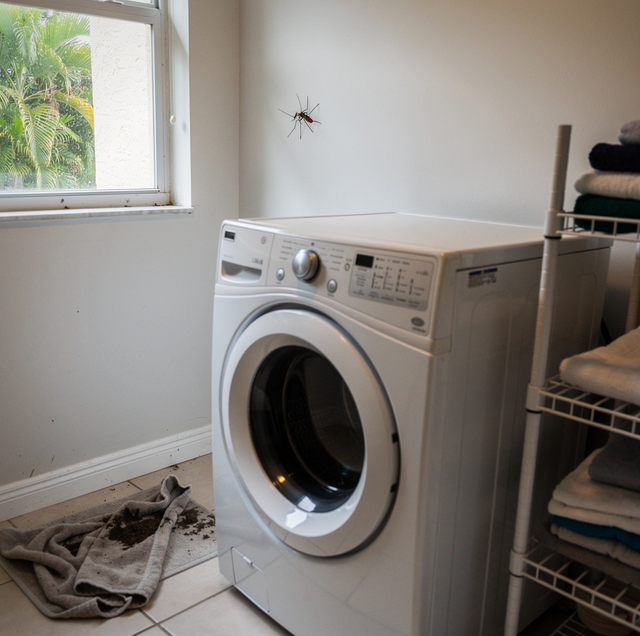
Quick Answer: Mosquitoes found inside a house are almost always chance visitors from breeding and resting sites outside. Indoor spraying kills what's already in the room but does nothing to reduce the outdoor population sending in the next one.
A single mosquito resting on the wall behind the laundry room door does not look like much of a threat. It sits still, wings folded, in the one room of the house that stays dim and humid most of the day. You swat it, or you miss, and by evening there is another one near the hallway linen closet where the light rarely reaches. Neither insect started its life in that room. Both flew in from somewhere on the property, and until that somewhere gets found, a new mosquito takes the last one's place.
Indoor Sightings Cluster in Rooms With Still, Humid Air
Bathrooms, laundry rooms, and dark interior hallways are the rooms you will name if someone asks where you keep finding them. That pattern is not random. Once a mosquito gets past your exterior wall, it looks for the conditions it had outside: shade, still air, and enough humidity to avoid drying out. Your bathroom a few hours after a shower, your laundry room with a damp floor mat, and the hallway your air handler barely reaches each hand in that combination.
Your kitchen and your living room carry more foot traffic and more moving air off a ceiling fan, so a mosquito that lands in either one rarely settles long enough for you to see it. You can go weeks assuming the house is fine and then start turning up two or three a week in the same back bathroom. They were almost certainly getting in the whole time. They were simply not stopping anywhere you would have looked.
One mosquito found once is rarely worth much concern. A pattern concentrated in the same one or two rooms, especially rooms near an exterior door or your garage entry, is a different signal. It tells you the entry point feeding that room is still open, and locating it is the whole job. Treating the room changes nothing.
A Mosquito Indoors Almost Always Came in Through an Open Door
Of all the ways a mosquito ends up inside your house, the most common is the simplest: it flew or walked in while a door stood open. Your garage door raised while you unload groceries, your front door propped for a delivery, your slider left cracked for the dog- each one hands it an opening during the hours mosquitoes are most active near dusk and dawn.
Your garage entry deserves particular attention, because a garage is rarely sealed as tightly as your living space, and a mosquito that gets in there in the evening often has hours to work its way through an interior door before anybody notices. The same goes for the side door you use for yard work and trash, which stays open a good deal longer than your front entry ever does. Door traffic explains most of your single-mosquito sightings on its own, with no structural failure anywhere else in the house.
Smaller Gaps Account for the Rest of the Entry Points
The ones that are not coming through one of your doors are coming through openings you have never thought to check. Weep holes along your brick or stucco veneer exist to let moisture drain from behind the wall, so they are sized for water and were never sized to hold an insect out, and older construction often leaves them unscreened. A dryer vent flap that no longer closes flush, the gap where a cable or an irrigation line passes through your exterior wall, and attic or soffit vents with mesh too coarse for a small flying insect all work the same way on you: a passage sized for airflow that happens to work for a mosquito.
The gap under an exterior door, especially where your threshold sweep has worn down, or the slab has settled a little, is common enough that an inspector checks it on nearly every visit. So are the utility penetrations behind your outdoor spigot and your electrical meter.
A window or door screen with a small tear near the frame, or one that was never seated flush in its track, belongs on the same list. From a few feet away it looks intact to you, and it still leaves an opening a mosquito can work through. What separates a house with an occasional mosquito from one with a recurring pattern is usually how many of these smaller gaps line up with a room where your humidity and your shade already are.
The Insects You Found Came From Sites You Cannot See From Indoors
Every mosquito that makes it through your door or a gap in your wall started its adult life outside, and most started as larvae in standing water you would walk straight past. Aedes mosquitoes, the group most often behind the ones you find resting indoors in daylight, need only about half an inch of standing water to finish a breeding cycle. A clogged section of your gutter, a tarp with a low spot in it, a plant saucer, or a toy left out after rain will each hold that much for days at a time.
Once they emerge as adults, mosquitoes spend roughly 23 of every 24 hours resting on foliage rather than flying. The shaded shrubs, ground cover, and broad leaf undersides against your walls work as a staging area, and a mosquito sitting there through the day is close enough to slip in the next time you open a door. Your house is not producing any of it. It simply sits close enough to a producing site for a share of the adult population to find its way inside. If you are seeing them often enough to notice a pattern, your property is probably carrying more than one small water source and more than one patch of resting habitat, working together on you.
Treating the Room Where You Found One Does Not Reach the Ones Still Outside
It is a reasonable instinct to want the bathroom or the hallway sprayed, since that is where you keep finding them. It is also the wrong target. An indoor application reaches whatever is already inside your walls at the moment it goes down and nothing else. It does not touch the resting adults on your foliage, the larvae developing in your gutter or your plant saucer, or the mosquito that comes through the same door tomorrow evening.
When an inspection traces your sightings back to an outdoor source, which is what happens in the overwhelming majority of cases, indoor treatment usually gets ruled out entirely. There is little reason to treat your bathroom or hallway when the insect responsible never spent a day of its life in either.
An Inspection Traces the Route Backward, From the Wall to the Yard
A useful inspection runs the opposite direction from the way the mosquito traveled. It starts in the room where you keep finding them, checks the nearest doors and the gaps in that stretch of your exterior wall, then works outward to the vegetation, the containers, and the low spots sitting within flight range of that wall. If your property includes a screened lanai or a pool cage, that space gets read on its own, since a mosquito turning up inside an enclosure involves a different set of entry points than one turning up in your kitchen.
Two things usually need to be handled once your source is confirmed. Clearing or treating the standing water and the dense resting vegetation cuts the population producing new adults, and that reduction plays out across roughly two to four weeks while the breeding cycle already underway finishes out. A barrier treatment on the resting habitat handles the adults already sitting on your property, so you are not waiting a month before anything changes.
Frequently Asked Questions
Both are uncommon, and they turn out to be the same short list. Mosquitoes need standing water to complete a life cycle, and your interior almost never holds water consistently enough for that. The exceptions an inspector checks are a saucer under a houseplant that stays wet longer than the soil needs, and a floor drain whose trap has gone dry. That trap normally holds a small column of water as a seal against the pipe behind it; once disuse causes the seal to evaporate, you have both a possible entry point from the plumbing and a spot that no longer behaves like the rest of your drains. Outside those two, essentially everything you find resting indoors flew in as an adult.
More often than a floor drain, yes. A garage refrigerator or chest freezer with a drip pan underneath, a dehumidifier bucket sitting between emptyings, and a laundry-room utility sink whose trap only sees water every few weeks all hold small volumes of still water in a warm, shaded space nobody walks through. Aedes needs only about half an inch, which any of those can hold for days at a time. A garage also sits between your yard and your living space, so an adult emerging in there has only an interior door left to work through. That is one reason garage-adjacent rooms come up so often when people describe where they keep finding them.
Mosquitoes key in on carbon dioxide and body heat to find a host. Proximity to an entry point is a much weaker signal than either. A room where you sit still for long stretches, a home office or a reading chair near a window, gives a mosquito more time and a stronger cue to work with than a room you only pass through. Your entry rate may be about the same all around the house; your bites concentrate where you hold still longest.
It does, and what does the work is time, not mesh. A single exterior door hands a mosquito the entire opening for as long as you stand in it. A screened front porch, an entry vestibule, or any arrangement where you pass through one door, let it shut behind you, and then open a second, leaves it caught in a few square feet of enclosed space with a second opening it has to locate on its own in the seconds before that one closes too. Most never manage it. The same reasoning explains why your garage is the worst opening on the house: it is the largest, it stays up the longest, and the interior door usually gets opened while the big one is still coming down. Letting the garage door finish its travel before you open the kitchen door gives you the same two-door sequence, but it takes a few extra seconds.
Generally not, though the evening feeders are worth understanding. Species that peak around dusk are most active in exactly the hours you are heading back inside, so one following you through the door at sunset and turning up on a bedroom wall that night is a common pattern even in houses where daytime sightings are rare. Anything you find resting on an interior wall mid-afternoon belongs to the population already active in your yard, simply passing through and not adapting to indoor life.
Not usually for long. Your interior lacks the humidity and the nectar sources adult mosquitoes rely on between blood meals, so one that gets trapped inside tends to die off well before it would outdoors, or it works its way toward a light source and an open door or screen edge looking for a way out. If you are seeing one every few days in the same room, that is a repeat entry point handing you new insects. One long-lived mosquito is not making the rounds of your hallway for a fortnight.
Have the outside of the house read first — the door, the gaps in the walls, and the water sitting within flight range of the room they keep turning up in. Buggify Pest Solutions serves Boca Raton, West Boca, and communities across Palm Beach and northern Broward. Call Tyler: (561) 672-0200.
