

Spider Control for Restaurant Patios: What Actually Works
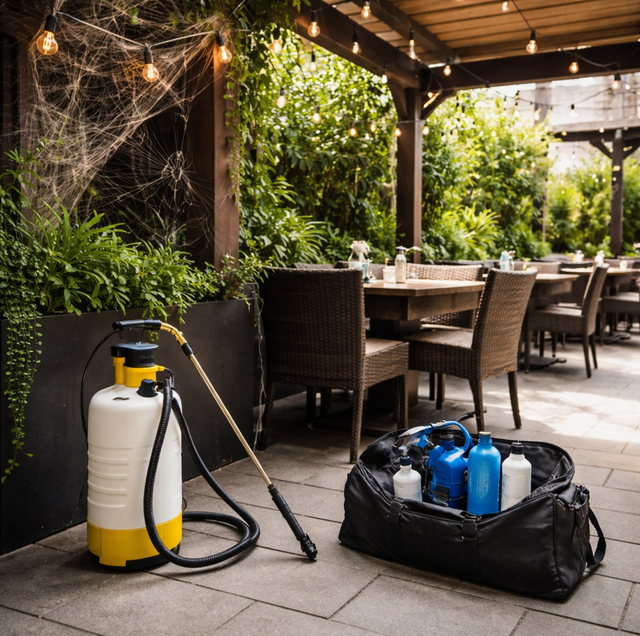
Quick Answer: A restaurant or retail patio needs a plan built around business hours, discretion, and food-service-safe product placement, not a homeowner's routine scaled up. Ask about technician continuity, scheduling flexibility, and how return visits between scheduled service are handled.
A web strung between two chair backs at a private home gets swept away with a broom before anyone thinks twice about it. The same web strung between two chair backs on your patio gets photographed by the party being seated next to it. The insects that build it don't know the difference between a homeowner's lanai and a paying customer's table, but what's riding on it is not the same, and the plan for controlling it shouldn't be either.
The Same Draw, a Different Set of Stakes
Spiders don't show up on a patio because something went wrong. They show up because the patio is doing exactly what it was built to do: it's lit after dark, it holds people and food, and it sits outside where flying insects gather. String lights strung over a dining area, sconces at a host stand, and even a lit sign draw moths, small flies, and other night-flying insects the same way a porch light does at a house. Orb weavers and cobweb-building species read that draw and set up where the prey traffic is heaviest, which is usually the exact fixtures, umbrella ribs, and railing corners closest to the light.
Water plays a supporting role. Planters, self-watering troughs, drainage lines from an ice machine or bar sink, and any low spot that holds runoff after a rinse-down all keep the surrounding air and greenery humid enough to support insect activity through the evening, which keeps the web-building going in the same spots night after night.
None of that is different from what happens at a house with a lit lanai and a few potted plants. What's different is who notices first. At a home, a web across a doorway is something the resident deals with on their own schedule. On a patio, it's something a seated guest sees before a manager does, on the one visit that guest will make. That's the real reason a restaurant or retail patio needs a plan built around the space's actual traffic and layout, not a scaled-up version of a homeowner's service.
Why Service Timing Works Differently for a Business
A residential technician can usually work around a house whenever the appointment lands. A homeowner might not even be there. A patio operator doesn't have that flexibility, and the reason isn't cosmetic.
Service during open hours competes with the dining room: A technician moving through a seating area during lunch or dinner service has to work around servers, guests, and the flow of the floor, which slows the visit and puts equipment and product application in the same space as people eating. Scheduling around open hours instead of during them solves that before it becomes a problem.
Discretion matters more than it does at a house: A homeowner rarely cares if a neighbor sees a pest control vehicle in the driveway. A patio operator generally does care whether guests walking up to the host stand see a technician working the railing with a sprayer mid-shift. A provider should be able to say clearly whether they can offer an early-morning, late-night, or between-shift window; confirm which ones before booking, since not every provider covers all three.
Layout familiarity saves real time on a commercial account: a patio has a specific arrangement of string-light runs, umbrella bases, planters, and drainage points that changes as furniture gets rearranged or seasonal decor goes up. A technician who has already walked that layout moves through it faster than one seeing it for the first time, which matters more on a property paying for a repeat visit rather than a one-off call.
Ask a prospective provider directly how they schedule commercial accounts around service hours, and whether the same technician returns each visit or the account gets whoever is on the route that week. The answer says a lot about how the rest of the relationship will run.
Food-Service-Safe Product Placement
The biggest practical difference between a home and a patio is what sits a few feet from where product goes. A residential lanai doesn't have a bar rail, a host stand, or a table where a plate is set down twenty minutes later. A patio does, and that changes both what gets used and where.
Spiders respond differently to treatment than crawling insects like ants or roaches. Many web-building species aren't walking across a treated surface the way a roach crosses a baseboard, so a residual barrier alone often does less than a combination of tactics: physical removal of webs and egg sacs with a pole or brush, a targeted crack-and-crevice or exterior perimeter application away from food and beverage contact surfaces, and reducing the flying-insect draw that keeps bringing spiders back to the same fixtures. That combination keeps product off tabletops, bar rails, and anywhere a napkin or a hand might land, while still addressing the parts of the structure, planters, umbrella poles, railing joints, and light fixtures, where webs actually form.
Whatever gets applied near a dining or beverage-service area should be used strictly according to its label directions and kept to label-compliant, food-service-appropriate placement, meaning exterior surfaces, cracks, and fixture bases rather than open dining surfaces. This is the same pet-safe and family-safe-by-default standard that applies to a home treatment, extended to a setting where a stray placement has consequences a residential yard doesn't: a bar top, a host stand, or a table a customer's hand will touch. A provider should be able to explain, without hedging, exactly where product goes and why, before the first visit.
What to Ask Before You Hire a Provider
A hiring decision for a patio account is a different conversation than picking the first provider who answers. Technician continuity, state licensing and liability coverage, and how a provider diagnoses before treating are worth a quick confirmation, but they don't separate a commercial account from a residential one the way the questions below do.
Will they work a window between shifts, not just before open or after close? A patio running lunch through late dinner may not have a clean gap on either end most days. A provider who only offers early-morning or late-night slots is describing a residential schedule, not a commercial one.
Does the same technician cover every visit, or does the account rotate? Continuity means less time re-explaining the layout and fewer surprises about who's walking through the dining area during service.
Who gets the report after each visit, the GM, the owner, or a property manager? On an account with more than one manager on rotation, a report that goes to whoever happened to be on-site that day gets lost. Ask who's on the list and whether it stays consistent visit to visit.
Do they document what was applied and where? A written record of product, location, and date matters for an operator's own files, particularly for anything applied near a bar rail, host stand, or kitchen entrance.
If it's a multi-location account, how do they keep scheduling and technician assignment consistent across sites? A provider serving several locations for the same operator should be able to describe how that stays uniform, not just how it works at one address.
Ask what triggers a return visit between scheduled ones and how fast a provider typically responds, before signing on. None of these questions require a pest-control background to ask. They just require treating the decision like the commercial contract it is, not a residential add-on.
What Sets a Commercial Patio Apart
The insects don't know they've moved from a residential lanai to a business. The lighting, the water sources, and the web-building behavior work the same way in both places. What changes is who's watching, how much flexibility there is around scheduling, and what sits close enough to the work that product placement stops being a minor detail and starts being part of the decision. A provider who treats a patio account like a slightly bigger house is missing that. One who asks about your open hours before proposing a plan, and can explain exactly where product goes near a bar rail or a host stand, is the one actually built for the account.
Frequently Asked Questions
Most of what builds visible webs on a lit patio, orb weavers and common cobweb-building species, is a nuisance rather than a hazard; they're not aggressive and rarely bite unless handled directly. The species worth watching for is the brown widow, which tends to hide rather than web in the open: check stacked chairs, folded umbrellas, planter drainage holes, and the underside of tabletops before a guest or staff member reaches into one of those spots.
A lit, food-service patio usually carries a heavier prey-insect draw than a residential yard, which is why a commercial account often needs a tighter interval than the every-8-week cadence a residential property runs on here, not the quarterly schedule that works fine in a climate with a real winter. The right interval still depends on how much lighting and water the specific property has, which a provider should assess on the first visit rather than propose before ever seeing the space.
Properly applied product shouldn't stain fabric or finished surfaces, but the risk depends on the form used. A liquid barrier applied to porous decking or unfinished wood can leave a mark if it's overapplied or applied too close to a surface it wasn't meant for; dust and gel formulations placed in cracks and fixture bases carry essentially no risk of staining because they never touch an open surface. Ask what form is being used near furniture and finished decking specifically.
Yes, and it's often the more effective lever. Bulb color plays a real role here: warmer, amber-toned string lights and sconces draw noticeably fewer night-flying insects than cool white or blue-spectrum bulbs, because insects are more strongly pulled toward the shorter wavelengths in cooler light. Swapping bulb temperature on patio lighting is a low-effort change that shrinks the prey base spiders are building webs to reach, on top of whatever direct treatment is scheduled.
Spiders follow prey through the same gaps ants and roaches use: door sweeps, threshold gaps, and cracks around conduit or plumbing lines, so an indoor area a few feet from the patio door is worth checking even though it isn't outdoor space. A provider inspecting a patio account should consider the interior-exterior interface as part of the same visit, not as a separate call.
Most providers schedule commercial visits to finish before the space reopens to guests, specifically so product has time to dry or settle undisturbed before anyone sits down. Staff generally don't need to be pulled off shift for it, but it's worth asking a provider directly how they sequence a visit around your particular open and close times so nobody's caught off guard by a technician working the railing during setup.
If your patio needs a spider plan built around service hours and food-service placement, not a residential routine scaled up — get a walkthrough and a schedule scoped around your service hours. Buggify Pest Solutions serves Boca Raton, West Boca, and communities across Palm Beach and northern Broward. Call Tyler: (561) 672-0200.
