

Mosquito Misting System vs Monthly Service: The Real Difference
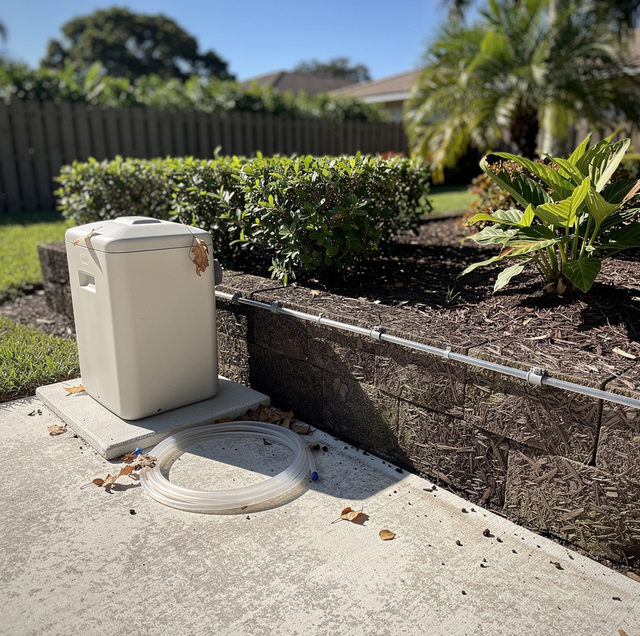
Quick Answer: A misting system automates coverage across a fixed zone on a timer. A recurring service targets the resting mosquito population throughout your property, including areas no misting line reaches, and adjusts as your plantings change.
Say a landscaper or pest company has just proposed an installed misting system, complete with a tank, tubing, and nozzles staged along your fence line and planting beds. Before you commit, you want to know how that system actually compares to hiring someone to walk your property on a schedule and treat it by hand. Both approaches aim at the same insect. They do not work the same way, target the same population, or ask the same things of you once they're running. Here is what each one actually does, dimension by dimension, so the decision comes out of your property and how you use it, with no sales pitch from either side doing the work for you.
What a Misting System Actually Does
An installed system runs a reservoir of insecticide through tubing to a series of nozzles set along a fence line, planting bed, or patio perimeter. On a timer or triggered on demand via a remote or app, it releases a fine spray at set intervals without anyone needing to be present or schedule anything. That automation is the real appeal: coverage that fires on its own, available whenever you decide to use the outdoor space, with no visit to plan around. For a property that often entertains in one defined zone, that convenience is a clear advantage, and it deserves to be named plainly.
The system doesn't distinguish between an evening you're hosting a dozen people on the patio and a Tuesday when no one is outside at all. It fires on the schedule it was set to, or on the trigger you activate, whether or not the zone actually needs treating right then. That indifference is the trade: predictable coverage, applied whether the evening called for it or not.
What a Recurring Service Actually Does
A recurring service is a technician-performed visit on a set schedule. Nothing fires into open air on its own. A technician walks your property, works in among your beds and hedges, and treats the vegetation, mulch, and structure perimeter where the mosquitoes on your lot spend their day. What gets treated is the surface the insect sits on, not the air a few feet above your lawn, and the ground covered is whatever the technician can walk, which on most properties means your side yards, fence rows, and tree line come along with your patio. If your plantings change between visits, the next visit accounts for them because someone is looking at your yard each time and can see what grew in. How often that visit should repeat through your year is a separate decision.
What Each One Targets: Airborne Adults or the Resting Population
This is where the two approaches diverge most. Mosquitoes spend roughly 23 of every 24 hours resting on foliage rather than flying, and the resting population sitting on that vegetation at any given moment is many times larger than the handful of adults you actually notice biting. A misting system fires into the open air on a schedule or on a trigger, so it knocks down whatever is airborne in the zone at that moment. Deposition onto the surrounding foliage is incidental to how it works, and the underside of a leaf is the surface it is least likely to reach. A treatment aimed at that resting population, by contrast, is applied as fine droplets that reach the underside of foliage where mosquitoes actually spend most of their time.
Coverage and Where Each One's Edge Falls
Coverage from an installed system is determined by where the tubing was routed and where the nozzles were placed. That's a real strength for a specific purpose: a patio, a pool deck, an outdoor kitchen, anywhere you want dependable coverage without thinking about it. Its edge is just as real, though. Once you step past the nozzle line, coverage ends. A recurring service doesn't have a hard edge in the same sense, since the technician treats wherever the property extends, including side yards, fence rows, and tree lines a fixed system was never routed to reach.
Think about how the two answer a simple question: what happens at the far corner of the yard, or along a side fence the original installer never routed tubing toward? A misting system's answer is nothing, because nothing was installed there. A recurring visit's answer depends only on whether the technician walks that ground, which a whole-property visit is built to do as a matter of course.
| Dimension | Misting System | Recurring Service |
|---|---|---|
| What it is | Installed hardware (tank, tubing, nozzles) that releases automatically on a timer or trigger | A technician-performed visit on a set schedule |
| What it targets | Airborne adults present in the zone at the moment it fires | The resting population on foliage, mulch, and structure |
| Coverage | A fixed zone defined by where the tubing was routed | Wherever the technician walks the property |
| What it depends on | The reservoir, nozzles, and timer staying maintained | The technician returning on schedule |
| Water sources | Not addressed by the system itself | Can be paired with a breeding-source audit |
| Best suited to | A defined entertaining zone that wants automated, on-demand coverage | Whole-property coverage without owning hardware upkeep |
What Each Approach Depends on to Keep Working
An installed system only does its job if the reservoir stays filled, the nozzles stay clear, and the timer stays set correctly as your routine changes. Someone has to keep an eye on all three, and on most properties that someone is either you or the company that put the system in.
A misting system's reservoir holds concentrated insecticide, and the tubing and nozzles run through planted beds where children and pets pass daily. Leave any inspection, refill, or repair to the installer who services it.
A recurring service depends on something simpler: the technician showing up as scheduled. Weather, especially heavy rain, wears down an outdoor application over the course of a cycle, and the repeat visit is meant to address that wear. How quickly a treated population rebounds after a visit, and how that compares between turf and foliage, are worth understanding in their own right.
What Each Approach Does About Standing Water
Neither approach is primarily built around breeding sources. A misting system treats adults in the air; it has no water component at all. A recurring service can be paired with a breeding-source audit, and what that audit turns up is largely what a fixed nozzle line was never routed to reach in the first place: a plant saucer or a gutter section well outside the treated zone, quietly feeding the population both approaches are otherwise managing on the adult side. Where those sources tend to hide on a typical property is a longer subject than this comparison needs. Any outdoor application, whichever approach you choose, also involves non-target considerations that timing and placement help manage.
Who Each Approach Suits and What Drives the Decision
An installed system suits a property owner whose priority is a defined outdoor zone, who entertains often enough that automated, on-demand coverage matters day-to-day, and who is prepared to maintain the hardware or arrange for someone else to do it. A recurring service suits someone whose actual use of the yard spans more than one zone, who wants the resting population addressed across the whole property, and who would rather hand that responsibility to a technician than track a reservoir and timer.
Getting started looks different too. An installed system needs the hardware in place before it can run at all, so there's a setup stretch between deciding on it and having working coverage. A recurring service typically begins with the next scheduled visit, since there's nothing to install first.
It depends, and it depends specifically on how you use the property and what you're trying to prevent. A fixed zone with automated coverage and a whole-property visit that targets where mosquitoes actually rest are not solving identical problems, and knowing which problem matters more to you is most of the decision. How far a mosquito actually travels from where it hatched also shapes how far any treatment needs to reach, which is a subject of its own.
Frequently Asked Questions
As your shrubs and canopy grow up around a fixed nozzle line, new growth blocks or redirects the spray pattern the system was set up to cover. A zone that was fully covered the week it was installed can develop gaps a few seasons later without the hardware itself changing at all. You, or someone you have asked to look, has to notice the new growth and account for it, because the system will not flag the change for you.
It keeps firing on its timer whether or not anyone notices a problem. If your reservoir empties or a nozzle clogs while the house sits closed up, the timer keeps running right on schedule and the zone gets nothing, which from the outside looks identical to coverage continuing. Nothing in the setup flags a dry tank for you, so the gap runs until someone checks it directly, and that could be the week you get home. A scheduled visit does not depend on your being present, so the next stop catches what the timer could not catch.
Pulling out beds, replacing a hedge line, or regrading along the fence means someone is digging directly over buried supply tubing, and a cut or crimped line will not announce itself the way a broken irrigation head does. It is worth having the installer walk the zone with your landscaper before the work starts, and worth a second look once your new plantings are in, because a nozzle aimed at a shrub that no longer stands there is filling a very different volume of air than the one it was set for.
The hardware stays with the property, but the arrangement behind it does not travel with the keys. If you are the one buying, who monitors the tank, refills it, and keeps the nozzles clear becomes your question the day you move in, and you may not learn any of it from the previous owner. A recurring service is simpler on that front: it is a relationship you choose to start or not, with no hardware to inherit either way.
It does, and the system has no way to read it. A fine spray released into open air goes where the air is going, so a breeze moving across your yard at the moment the nozzles fire can carry a good share of the output well past the patio you meant to cover, while a still, heavy evening lets it settle close to the line. Your zone on paper stays the same size every night. In practice, your zone moves with conditions you do not control. A technician placing an application by hand can see which way the foliage is moving and work with it.
Yes. Plenty of owners run both, keeping the system for on-demand coverage in the one zone you actually entertain in, and a recurring visit for the rest of your yard. The two are not solving the same problem, so pairing them means neither one is asked to cover ground it was never built for, and you are not depending on a fixed line to reach your side yard.
Walk your own property with someone who can point out where each approach actually reaches — that comparison decides more than any brochure. Buggify Pest Solutions serves Boca Raton, West Boca, and communities across Palm Beach and northern Broward. Call Tyler: (561) 672-0200.
