

HOA Spider Control: Why Spot-Treating One Building Fails
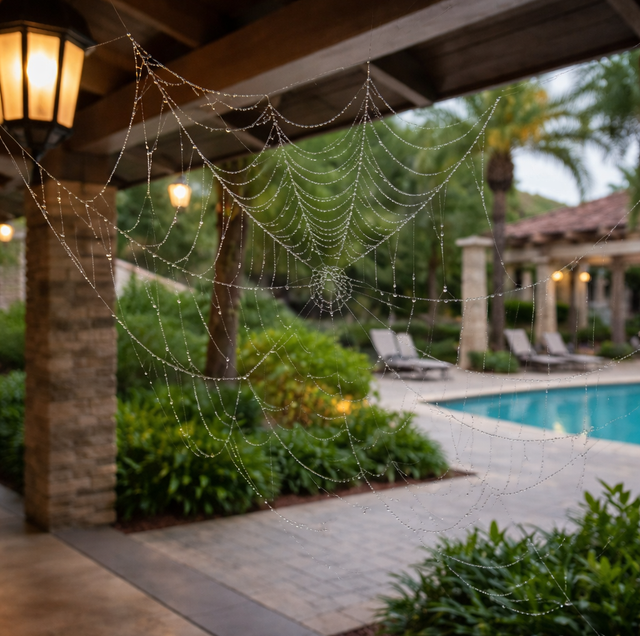
Quick Answer: Breezeways, clubhouse entrances, and pool decks concentrate more spiders than a single lanai because their lighting and cover pull in the same prey insects across shared property, not just one address. Spot-treating one complaint leaves the shared driver untouched.
By the third email in a week, the pattern is hard to miss: one resident sends a photo of a web strung across the clubhouse door handle, another mentions ducking under a strand at the pool gate, a third just wants to know why the covered walkway to Building 4 has more spiders than her own patio ever did. To the board member or manager fielding them, the three messages appear to be unrelated nuisance calls. Walk the property, and they turn out to describe the same handful of shared spaces doing the same thing every night.
Breezeways and Covered Walkways Stack Two Drivers at Once
A covered walkway does two things a single home's exterior mostly doesn't: it blocks wind and rain, and it usually runs a light fixture or two from dusk to dawn for resident safety. Take away the wind, and a web strung across a soffit corner or a stairwell rail survives storms and gusts that would tear it down in an open yard. Add a light source running most of the night, and the corridor becomes a reliable feeding ground for moths, midges, and other flying insects, which is exactly what draws orb weavers and house spiders to set up along the beam lines and doorframe corners.
A single lanai screen sees some of this too, but a breezeway concentrates it across every unit that shares the walkway, so the same handful of fixtures end up supporting web activity for a dozen or more households at once.
When a board reports webs "only near the light fixtures," check the fixture housing itself before assuming a surface treatment failed. Gaps around the housing seal are common web anchor points that spraying the surface alone won't reach.
Clubhouse Exteriors Run More Light per Square Foot Than a Typical Yard
A clubhouse rarely gets by on a single porch light. Entrance sconces, perimeter wall packs, and parking-lot pole fixtures usually run together, covering far more exterior surface with light than any one home's yard does. Flying insects orient to light more than they orient to any particular building, so a cluster of fixtures pulls prey in from a wider area and gathers it at fewer structures. The practical effect: a clubhouse can carry a heavier, denser spider population at its entrances than the sum of every private patio in the community, simply because it's lit like a small commercial building rather than a house.
That density is also why a single evening spray at the front door rarely holds. The lighting keeps refilling the food source faster than one treatment can clear it.
Pool Decks and Cabanas Add Water to the Same Lighting Problem
At the pool, evening deck, and underwater lighting layer on top of the humidity and standing-water evaporation that already draw their own insect traffic. Pool cage mesh seams, cabana eaves, and the underside of umbrella frames all give a web an anchor point close to the light and close to the water. It's a small footprint doing a lot of nightly work: the nearby irrigation and pool equipment rooms tend to sit undisturbed for weeks between service visits, which is exactly the kind of dark, quiet void brown widow spiders favor over an open web site.
Furniture storage closets and folded pool furniture stacked against a cabana wall play the same role on a smaller scale. Nobody moves that stack often enough to disturb what's tucked underneath it, and the equipment room shares the same problem: a pool pump or irrigation timer enclosure gets opened for maintenance on its own schedule, not because anyone is checking for webs, so a void that sat undisturbed for weeks is exactly the kind of spot a brown widow settles into and stays.
Per-Unit Spot Treatment Leaves the Shared Driver Standing
When complaints come in by unit or by entrance, the easy response is to treat wherever the resident pointed a phone camera: the clubhouse door, one breezeway corner, a stretch of pool fence. That clears the visible web, but it doesn't touch what produced it. The light fixture is still running all night, the prey insects are still gathering under it, and the untreated void two fixtures down is still available for a spider to move into. A property with shared rooflines and shared grounds doesn't have five separate spider problems tied to five complaint calls; it has one population using several connected entry points.
That's the difference between spraying a spot and inspecting a footprint. A community-wide pass covers the same fixtures and voids a single-unit visit would check, applied across every shared structure at once, not only the ones a resident has photographed:
- Breezeway soffits and stairwell corners: Where wind shelter and corridor lighting stack together.
- Clubhouse entrance and perimeter lighting: Usually the single densest prey-insect draw on the property.
- Pool cage seams and equipment rooms: Water, evening light, and undisturbed voids in one small footprint.
- Utility and irrigation enclosures between buildings: Dark and rarely opened, easy to miss on a single-unit visit.
South Florida humidity also shortens how long an exterior residual holds up, typically three to four weeks before it needs reinforcing, and a single hard rain can wash a fresh application off exposed stucco or railings well before that. A schedule built around the property's actual fixtures and voids, rather than the order in which complaints happen to arrive, is what keeps a shared space from cycling back to the same webs every few weeks.
One Inspection Across the Whole Common-Area Footprint
As the board or manager fielding these calls, you don't need to decide whose complaint gets handled first once the property is treated as a single connected system rather than cft a string of separate addresses. The zones that draw spiders, the covered walkways, the clubhouse lighting, the pool deck, are shared infrastructure, so the diagnosis and the fix work the same way: find which fixtures, voids, and outdoor features are actually driving the activity, then treat and seal across all of them in the same pass, on a schedule that accounts for how fast South Florida humidity and rain wear a treatment down. That's a different conversation than asking someone to spray the clubhouse again, and it's the one that actually keeps the webs from simply relocating to the next building over.
Frequently Asked Questions
Often, yes, mainly because a shared property has more of the small, rarely opened voids brown widows favor over open web sites, meter box interiors, breaker panel housings, and the underside of stacked pool furniture cushions among them. Their webs also look different from an orb weaver's: a loose, tangled, three-dimensional mesh rather than the flat wheel shape most people picture, which is part of why residents sometimes miss one until an egg sac is already tucked into the void.
How fast it refills often depends as much on the surface underneath as on the lighting. A hard rain typically strips a fresh residual off painted metal railings within a day or two, while porous stucco holds the application closer to its full three-to-four-week window because the material absorbs more of it. A board that asks a vendor for a written log of which surfaces were treated and when, not just a general "treated" note, has an easier time telling a weather-driven gap from an actual coverage miss the next time a resident reports a new web.
Juveniles of several common species disperse by releasing a strand of silk and drifting on air currents, a behavior called ballooning, which lets them travel between buildings on a shared property far more easily than they could cross open ground on foot. That's part of why treating one structure in isolation rarely holds for long on a multi-building site.
Web removal clears what's visible for the moment; exclusion targets the gaps a spider actually uses as a den between hunting trips, things like a warped door sweep on a utility closet, a gap around a conduit or pipe entry, or a weep hole along a soffit edge. Sealing those closes off the retreat spot itself, which holds up longer than knocking the web down and waiting for it to reappear.
It can help on the margins. Warm-spectrum LED bulbs draw noticeably fewer flying insects than cool-white or metal halide fixtures, since many night-flying insects orient more strongly toward the blue and ultraviolet end of the spectrum, but a bulb swap alone won't remove the draw entirely on a property with several other lit structures nearby.
Not usually, and mud daubers actually do the opposite in one specific way: several mud dauber species hunt and paralyze spiders to provision their mud nest cells, so an active mud dauber nest can be quietly removing spiders from the same corner rather than adding to the problem. Their nests are still worth inspecting on their own, since they're a separate pest issue with distinct habits.
Schedule a common-area spider inspection — Tyler walks the entire property, not just the complaint spots, and treats the fixtures and voids that are actually driving the webs. Buggify Pest Solutions serves Boca Raton, West Boca, and communities across Palm Beach and northern Broward. Call Tyler: (561) 672-0200.
