
Abandoned Pool Mosquitoes: The Water You Can't Treat
The mosquitoes landing on your patio at dusk did not necessarily hatch anywhere on your lot. That is the part most homeowners never start with, and it changes the question from what is wrong with this yard to which water within reach of it is actually producing. The answer often sits on a parcel you do not own, have never walked, and have no way to do anything about directly.
Mosquitoes are weak fliers compared to most flying insects, but their range still reaches past a fence line, a hedge, or a canal bank without much effort. Which means every parcel around your lot is part of your mosquito picture, whether you have ever set foot on it or not. A house with a green, untended pool three doors down, a construction pad being graded for a new build, the grassy edge of a retention pond your community backs onto, a lot sitting empty between owners: to a female mosquito looking for somewhere to lay eggs, these are simply water. She does not check who holds the deed before she settles on one.
Some of that water produces a handful of mosquitoes after a single rain. Some of it becomes a running nursery that keeps sending out new adults for months. Knowing which kind of source is near you, and how much it actually produces relative to everything else nearby, is what separates a yard problem from a neighborhood problem.
An Untended Pool Can Outproduce Every Container on Your Property Combined
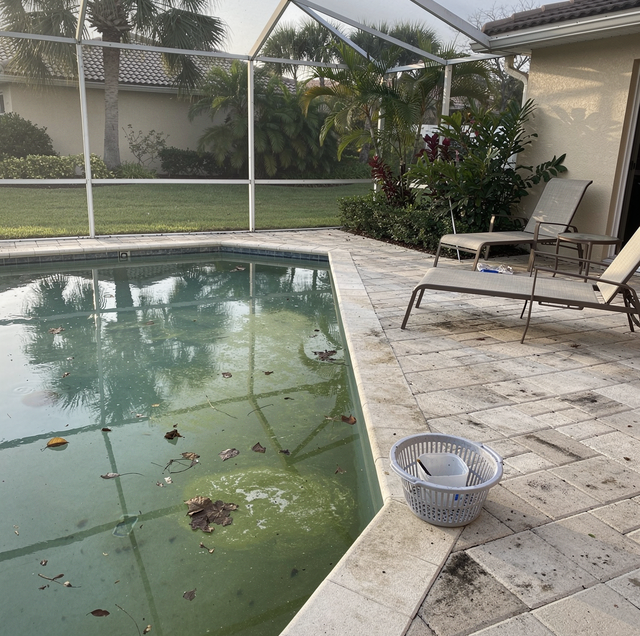
Of every off-site source, an abandoned or untended pool is by far the largest. Your own backyard has, at most, a handful of containers capable of holding water: a saucer under a planter, a clogged corner of a gutter, a tarp with a low spot. A pool holds thousands of gallons in one contained basin, already at the surface, already protected from sun and wind by the pool's own walls and often a screen enclosure above it.
What turns a pool from an asset into a source is neglect of the systems that used to keep it inhospitable. A pump that no longer runs stops moving the water, and moving water does not support mosquito development the way still water does. Once circulation stops and sanitizer is no longer maintained, algae begins to take hold, and that algae becomes a food source for developing larvae.
The timeline is short. In summer heat, a container species goes from egg to biting adult in seven to ten days, so a pool left still for a week or two is already producing, and it will keep producing on that cycle for as long as it sits untouched.
From your side of the fence, listen before you look. A pool pump on its afternoon cycle is audible from a lot or two away, and repeated silence at that hour is the earliest sign the water next door has gone still.
An Active Construction Site Creates Water in Places You Cannot See
A site being graded for a new home or addition changes week to week, and each change can create a new place for water to sit. Excavation for a foundation or a pool holds rain in a bowl shape with no drainage engineered into it yet. Silt fencing and stacked construction material trap runoff along their base. Equipment ruts in bare soil fill after a storm and, because the soil has just been disturbed, there is no established plant cover to draw that water back down.
It's freshly turned soil holding rainwater, with nothing living in it yet to compete with mosquito larvae for the nutrients in it. A site that sits between phases of construction, especially over a weekend or a stretch of rain, can hold water in half a dozen separate spots at once, each developing on its own timeline.
Standing water on an active construction site often sits inside an excavation trench, on loose fill, or near parked equipment. That ground is not stable to walk on, and it isn't a spot to approach for a closer look.
The Vegetated Margin of a Retention Pond Breeds Even When the Water Looks Fine
The retention pond your community backs onto is not one uniform body of water. Its open center, where wind moves across the surface and any resident fish patrol, is a poor place for larvae. The shallow margin thick with grasses, reeds, or cattails growing right at the waterline is a good one. From your side of the yard, that pond can look entirely healthy, clear open water and no algae bloom on it, while the edge you never walk quietly runs as a source for the whole season.
A Vacant Lot or a Home Between Tenants Collects Water No One Is Watching
A property with no one living in it loses the routine attention that keeps water from sitting. Nobody empties the bucket a previous occupant left behind, nobody flips the tarp that has pooled rain, nobody notices that a low spot has not drained a week after the same storm your yard already shed. All it takes is time passing with no one there to look.
The lot between tenants or between sales down your street can sit that way for weeks or months. Stored materials, discarded containers, an uncollected yard debris pile that cups rainwater in its folds: those are ordinary features of an unoccupied property, and any one of them can hold enough water to run a small breeding cycle before anyone moves back in. You will not see any of it from your patio, and you will feel all of it there.
Mosquitoes Cross Property Lines Without Needing Wind or Water to Carry Them
It's worth being clear about how a source two or three lots away ends up biting you on your own patio: the adult mosquito flies there under her own power. She is not blown in on a breeze or carried by runoff. Female mosquitoes seeking a blood meal fly low, near vegetation, and are drawn toward the moisture and carbon dioxide a yard with people, pets, and irrigation naturally gives off, especially around dusk.
Once she has fed, she doesn't stay in the open. Adult mosquitoes spend the overwhelming majority of their time, roughly 23 of every 24 hours, resting on the underside of leaves and other shaded foliage rather than flying, and the resting population on a property commonly runs ten to a hundred times the number actually biting anyone. That habit is exactly why a source on someone else's property still shapes what happens in your yard: the mosquitoes she produces don't stay confined to where they hatched, and the ones that reach your foliage will rest there between meals regardless of which parcel they were born on.
What a Property Treatment Can and Cannot Do About Water You Don't Own
This is the part worth being direct about. A barrier treatment applied to your property targets the vegetation and shaded surfaces where adult mosquitoes land and rest, holding a residual for roughly three to four weeks under warm, humid conditions before it needs to be reapplied, typically monthly through the warmer months and every other month once the weather cools. Applied on that schedule, it interrupts a meaningful share of the adults that land on your lot looking for a place to rest or a person to bite.
What it does not do is reach the water itself, and it cannot reduce what's being produced on a parcel it was never applied to. If the pool, the retention pond edge, the construction site, or the vacant lot near you is running as an active source, new adults keep emerging there on their own schedule, independent of anything happening on your property. A breeding-source audit that walks your own lot first is useful precisely because it tells you the honest split: what's yours to address, and what's coming from somewhere you have no way to reach. That distinction is what a diagnosis like this is for. It won't make the water next door disappear, but it will tell you plainly whether your own yard is contributing to the problem or simply catching overflow from elsewhere.
Frequently Asked Questions
A female chooses where to lay partly on chemical cues she picks up from the water itself, including the bacteria and organic film that build up as algae grows. So the pool you can see going green from your fence line is advertising a steady food supply for developing larvae, making it a far more attractive egg-laying site than plain, food-poor standing water. The color you notice from a distance is telling you something real about what it produces.
Not entirely; the pond's shape determines how much they help. Many community ponds are built with a littoral shelf, a deliberately shallow planted bench running around the perimeter. If the water near you has one, that shelf is both the pond's planting zone and the exact band fish cannot work. After a heavy storm, the water rises over the shelf and then recedes over the following days, re-exposing a fresh strip of wet, vegetated ground each time it drops. The bites you get the following week come off that strip.
It can. A mosquito flies toward you under her own power, but she picks up carbon dioxide and scent cues on moving air, so a patio downwind of a producing property gets found sooner and more often than one upwind of it. On a still evening that difference largely disappears. On an evening with a steady breeze off the water, the downwind side of your house can be unusable while you sit comfortably on the other side of the same building.
Less time than the grading phase would suggest. Once sod or planting goes down and the ground has a root system drawing water back out of the top layer, the shallow sheets that stood on bare fill drain or dry within a day or two of a storm. What outlasts the build are the engineered features, and those are the ones that keep reaching you: a low spot the final grade left in place, or a drain tied in and then silted up before anyone ever used it.
Yes, and sometimes worse for you. A vacant home listed for sale often has its irrigation running on the original timer and its pool autofill still connected to the water supply, so the yard beside yours keeps getting wet on schedule while nobody walks it. A pool topped up automatically and no longer circulated stays full, still, and untreated for months. That is a far steadier source than a shell slowly evaporating down.
Quite a lot, because the residual finally reaches the foliage adults rest in on both sides of the fence. Coverage on a single lot stops at your property line. A fence-line application reaches the vegetation on the treated side of it and goes no farther, so the hedge, the bank, and the pool cage beyond it stay exactly as they were. Where a neighbor enrolls too, the two treated areas meet, and the untreated gap between them closes.
Find out whether the water driving your mosquito problem is even on your own lot — a breeding-source audit shows you exactly what your property is and isn't contributing. Buggify Pest Solutions serves Boca Raton, West Boca, and communities across Palm Beach and northern Broward. Call Tyler: (561) 672-0200.
