

AC Condensate Line Mosquitoes: The Drip That Never Stops
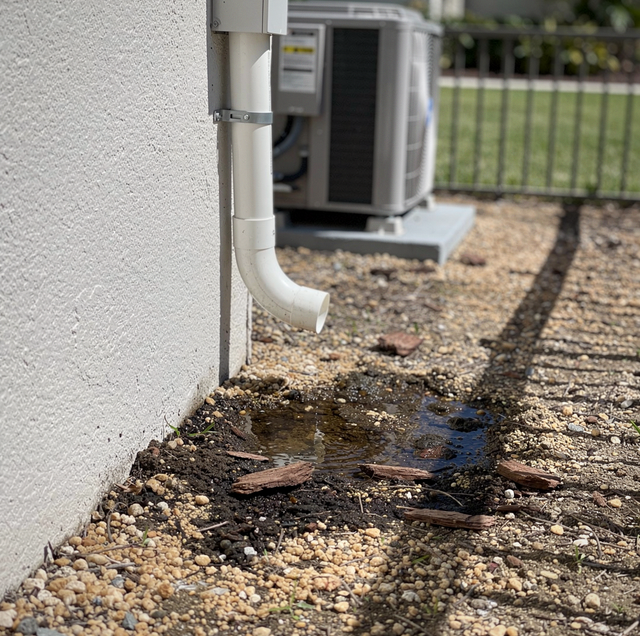
The bites are not spread evenly across your yard. They come in the side yard, the narrow strip you cut through twice a week to reach the trash cans, and they come in the middle of the afternoon when the rest of the property is quiet. It is the least interesting few feet you own, and it is where you get hit.
That strip usually has one feature the rest of your yard does not. A short length of white PVC runs from the exterior wall near your outdoor condenser unit, low to the ground, and is aimed at a patch of soil, mulch, or gravel that stays a shade darker than the surrounding ground. That pipe is the condensate line. The dampness underneath it is not rain, sprinkler overspray, or a spill. It is water your air conditioning system makes on purpose, every time it runs, and routes outside because it has nowhere else to go.
Two different things can happen at that spot, and they are worth keeping apart because a technician records and treats them separately. One is breeding, which requires genuine standing water, roughly half an inch of it, held somewhere the discharge keeps topping up. The other is resting, which requires no standing water at all, only damp ground and shade. Your drip point may produce one, both, or neither. Damp ground on its own produces neither.
The Coil Produces Water Every Time the System Runs
Inside your air handler, warm room air passes over a cold evaporator coil. The coil pulls heat out of the air, and moisture along with it. That moisture collects on the coil's surface as liquid, drips into a shallow pan built into the unit, and needs an exit. In coastal South Florida, where humidity typically sits in the 70–85% range, the air moving across that coil carries a substantial moisture load almost year-round, well beyond the wettest weeks of the season. A system that runs a few hours a day in mild weather is still pulling water out of the air on every one of those cycles.
The pan itself is not what an audit would worry about, since it sits inside a sealed equipment cabinet designed to shed water. What matters, for a property being checked for mosquito activity, is where that water goes once it leaves the pan and reaches your yard.
The Line Carries That Water Outside the Building
From the drip pan, a length of PVC tubing runs to an exterior wall and exits at a fixed point, most often near your outdoor condenser or along a foundation wall close to it. Gravity moves the water in most residential setups, with no pump involved anywhere in the run. The line has no valve, no shutoff, and no way to hold water back. Whatever the coil produces exits within minutes, which is why the ground under your termination point rarely looks dry for long.
Because the line carries whatever the coil sheds, the volume passing through it tracks your system's run time and ignores the forecast entirely. A system cycling on a humid, overcast day is still discharging water when no rain has fallen in a week, and a system working hard through a hot, dry stretch can be putting out more water at that one point than your whole yard is getting from the sky.
Breeding Needs a Pocket That Never Draws Down
Start by ruling out the thing that looks most suspicious. Damp ground does not breed mosquitoes. Wet soil, saturated mulch, and gravel that never dries all fail the same test: a mosquito needs free water to lay on, and larvae need free water to develop in, roughly half an inch of it for Aedes, and damp material holds no free water at all. If your condensate discharge simply soaks into open ground, there is nothing breeding at that spot.
What turns a discharge point into a breeding site is a container, in the loosest sense of the word. A depression worn into the soil under the drip, a splash block with a lip, a saucer or bucket somebody set underneath, a gravel pocket lined with weed fabric, a length of corrugated drain sleeve with a low run in it, a settled low spot against the slab: any of those can hold free water. The condensate line is what keeps them from drawing down. A rain-fed depression fills once and then loses depth to evaporation and soaking until it is dry, which cuts a developing batch short. The same depression under a running condensate line is topped up on every cycle, so it never drops below the half-inch Aedes needs, and larvae that would have run out of water in an ordinary dry stretch finish out instead.
That is the whole breeding mechanism, and it is deliberately narrow. The question at your discharge point is never how wet the ground looks. It is whether anything there is holding standing water, and whether the drip is refilling it faster than it drains away.
The ground around an outdoor condenser is wet, and the unit is energized, with a disconnect box and line set within arm's reach. Do not dig, probe, or move gravel there yourself. Leave that inspection to someone equipped for it.
Damp Ground and Shade Are a Resting Story, Not a Breeding One
The second thing happening at that spot has nothing to do with eggs. Adult mosquitoes spend roughly 23 of every 24 hours resting, not flying and not biting, and the resting population on a property runs 10 to 100 times larger than the number biting you at any given moment. What that resting population needs is shade, still air, and humidity high enough that it does not dry out.
A condensate discharge point supplies all three without holding a single drop of standing water. The damp ground lifts humidity in the few feet around it. The unit and the wall behind it block sun and wind. Whatever got planted to screen the equipment from view, usually something dense, adds shaded leaf undersides at the height mosquitoes prefer. The result is a pocket of your property that reads as a good place to spend the day, and that is a real finding even when nothing there is producing larvae.
That distinction explains the bites you are getting in a strip of yard that may generate no larvae at all. The mosquitoes landing on you there can have developed in a gutter or a bromeliad on the far side of the house and simply moved a few feet out of the shrubs when you walked past. During an inspection, the two are written down differently: standing water goes on the source list, and shade and humidity go on the barrier side of the visit.
A Secondary Line Means the Primary Is Already Failing
Many systems include a second, backup drain line that is intended to carry water only if the primary line clogs and the primary pan overflows into the emergency pan beneath it. This auxiliary line often terminates somewhere far more visible than the primary: over a window, above a door, or along the front of the house, specifically so a homeowner notices water where none should be. If you find drips or a wet stain coming from that secondary point, it is a sign the primary path is already blocked or backed up. It is never a small separate issue on its own. That is a call for an HVAC contractor, not a pest control visit, since clearing or repairing a condensate line falls outside what a pest technician is equipped to touch. A property audit can flag the wet spot and the pattern behind it, but the line itself needs a technician who works on the equipment.
Outdoor Showers and Rinse Stations Share the Same Pattern
Your condensate line is one of several fixtures on a property that drip continuously, with no fill-and-dry cycle behind them. Outdoor showers, pool rinse stations, and hose bibs with a worn washer behave the same way: they produce a small volume of water on a near-constant basis, with no single weather event behind any of it. An audit walking your property checks these constant-drip points specifically, because they behave differently from the water sources most people picture, and because the same test applies to every one of them: the drip is not the finding, the pocket it keeps topped up is.
A rinse station on a pool deck or a dock is the clearest case. The base stays damp for hours after each use, which is a resting condition and nothing more, but where the drainage underneath runs uneven, a shallow depression can hold water long after the surrounding concrete has dried, which is the other thing entirely. A hose bib with a worn washer works the same way at a smaller scale: the drip itself is inert, and whether it matters depends on what sits in the soil at the base of the spigot to catch it.
Constant-Drip Water Behaves Differently Than a Filled Container
Most guidance about mosquito water treats habitat as something that fills and then dries: a bucket after a storm, a clogged gutter section, a tarp fold. That framing works for rain-fed containers, where a dry stretch interrupts the cycle, and the site stops mattering until the next storm refills it. Nothing you have read above works on that schedule. A pocket under a condensate line, an outdoor shower base, or a dripping hose bib is topped up by something other than the weather, so a week without rain does not touch it.
That is why these points deserve a closer look when you are checking the rest of your yard after it rains. Everything else on your property is on the rain's clock and draws down when the rain stops. These few spots are on your equipment's clock, which runs hardest in exactly the weeks Aedes needs 7 to 10 days to turn a batch of eggs into adults biting you in the side yard.
Frequently Asked Questions
Not for breeding. Most condensate lines include a U-shaped trap near the connection to the drip pan, and that trap does hold a permanent column of water. Its purpose is to break the pressure difference across the line, preventing the blower's suction from pulling air up the drain and stalling the flow. Water in a line that discharges on every cooling cycle also does not sit still long enough to carry a brood through to adult, so the column itself is not a site no matter how long it holds. The part of the assembly worth a look is an open or vented cleanout tee near the trap, because an uncapped opening is accessible in a way the sealed column never is.
It can, and the same test settles it. Portable and whole-house units pull moisture off a cold coil the way an evaporator does, and many drain through a hose run out a door or window to the ground outside. If that hose ends over open soil, the water soaks away, and you have damp ground, which is a resting consideration and nothing more. If it ends in a saucer, a paver depression, or the same gravel pocket your condensate line uses, you have a container being topped up, which is the finding that counts.
Sometimes, and they are easier to miss. Some installations route condensate through tubing to a fixed discharge point, as a central system does; others let the outdoor unit drip straight onto the ground beneath it, with no line to follow. A bare drip onto gravel or soil is the same non-event as any other soak-away, with no free water and no larvae. It becomes a site only when something underneath holds what falls, which on a mini-split is usually a mounting pad with a lip, a paver set slightly proud of grade, or a shallow pocket worn into the gravel directly under the drip.
Yes, because volume alone does not make a site productive. Aedes needs about half an inch of standing water and 7 to 10 days of summer heat to get from egg to biting adult. A pocket that receives a little water on most days holds that half inch far more reliably than one that takes a downpour and then goes two weeks dry. A modest system cycling daily can keep a saucer or a depression at working depth indefinitely, which is a condition a rain-fed container almost never reaches.
Shade slows evaporation, so a small pocket in shade holds its depth through conditions that would take a sunlit one below the half-inch threshold in an afternoon. Shade also keeps local humidity up, which suits the adults doing the laying, and the species most likely to bite you in your own side yard favor small, sheltered water tucked against structures over large, open, sun-exposed surfaces. A discharge point set low against a wall and screened by planting matches all of that, which is why it can be productive on a property where the pool and the pond are immaculate.
Two separate notes, because the two mechanisms get handled differently. The breeding note records whether anything at the discharge is holding free water, what is holding it, and roughly how deep it is, since that determines whether the spot goes on the source-elimination list and gets rechecked on the next visit. The resting note records the shade, planting density, and humidity in the few feet around the unit, which instead feeds the barrier side of the visit. Your drip point can generate one note, both, or neither, and a wet patch on its own generates neither.
Have the water side of the property read, line by line — the condensate discharge points, the rinse stations, and every other spot that keeps getting topped up, checked as part of a full breeding-source audit. Buggify Pest Solutions serves Boca Raton, West Boca, and communities across Palm Beach and northern Broward. Call Tyler: (561) 672-0200.
