
Ant Control in Coral Springs
Species ID first, then the right bait, then exclusion. HOA-mandated identical landscape architecture results in a single dominant species profile per community.
- FL DACS License #JB268060 · Certified Operator Tyler Craig
- Bayer Authorized Applicator (Termidor)
- $1M general liability insurance
- Google 5.0 Rated · live review feed
- Family-owned · 1,000+ South Florida homes served since 2018
- Pet-safe and family-safe treatments by default
- Free phone estimates · no long-term contracts
Coral Springs has an unusual ant control fingerprint driven by one specific fact: the city's master-planned communities enforce HOA landscape architecture that's remarkably uniform within each community. Eagle Trace, Heron Bay, Turtle Run, Wyndham Lakes, Kensington, Hidden Hammocks, and The Isles each have their own approved plant palettes, mulch specifications, irrigation cycles, and lawn treatment schedules. Because the landscape is so uniform, the dominant ant species is also uniform across each community. Big-headed and ghost ants dominate the irrigation-heavy communities. Fire ants dominate the open-field-edge properties along Cypress Run, North Springs, and Everglades-adjacent zones. Carpenter ants are rare here because Coral Springs housing is almost universally concrete block stucco (CBS) construction, a very different pest picture from older frame-construction cities. Tyler's Coral Springs ant protocol starts with species identification against the community-specific baseline, then selects bait chemistry and placement accordingly.
HOA Landscape Architecture Mapping
Eagle Trace, Heron Bay, Turtle Run, Wyndham Lakes, Kensington, HOA-mandated identical landscape design creates one dominant ant species profile per community. Tyler knows which is which.
Big-Headed + Ghost Ant Specialty
Coral Springs' irrigation-heavy master-planned landscaping favors big-headed ants (soil moisture) and ghost ants (irrigation-adjacent mulch). Different baits, different placement.
Fire Ant Edge-Zone Work
Cypress Run, North Springs, and Everglades-edge properties see fire ants at the open-field property lines. Mound-injection treatment rather than perimeter spray.
Carpenter Ants Rare Here (CBS Construction)
Coral Springs housing stock is almost universally concrete block stucco (CBS); carpenter ant pressure is far lower than in older frame-construction cities like Boca. Tyler flags actual carpenter ant finds as a separate protocol.
Same Technician Every Visit
Tyler runs every Coral Springs ant job. Learns your community's dominant species and irrigation cycle.
No Long-Term Ant Contract
Bi-monthly plans bill per visit and can be canceled anytime. Most Coral Springs ant problems resolve inside one bi-monthly cycle.
Four Coral Springs conditions that shape ant work
Coral Springs' HOA-mandated landscape uniformity, Everglades-edge sunny zones, universal CBS construction, and 50+ park system define the ant protocol.
HOA-Mandated Landscape Uniformity
Eagle Trace, Heron Bay, Turtle Run, Wyndham Lakes, Kensington, Hidden Hammocks, and The Isles each enforce landscape architecture that's uniform community-wide, approved plant palettes, mulch specifications, irrigation cycles, and lawn treatment schedules. The dominant ant species is therefore uniform community-wide rather than house-specific. Big-headed + ghost ants dominate in the irrigation-heavy communities.
Everglades-Edge + Cypress Run Open-Field Zones
Fire ants favor sunny, open, disturbed soil rather than dense mulched landscaping. Outer property lines of Cypress Run, North Springs, and Everglades-adjacent Eagle Trace / Heron Bay meet open field, drainage-swale slopes, or park edges; that's the fire ant pressure zone. Mound-injection treatment rather than perimeter spray.
Universal CBS (Concrete Block Stucco) Construction
Coral Springs housing built 1970s-2003 is almost entirely CBS construction. Carpenter ants need wood, and the CBS envelope offers very little of it, so carpenter ant pressure is far lower here than in older frame-built cities like Boca. When carpenter ants do show up, it's driven by a specific wood-moisture source that Tyler flags for resolution.
Four technical details specific to Coral Springs ant work
Buggify's Coral Springs ant protocol covers species-community mapping, bait chemistry selection, fire ant treatment mechanics, and irrigation-cycle coordination.
Community-Level Species Mapping
Tyler builds a working map of the dominant ant species in each Coral Springs community based on his ongoing job history. Turtle Run and Heron Bay tend toward big-headed and ghost ant work; Wyndham Lakes and Kensington skew toward ghost ants inside kitchens; Cypress Run and Eagle Trace open-field-adjacent properties see the fire ant work at fence lines. The specific dominant species is confirmed on the on-site inspection for every job; the address alone does not confirm species. This mapping speeds diagnosis and reduces species misidentification, which is a common source of ant treatment failure.
Bait Chemistry, Protein vs Sugar-Based by Species and Season
Big-headed ants prefer protein baits (workers feed protein to larvae). Ghost ants prefer sugar baits (workers exchange sugar with the colony). Sugar ants and odorous house ants prefer sugar. Fire ants take both but respond faster to protein-oil baits. Tyler carries multiple bait chemistries and matches by species; no single-bait blanket approach. Seasonal shifts also matter: cooler-weather ant activity often shifts toward a preference for protein across species.
Fire Ant Mound Injection vs Broadcast Bait Decision Rule
Individual mound injection with a penetration wand kills the queen fast but only treats the visible mound. Broadcast granular bait treats yard-wide light infestations but takes 4-6 weeks to reach the queens via worker foraging. Tyler's rule: 5 or fewer visible mounds = mound-injection only. 6-20 mounds = mound-injection on the largest + broadcast bait yard-wide. 20+ mounds = broadcast bait primary + selective mound injection. Priced accordingly.
HOA Irrigation Cycle Coordination for Bait Persistence
Granular bait needs to stay in place long enough for foraging workers to collect and carry back to the colony, usually 24-48 hours. HOA irrigation cycles that run within that window wash the bait away. Tyler coordinates bait application timing with the community's HOA irrigation schedule (before a 2-3 day dry window) whenever possible. Where the HOA schedule can't accommodate, Tyler uses gel bait in protected placements instead of granular in exposed beds.
Why Coral Springs ant pressure sorts by community-level HOA architecture
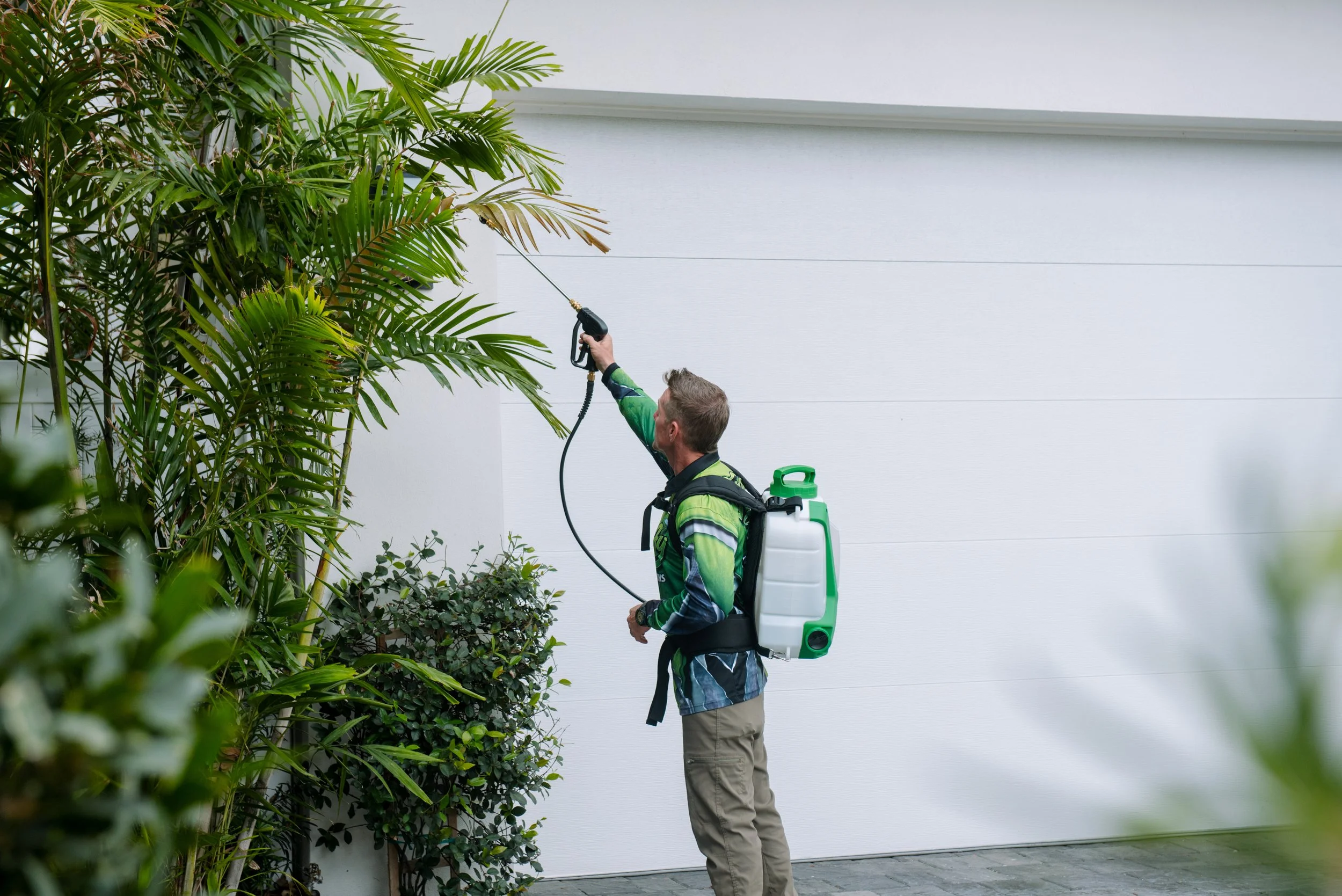
In most South Florida cities, ant pressure varies house by house depending on individual landscaping choices, some yards have heavy mulch, some don't; some have irrigation, some don't. Coral Springs is different. HOA-mandated landscape architecture in the master-planned communities makes the landscape uniform within each community. Eagle Trace has a defined approved plant list. Heron Bay has an irrigation cycle mandated in the HOA docs. Turtle Run enforces mulch bed depth. Wyndham Lakes coordinates lawn treatment across the community. That uniformity means the ant species that finds the environment favorable dominates the entire community, spanning yards uniformly.
Big-headed ants (Pheidole megacephala) thrive in the mulched, irrigated, moisture-consistent conditions common in Eagle Trace, Heron Bay, Turtle Run, Kensington, and Wyndham Lakes. Ghost ants (Tapinoma melanocephalum) favor the same conditions but nest inside plant material and near irrigation heads; they show up on kitchen counters after moving from exterior nests through wall-void entry points. Both species need bait chemistry to work; residual perimeter spray only pushes them further into the building envelope. Tyler's protocol identifies which is which (they look different up close) and matches bait chemistry accordingly.
Fire ants (Solenopsis invicta) show a different pattern. They favor sunny, open, disturbed soil rather than dense mulched landscaping. In Coral Springs, that means the outer property lines of Cypress Run, North Springs, and Everglades-adjacent Eagle Trace / Heron Bay, where private lawns meet open field, drainage-swale slopes, or park edges. Fire ants build visible surface mounds and need direct mound-injection treatment; perimeter spray around a fire ant mound accomplishes nothing. Carpenter ants (Camponotus species) show up in Coral Springs only where a specific wood-moisture source exists, a leaking deck footing, a soft trim board, a chronically damp door threshold. Because Coral Springs housing is almost entirely CBS construction, that pressure is much lower than in older frame-built cities.
Every Coral Springs ant issue Buggify handles
Standard Coral Springs ant scope organizes by species and by community landscape signature rather than by pest count.
Big-headed ants (Eagle Trace, Heron Bay, Turtle Run, Kensington, Wyndham Lakes)
Dominant species in irrigation-heavy master-planned communities. Nest in soil under mulch beds, along irrigation lines, and beneath concrete slabs. Enter homes through slab expansion joints and door thresholds. Treatment: granular bait (protein-based) at nest sites + non-repellent perimeter product at entry points. Repellent sprays make the problem worse (colony splits into multiple nests). Full resolution typically 2-4 weeks with correct bait chemistry.
Ghost ants (interior kitchens across HOA communities)
Small pale ants that show up on kitchen counters, near sinks, and around pet food bowls. Nest in wall voids near warmth (attic soffits, behind refrigerators), foraging out through the building envelope. Treatment: gel bait (sugar-based) placed directly on foraging trails + exterior perimeter treatment. Ghost ant colonies bud when disturbed; the same rule against repellent spray applies.
Fire ants (Cypress Run, North Springs, Everglades-edge property lines)
Sunny outdoor mound-building species along open-field property lines and drainage-swale slopes. Direct mound injection (contact insecticide with a mound-penetration wand) treats individual mounds; broadcast granular bait handles yard-wide light infestations. Tyler quotes mound-count-based pricing rather than blanket yard treatment. Kids-and-pets safety window covered in the on-site walk-through.
Sugar ants + odorous house ants (interior nuisance)
Smaller kitchen ants that trail from windowsills, along baseboards, and into pantry areas. Bait-primary treatment; identify the exterior source (usually a landscape feature within 20 feet of the entry point) and address there. Tyler's inspection walks the perimeter to identify the source before treating the interior symptom.
Carpenter ants (rare in Coral Springs, flagged separately when found)
Coral Springs' near-universal CBS construction makes carpenter ant pressure much lower than in older frame-built cities. When Tyler does find carpenter ants in Coral Springs, it's usually driven by a specific wood-moisture source: a leaking deck footing, a chronically damp door threshold, or a soft trim board around a bathroom window. Treatment: identify + resolve the moisture source (referred out for structural repair) + targeted carpenter ant bait at the trailing entry point.
Wyndham Lakes new-owner discovery: ghost ants across three kitchens right after closing
The move-in
A new Wyndham Lakes owner discovered ghost ants on kitchen counters, bathroom vanities, and in the pantry within the first two weeks after closing on the home. The previous owner had never mentioned an ant issue in the seller disclosure. She called Buggify wanting to catch it before the pattern spread deeper into the home.
The inspection
Tyler ran a 40-minute walk-through. Identified ghost ants (small, pale, sugar-preferring species) with three separate foraging trails converging on the kitchen sink area from a common exterior wall void. Traced the exterior entry to a mulch bed along the east side irrigation line where ghost ants had established a nest tucked under a landscape rock. Wyndham Lakes leans ghost ant per the community pattern; this matched.
The protocol
Sugar-based gel bait placed directly on all three interior foraging trails plus at the wall-void entry point. Non-repellent perimeter product treatment at the exterior nest site under the landscape rock. No repellent spray anywhere. Advised the new owner to hold off on any DIY yard treatments for 30 days so the bait cycle would complete.
The result
Interior activity gone by day 7; exterior nest inactive by day 12. Homeowner moved to Full Home Protection bi-monthly for the built-in ghost-ant recurrence coverage. Total first-treatment cost $175. She flagged it to two Wyndham Lakes neighbors as an early-warning check before their own kitchens showed activity.
Coral Springs ant job pricing
Standard Buggify ant pricing applies in Coral Springs, with fire ant work priced by mound count.
One-Time Treatment,from $175
Single-species interior/perimeter treatment. Species ID + bait application + entry-point treatment. Typical Coral Springs one-time ant job.
Fire Ant Yard Treatment,Custom
Priced by mound count and yard size. Individual mound injection + optional broadcast granular bait for yard-wide light infestations. Not a flat-rate product.
Whole-Home Ant Program,Custom
Multi-species interior/exterior for properties with mixed ant pressure. Typical on Everglades-edge properties with big-headed + fire ant combined pressure. Custom quote after inspection.
Bi-Monthly Plan Coverage
All three bi-monthly plan tiers include ant coverage at 8-week cadence. Full Home Protection is the standard for typical Coral Springs homes with recurring ant pressure. Complete adds exclusion monitoring.
Buggify vs. National Pest Chains
Six-point comparison. Every row verifiable from how Buggify operates.
| Feature | Buggify in Coral Springs | National Pest Chains |
|---|---|---|
| Species identification before treatment | Standard on every Coral Springs ant inspection | Often skipped, same product used regardless of species |
| HOA-community landscape awareness | Tyler maps community-specific dominant species | Uniform treatment regardless of community landscape signature |
| Bait-primary for big-headed + ghost ants | Correct product per species | Repellent perimeter spray often used, makes big-headed ants worse |
| Fire ant mound-count pricing | Priced per mound + optional broadcast bait | Flat-rate yard treatment regardless of mound count |
| Carpenter ant moisture-source diagnosis | Standard: resolve the source, not just treat the symptom | Chemical treatment only; underlying moisture issue continues |
| Same technician every visit | Tyler runs every Coral Springs ant job | Rotating route techs |
Read what Coral Springs customers say on Google directly
Reviews from Coral Springs HOA communities routinely mention two things: Tyler often flags the likely species by community before the inspection, then confirms on-site, and the bait-primary approach holds where a previous company's repellent spray sent the colony budding into new nests. Google 5.0 Rated · live review feed.
Three things Buggify will never do to you
Three things Buggify will never do to you (full list of seven on Why Choose Buggify):
Quote a real treatment price without inspecting the property first. Phone gives a range; firm pricing comes after an on-site walkthrough.
Indoor spraying when the source is outside. Most of the pest pressure in Coral Springs is driven by outdoor harborage; indoor-only work is a short-term cover-up.
Long-term contracts that lock you in. Bi-monthly plans bill per visit and cancel anytime, no fees.
Call (561) 672-0200. Tyler answers, gives you a price range on the first call, and (in most cases) gets you on the Coral Springs schedule the same day or the next morning.
Six Coral Springs ant questions Tyler hears most often
I'm in Turtle Run. Why does my neighbor have the same ant problem I do?
Because your HOA enforces uniform landscape architecture across the community. Same plant palette, same irrigation cycle, same mulch specs, same dominant ant species. Turtle Run tends toward big-headed ants; treatment approach is the same house to house.
My previous pest company sprayed the perimeter, and the ants came back worse. Why?
Almost certainly big-headed or ghost ants treated with a repellent perimeter spray. Repellent spray splits the colony (workers scatter to new nest sites to avoid the treated zone). The correct approach is non-repellent product + species-specific bait, Tyler's standard protocol.
I have fire ants along my back fence line where the yard meets the park. What's the fix?
Individual mound injection with a contact insecticide wand for each visible mound. If there are more than 5-6 mounds, Tyler adds a broadcast granular bait sweep across the affected zone. Priced by mound count.
Do I have carpenter ants? My house is in Eagle Trace.
Probably not. Coral Springs housing is almost universally CBS (concrete block stucco), and carpenter ants need wood. If Tyler does find carpenter ants in your Eagle Trace home, it means there's a specific wood-moisture source somewhere, a leaking deck footing, a soft trim board, a chronically damp door threshold. Fixing that source is more important than the chemical treatment.
My HOA sprays the neighborhood on Wednesdays. Should Tyler come Wednesday too?
No, the opposite. Bait needs 24-48 hours in place to reach the colony. If HOA irrigation or spray hits the yard in that window, the bait washes away. Tyler coordinates timing with your HOA cycle so treatment lands during a dry window.
How long does a Coral Springs ant treatment take to work?
Big-headed ants and ghost ants usually resolve in 2-4 weeks with correct bait chemistry. Fire ant mound-injection kills the queen within 24-48 hours per treated mound. Sugar ants and odorous house ants often resolve inside a week. If activity persists past those windows, Tyler comes back for re-service at no charge on plan customers.
Direct line to the technician serving Coral Springs
Phone: (561) 672-0200 (Tyler answers) · Mon–Fri 8 am – 5 pm
Email: Getbuggify@gmail.com
Address: 22617 Middletown Dr., Boca Raton, FL 33428 (West Boca shop, primary dispatch)
License: FL DACS #JB268060 · Certified Operator: Tyler Craig
Call (561) 672-0200 or submit the form below for a free phone estimate. Tyler answers directly and gets you on the Coral Springs schedule the same day or next morning.