

Why Do Mosquitoes Bite Me More Than Others? CO2, Heat, Odor
Quick Answer: Carbon dioxide, body heat, and skin chemistry decide who mosquitoes pick, and those traits are largely fixed. You cannot change your chemistry, so the yard and the shaded foliage where adults rest are the variable that actually moves.
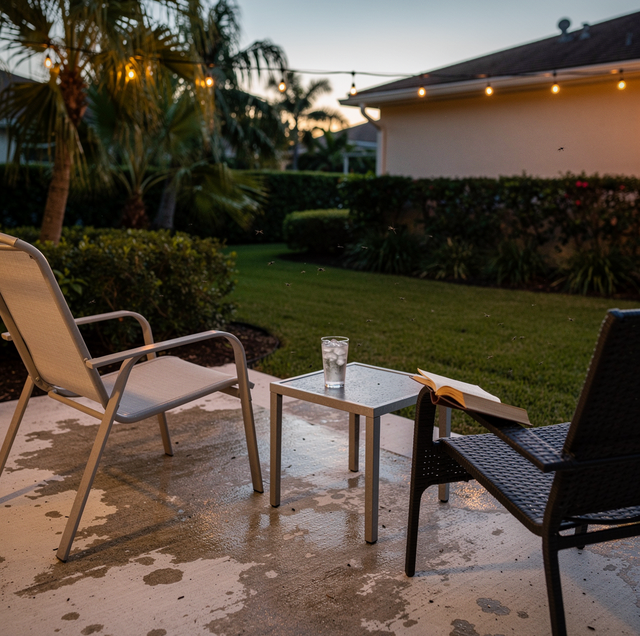
Two people sit on the same patio for the same hour. One goes inside itching, counting six fresh bites. The other goes inside untouched, shrugs, and offers a theory about sweet blood.
Same yard, same evening, same mosquitoes. The difference is real, it repeats, and it has an explanation that has been tested under controlled conditions. Controlled laboratory studies that place two volunteers in a shared arena and let mosquitoes choose between them find the same individuals drawing more insects, session after session, on separate days.
One correction before the factors, because it changes the arithmetic. Part of what you are comparing on that patio is not how many times each of you was bitten. It is how much each of you shows it. Two people bitten the same number of times can look nothing alike the next morning, one counting six angry welts and the other never registering three small bumps. Being the person who complains is not proof that you were the one preferred.
Exhaled Carbon Dioxide Is the Signal That Finds You First
Of everything your body puts into the air, the plume of carbon dioxide you exhale is the cue with the most evidence behind it. Female mosquitoes carry receptors tuned to small increases in CO2 above the level already in the air, and laboratory work and field trapping research point the same direction: a rise in CO2 switches a resting insect into active search mode and steers it upwind toward the source.
This is also the part of the process that works at distance. A mosquito sitting in shaded foliage has no idea you exist until your breath reaches it. You produce more of it when you talk, laugh, stand up, carry something across the yard, or play with the dog. Anything that raises your metabolic rate raises your output.
What carbon dioxide does not do is choose between two people sitting three feet apart. By that point, both of you are inside the same plume. CO2 gets mosquitoes into your half of the yard. Something else decides which chair they land on.
Body Heat and Skin Moisture Confirm You at Close Range
Inside roughly the last arm's length of the approach, the insect switches to cues it can only read up close: warmth and water vapor. Laboratory studies using heated targets show mosquitoes landing on a warm surface with no odor at all if it is the warmest thing on offer, and adding moisture to that surface makes it even more attractive. Human skin sits squarely in the range they respond to.
Both cues vary between people and within the same person hour to hour. Resting skin temperature varies from person to person, as does how much you sweat and how quickly that moisture evaporates. Someone who ran errands in the heat and sat down still warm is presenting a stronger close-range target than someone who came out of the air conditioning ten minutes ago. Your baseline chemistry holds steady while the heat and humidity at your skin surface move around while you sit there.
Skin Odor Is What Separates Two People in the Same Yard
If carbon dioxide brings mosquitoes near and heat confirms a target, skin odor is the cue that explains which of you gets chosen. This is where the evidence for individual preference is strongest.
Your skin carries a resident community of bacteria that feeds on what your sweat glands release and gives off volatile compounds as a byproduct. One group of these, the carboxylic acids, has repeatedly emerged from controlled laboratory studies as central to the differences between individuals. In trials where mosquitoes chose among worn nylon sleeves, participants whose skin carried higher levels of these acids were selected far more often, and the same people held their positions in the ranking when tested again much later.
The bacteria themselves appear to matter, beyond the sweat that feeds them. Research comparing people who were highly attractive to mosquitoes against people who were not found differences in the makeup of the skin bacterial community, with the more attractive group carrying a more abundant but less varied mix of species. One small twin study found more similarity within identical pairs, which is suggestive of an inherited component but is a single small result. It is the thinnest strand in this section, and it should be read that way.
That is the part that stings. Neither of you earned your position on that patio. One of you carries a chemical profile mosquitoes lock onto more easily, and almost every part of it arrived without your choosing it.
Pregnancy, Exertion, and Body Size Shift the Odds a Little
Three factors sit below odor and heat, yet still have real support behind them.
Pregnancy: Field research in areas with heavy mosquito activity has found that women in later pregnancy attract more mosquitoes than non-pregnant women in the same setting. The explanations offered are the two cues already covered: a higher resting metabolic rate producing more exhaled carbon dioxide, and a slightly warmer abdominal skin surface. The finding comes from a small number of field studies and the effect is not large.
Exertion: Working in the yard, playing with the kids, or sitting down straight off a run raises your CO2 output and changes what is on your skin, including lactic acid, which regularly appears in laboratory studies of attractive skin compounds.
Body size: Adults present a larger warm, humid, CO2-producing surface than children do, and larger adults more than smaller ones. It is real, and smaller than the skin-chemistry differences separating two adults of similar build.
Blood Type Is a Small and Mixed Finding
This is the claim repeated with the most confidence and the least supporting evidence.
The blood type idea comes from a handful of small, controlled studies, most of which used small volumes of blood or a modest number of volunteers, testing whether mosquitoes land more often on people of one ABO group. Some of that work reported a preference, often for type O. Other studies, using different species or methods, found no reliable difference or found that the effect faded once stronger cues were controlled for. The results do not line up cleanly; the samples are small, and mosquito species do not all behave alike.
Where that leaves it: blood type may contribute something. Whatever it contributes is far smaller than carbon dioxide, skin temperature, and skin odor, and it is not a result to act on. If you have type O blood and rarely get bitten, nothing is broken.
And "sweet blood" is not a thing: A mosquito does not sample your blood and then decide. It commits from outside your skin, using cues carried in the air, and nothing about the sugar content of your blood reaches the surface where an insect could read it. The phrase describes a folk belief, not a mechanism.
Clothing Color, Diet, and Beer Are Mostly Overstated
Clothing color: There is a small real cue here and a large exaggeration on top of it. Laboratory studies using colored targets show mosquitoes orienting toward dark, high-contrast objects against a lighter background during the final approach, so a dark shirt may make you marginally easier to pick out at close range. It is not why the mosquito came into the yard, and switching to white will not give you an evening off.
Diet: Bananas, garlic, vitamin B supplements, and the rest of the food folklore have been put to controlled tests and have not held up. No ordinary food reliably changes how attractive your skin is.
Beer: One small controlled trial reported that volunteers became slightly more attractive to mosquitoes after drinking beer, and the result has circulated ever since. The effect was small, the proposed explanations did not survive follow-up work, and the finding has not been convincingly reproduced. It belongs in the curiosity column.
The Yard Is the One Variable That Responds to Effort
Put the factors together, and the conclusion is useful even if it is not the one you were hoping for. The traits that make you the preferred target are the traits you cannot change: how much carbon dioxide you exhale, how warm your skin runs, and the bacterial community producing the compounds that lift off your skin into the air. You can change your shirt. You cannot change your chemistry, and no diet, supplement, or blood type workaround has survived testing. Worth noting, too, that the untouched spouse sits lower on the list on a given evening, without being immune to anything.
Which leaves one variable that actually responds to effort. The yard.
Adult mosquitoes spend roughly 23 of every 24 hours resting in shaded foliage. The population sitting in your shrub line is commonly 10 to 100 times larger than the handful actively biting you.
Adults leave that cover to feed and return to it, so the insects reaching your patio are a thin slice of the insects on the property. Aiming control at the person chases the few already in the air. Aiming it at the shaded, humid, wind-protected vegetation along fence lines, under hedges, and beneath dense plantings works on the population those few came from, which is what a barrier treatment is built around.
It also explains why professional mosquito work runs on a schedule instead of as a single visit. In warm climates, the pressure climbs with heat and rain and eases in cooler months without hitting zero, so service tightens through the wet season and spaces out through the dry one. Which species is biting you, how far it flew, what hours it hunts, and how long its eggs survive a dry spell are separate questions with their own answers.
The one this article answers is simpler. Whatever makes you the preferred target arrived with you, and the only part of the equation that responds to effort is the ground you are sitting in.
Frequently Asked Questions
Several of the mosquito species that bite around homes approach low and stay low, so your lower legs are the first thing they meet. Feet also carry a denser and more distinctive population of skin bacteria than most of the body, producing a stronger version of the odor signature mosquitoes follow. Bare feet on a patio remove the last thing in the way.
The puncture itself is barely felt. A feeding mosquito injects a small amount of saliva that keeps blood moving, and your immune system reacts to proteins in that saliva. The itch and the raised bump are that reaction, which is why bite size varies so much from person to person.
Repeated exposure to the saliva of the same mosquito species gradually dampens your body's response to it, and that shift plays out across seasons of steady exposure. It is specific to what you have been exposed to, which is why moving between regions with different resident species can reset it, bringing the strong reactions back for a while. People raised under heavy mosquito pressure often show barely a bump from a bite that would raise a welt on a recent arrival, and someone who came down from a colder region typically reacts hard for the first few seasons and less after that.
Possibly, but not predictably. Controlled work has found that washing with different soaps can shift how attractive a person is, and it moves in either direction depending on the soap and the person, because you are adding compounds to skin that already has a profile of its own. No soap or fragrance reliably makes someone unattractive to mosquitoes.
Holding still earns you a slightly later landing and very little else. The cues that decide the landing at arm's length are warmth and skin odor, and both keep working while you sit perfectly still, so stillness never makes you invisible to anything already in your half of the yard. What motion adds on top is a visual cue: several of the species biting around homes read movement against a background over the final few feet of an approach, which is why the person crossing the patio with a tray gets found before the person already seated with a drink. The practical version is that sitting down changes the timing of your first bite and almost nothing about the total.
More than most people expect, because mosquitoes are weak fliers. The species biting around homes cruises at about one to one and a half miles per hour, and air moving faster than that makes a controlled approach and landing hard work for them. A fan aimed low across the seating area, at ankle height where these species tend to fly, does considerably more than one pointed straight down from overhead. Moving air also breaks up the carbon dioxide plume rising off you, which smears the trail that brought the insect in your direction to begin with. The catch is that the effect stops at the edge of the airflow and does nothing at all to the population resting in your shrub line. For one chair on one evening, though, it is real.
Change the yard — a barrier treatment aimed at the shaded foliage where adults rest cuts down the population that finds you in the first place. Buggify Pest Solutions serves Boca Raton, West Boca, and communities across Palm Beach and northern Broward. Call Tyler: (561) 672-0200.
