

How Rodent Pressure Differs Across Buggify's Service Area
Quick Answer: Rodent pressure across the thirteen cities covered follows several recurring patterns rather than city boundaries: tile-roof construction, canal and water-edge lots, coastal frontage, older inland cores, and newer master-planned subdivisions. Most addresses carry more than one at once.
Two properties can share the same municipal name on the mailing address and have almost nothing in common here. What the roof is made of, what borders the rear lot line, when the block was built out, and how close the nearest open water sits all set rodent pressure at an address, and none of those start or stop at a city limit. Rodent pressure across the service area instead follows several recurring patterns, and a property usually sits within one or more of them before anyone has looked at it.
Thirteen cities make up the regular service area: Boca Raton, West Boca Raton, Parkland, Coral Springs, Deerfield Beach, Delray Beach, Boynton Beach, Pompano Beach, Coconut Creek, Margate, Lighthouse Point, Hillsboro Beach, and Ocean Ridge, across Palm Beach and northern Broward. The patterns that run through them are tile-roof construction, canal and water-edge lots, coastal and barrier-island frontage, older inland cores, and newer master-planned subdivisions. Most addresses fall under more than one at once. This is a guide to which pattern (or patterns) an address is likely to sit under, not a full account of any single one.
Tile-Roof Inland Communities
Tile roofs are common across much of Boca Raton, West Boca Raton, and Parkland, and are found throughout the rest of the service area. Tile-roof construction carries its own roof rat pattern, worked out in full elsewhere.
An address under a tile roof gets its inspection started at the roofline and the soffit-fascia line before anywhere else, because the roof material sets the starting point rather than the city limit around it.
Canal and Water-Edge Communities
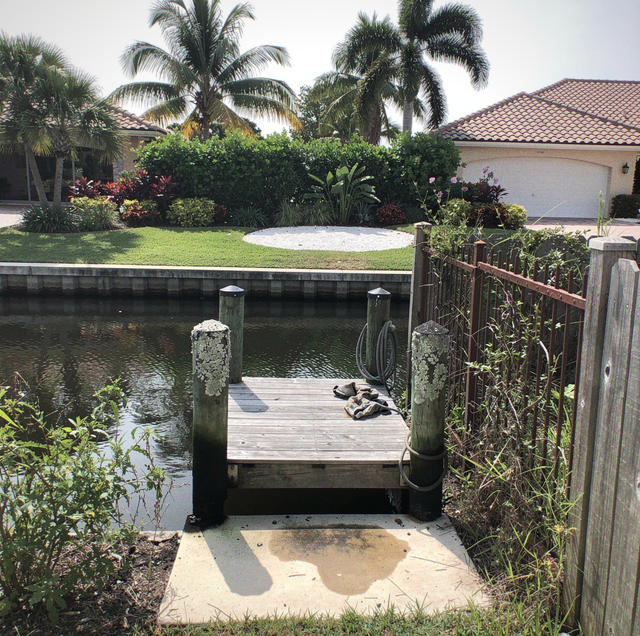
A canal, a retention pond, or a seawall sits at the rear line of large stretches of Coral Springs, Parkland, Lighthouse Point, Delray Beach, Deerfield Beach, Boynton Beach, Coconut Creek, and Margate, and the mechanisms that follow from that are each already worked out on their own: how a connected canal grid spreads pressure differently from a contained pond, largely a Parkland and Coral Springs story, and how a canal bank or seawall functions as a Norway rat's travel route from open water to the slab edge. What both cases share, at the level this guide needs, is that the water's edge sets pressure more than the surrounding street grid does.
An address backing onto any kind of open water, in any of the cities above, is worth reading from the water in rather than from the street out.
A quick first check for your own address: look at what actually borders the rear lot line, not just what is visible from the street. A property that reads as landlocked from the front often is not.
Coastal and Barrier-Island Properties
Hillsboro Beach and Ocean Ridge sit on a barrier island, and stretches of Deerfield Beach, Delray Beach, Boynton Beach, Pompano Beach, and Lighthouse Point carry ocean or intracoastal frontage along their eastern edges. That geography is its own pressure profile, with its own set of failure points, distinct from an inland canal lot or a landlocked one further from either coast.
Coastal and barrier-island frontage is its own read, treated separately. The pattern is worth naming and keeping apart from the others here, because a beachfront or intracoastal address should not be read by the same checklist as an inland canal-front lot just because both back onto water.
Older Inland Cores
Boca Raton's Old Floresta and the established inland sections of Deerfield Beach, Delray Beach, Boynton Beach, and Pompano Beach were all built out earlier than the master-planned subdivisions that came later, and an older core reads differently at the roofline, the soffit, and the utility penetrations than a later-generation build does, a contrast already worked out in detail for Boca Raton's own east-west split. The same build-era logic carries to the other cities' older cores.
An older core reads less uniformly than a newer subdivision does, because what accumulated on each house over its life differs from one property to the next even on the same block.
Newer Master-Planned Communities
Parkland, West Boca Raton, and the newer sections of Coral Springs, Coconut Creek, and Margate were built out under more uniform standards: HOA-governed subdivisions and 55+ communities where lots sit closer together, and construction detailing repeats from one house to the next rather than accumulating piecemeal. Where a build standard repeats across a block, the construction points that accompany it repeat as well.
Where the Patterns Overlap
None of these patterns stops cleanly where the next one starts, and most addresses in the service area carry more than one at once. A tile-roofed home in Coral Springs on a canal-front lot carries both the roofline pattern and the water's-edge pattern together, not one instead of the other. An older core home a few blocks from the water in Deerfield Beach can carry the build-era pattern and the coastal pattern at the same time, and Delray Beach's Marina Historic District, which fronts the Intracoastal, sits under both at once by definition rather than by chance.
Reading an address against a single pattern, because it happens to be the most visible one from the street, is how a second, quieter source of pressure gets missed until it turns into its own call weeks later. The patterns above are a starting point for orientation, not a way to sort an address into exactly one box.
Frequently Asked Questions
A drainage district is drawn around a water system rather than around a population, so its boundary follows the canals, control structures, and outfalls it exists to manage. That line tracks something physical. On one side of it, the water is managed as a single connected network; on the other, it belongs to a different system with its own cycle for how banks and rights-of-way get maintained, and that cycle is what decides how much cover a bank is carrying at any point in the year. A special taxing district formed around some other shared service works the same way. Two addresses inside one city can sit in different districts, and an address can share a district with a home in a neighboring city while sharing nothing with the house at the far end of its own street.
Sometimes, in a specific way: an edge address is more likely to sit where two patterns actually meet, such as a newer subdivision built up against an older core, or a canal system trailing off into landlocked lots further from the water. A property well inside one uniform pattern, with the same construction and the same water access as its neighbors on every side, is more likely to read as a single clean pattern rather than a mix of two.
The one the property is already arguing for. A tile roof and a canal bank at the same address point an inspection to opposite ends of the structure, roofline first against grade first, and nothing settles that in the abstract. What settles it is the evidence in hand: noise overhead points the read up, a sign at floor level points it down, and species narrows it further, since a roof rat and a Norway rat do not work the same half of a building. With nothing showing either way, the pattern offering the shorter route from cover to structure gets read first. The second pattern is still covered in the same visit rather than pushed to another one.
It can, because a canal, a preserve buffer, or a shared drainage system does not answer to a service roster. A served address bordering an unserved neighbor's stretch of the same canal or preserve is still connected to whatever that stretch is carrying, the same way it would be connected to a served neighbor's stretch, since the water or the ground does not change on either side of a line that only exists on a service map.
A handful of nearby areas, including Highland Beach, Lake Worth Beach, Wellington, and Tamarac, fall outside the regular service area and are handled on a case-by-case basis, by appointment, rather than on the standard rotation the 13 core cities get. An address in one of those areas is not automatically excluded from a pattern described above; it is simply outside the regular cadence run across the core 13.
Route practicality, rather than anything about the addresses themselves. The work is owner-operated: one technician runs each job from start to finish rather than handing sections to rotating route technicians, so the regular rotation is limited to what one technician can cover in a working day outside Boca Raton. Nothing about a by-appointment address makes its rodent pressure any different from that of a rotation address a few streets away. The difference sits in how the visit gets scheduled, not in what the visit finds.
Have your address read against the pattern it actually sits under — the inspection starts where the property's own construction and rear line say it should. Buggify Pest Solutions serves Boca Raton, West Boca, and communities across Palm Beach and northern Broward. Call Tyler: (561) 672-0200.
