

Luxury Home Rodent Control in Boca Raton: What Scale Changes
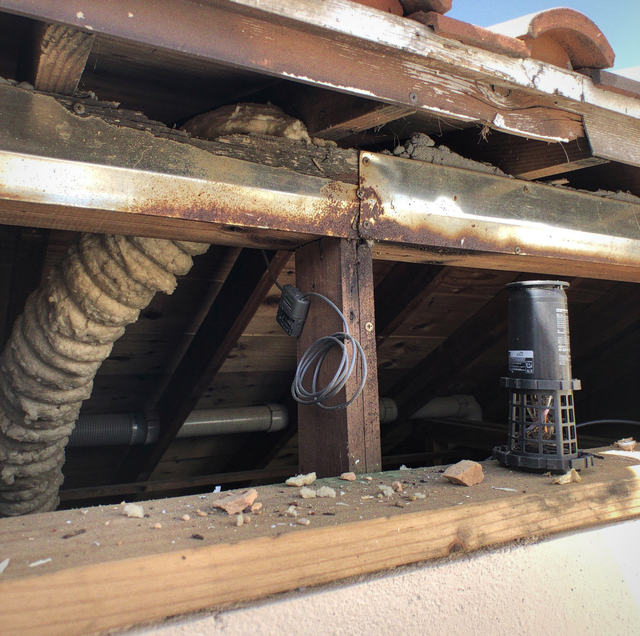
Ask how many attics a house has, and the answer is usually one. Under an articulated estate roofline, it is often several, and that is a difference in kind rather than a difference in size. Additions, wings carried on their own roof plane, and the extra hips and valleys of a more complex roof leave framed breaks that interrupt travel from one section to the next and that a trap line cannot read across. The loop that clears a compact attic, placing a line, monitoring it, and sealing the last opening once the catches stop works because there is one continuous space that one set of traps can cover on every visit. Where that space is discontinuous, the assumption behind the loop fails before the first trap goes in.
Quick Answer: An estate-scale rodent job is usually not one attic job. An articulated roofline divides the space above the ceiling into several compartments with no travel between them, so coverage is built compartment by compartment rather than as one line scaled up.
An Attic That Behaves as Several Structures, Not One
On a single-block home, one roof plane usually ties one attic together end to end. An estate-scale roofline rarely holds that shape. Additions, wings on a different roof plane, and the extra hips and valleys of a more articulated roof introduce breaks in the framing itself. A ridge that changes direction, a fire block where one section of framing meets another, or a soffit boxed out to hide ductwork can each mark the edge of a separate attic compartment rather than a continuation of the one beside it.
That segmentation is not visible from the ground, and often not obvious from a single attic hatch either. A compartment read from one hatch can have no framed connection to the section on the far side of the house, even though both sit under what reads, from the driveway, as one continuous roof. Two compartments can also connect at one seam and not another, so a gap sealed on one side says nothing about the same joint on the other.
None of this means a larger property carries more rodent risk in the abstract. It changes the question an inspection has to answer: not just where the activity is, but which compartment it is confined to, and whether that boundary matches where the walls appear to divide the house from outside.
What Monitoring Coverage Has to Mean When Sections Do Not Connect
A trap line answers a question about the space it sits in, not about the property as a whole. On one continuous attic, a line placed along the travel route an inspection identifies is a fair read on the whole space. Once a property breaks into several framed compartments, a line placed in one of them answers for that compartment alone. A fire block interrupts the open run, so activity read on one side is not a read on the other.
That changes what full coverage means going in. Rather than one line scaled up, an estate-scale job runs a set of lines, each placed against the travel and droppings found in its own compartment, each checked on the same seven-to-ten-day rhythm. A compartment with little or no sign still gets a point placed and checked because an unchecked compartment is not a confirmed clear.
The interval between visits holds at the same seven-to-ten-day rhythm no matter how many compartments a roofline contains. A single stop just produces several separate reads instead of one.
How One Technician Sequences a Property This Size
A compact job fits inside one visit's attention: one attic, one line, one set of notes carried from one stop to the next. A property broken into several compartments does not compress that way. Each stop runs within a limited window, and that window must be divided among compartments that are not all at the same stage of the same job.
That is where continuity does the most work. The same technician runs every visit on a property like this rather than the job passing between hands, so the map of which compartment sits at which stage, and which opening is still deliberately held open, carries forward with the person who set it up.
When calling about a large property, mention which side of the house or which structure the sound or sign was near. That detail helps a technician decide where to focus the first visit, rather than starting the walk from an arbitrary point.
A Guest House or Detached Structure Is Its Own Envelope
A detached guest house, cabana, or garage is its own envelope, not a wing of the main attic with a longer walk to reach it. It is framed and roofed on its own, and the compartments inside the main house do not extend into it, however close the two buildings sit. A rodent using the main roofline as a travel path has no framed route into a detached attic; it would need its own point of entry into that building.
Treating a detached structure as an afterthought is where estate-scale coverage goes thin. A visit scoped around the main house's compartments, with the guest house folded in if there is time left, tends to give it a lighter read than it needs. A cabana or guest house often sits closer to trees or open yard than the main house does, which can mean more exposure at its own roofline rather than less. Scoping it in from the outset keeps that roofline and grade line from being read as already covered by the compartments next door.
What Tells You a Large Job Is Actually Finished
On a single attic, the finishing moment is easy to locate: one line, no catches, no fresh sign, held across enough visits in a row to trust the pattern, then the last opening gets sealed. It is visible because the space that produced it is visible too, under one hatch, on one visit.
An estate-scale property does not offer that single vantage. Several compartments, and possibly a detached structure or two, are each read on their own line and their own pattern of visits, and no one stop puts all of them in view. A property this size closes out compartment by compartment, each one confirmed quiet on its own evidence. Quiet and sealed are not the same step. A compartment that shares any seam with a section still running holds its final seal until that connected section is clear as well; only a compartment with no seam to an active section closes on its own evidence alone.
That is why a written record does more work here than on a smaller job. With no vantage point that confirms the whole property at once, what stands in for it is a per-compartment status: which sections are still active, which are quiet and waiting on a neighboring section, which are sealed for good. That list is the only place a property like this exists as one job.
Frequently Asked Questions
Some sections of an estate roofline have no hatch at all, and the only way into them runs through finished work: a closet ceiling, a coffered detail, a second-floor knee wall. That changes when the compartment can be read, not whether it can be. Creating an access point there is a finish-trade decision belonging to the owner, so until one exists the compartment is read from outside at its soffit line, roof penetrations, and any grade-level points that feed it. Where sign elsewhere in the house points toward that section, the access question moves to the front of the job.
Its final seal waits. A compartment that meets a still-running section at any seam, a shared top plate or the framing either side of a fire block, is not closed for good until that section is clear too, because closing it early can push what is still active next door into the compartment that just went quiet. Meanwhile, the quiet compartment holds its position: monitoring continues, and the seam remains on the list as a possible route. A compartment with no seam to an active section is the exception, and can be closed on its own evidence.
In the main house, the first sign is almost always heard: scratching overhead at night in a room somebody sleeps in. A cabana or guest suite that goes weeks between stays has no one inside at night, so the sign that reaches an owner first is of a different kind. It arrives as something seen on the next visit rather than heard, droppings on a counter or in a linen closet, gnaw marks on a pantry seal, an odor in a closed room. A visual sign is generally older than the day it turns up, which is why a structure used intermittently gets scoped into the inspection on the calendar rather than on a complaint.
Both sit low, stay in place for years, and create a dark, rarely disturbed void around or beneath the housing that a rodent can use without ever climbing toward a roofline. Each gets checked as its own point at ground level, because activity at grade does not depend on anything happening in the attic.
Its position gets recorded when it is set rather than remembered. A point placed at a particular downspout base, foundation corner, or edge of an equipment pad is logged with sufficient locating detail so that its absence is detected on the next visit rather than appearing as bare ground. Exterior points on a large property face ordinary displacement: irrigation work, mulch refreshes, moved planters, anything else happening along the foundation line. The record is what makes a missing point a finding rather than a quiet gap in coverage.
Not the one closest to the driveway, and not the one noticed first from inside the house. Among the compartments showing current activity, the first line usually goes to whichever one has its activity sitting closest to a ceiling-plane penetration into occupied space, a recessed fixture, a return chase, or a hatch over a hallway. That is the shortest path from the compartment into rooms people use, while activity confined over a garage or an unconditioned run can hold its place further down the sequence.
Buggify Pest Solutions serves Boca Raton, West Boca, and communities across Palm Beach and northern Broward. Call Tyler: (561) 672-0200.
