
Wasp, Bee & Hornet Removal in Parkland
Kid-and-pet-safe playground, pool cage and lanai response on Parkland estate lots. Walk-the-perimeter proactive audit before the summer swarm cycle.
- FL DACS License #JB268060 · Certified Operator Tyler Craig
- Bayer Authorized Applicator (Termidor)
- $1M general liability insurance
- Google 5.0 Rated · live review feed
- Family-owned · 1,000+ South Florida homes served since 2018
- Pet-safe and family-safe treatments by default
- Free phone estimates · no long-term contracts
Parkland's family-home demographic and estate-lot residential scale shift the stinging-insect work profile toward proactive prevention on kid- and pet-active zones. The city's median household age profile skews younger than Broward as a whole, home lots are estate-scale (three-quarter acre and up on much of the residential stock), and playgrounds, pool cages, and shaded lanais are heavily used by young children and family dogs during the spring and summer months when paper-wasp and hornet activity peaks. A reactive wait-until-someone-gets-stung workflow does not fit the family-home use case; the working standard is a walk-the-perimeter proactive audit ahead of the summer swarm cycle, treating identified active nests before they become a kid or pet exposure situation. The 12-18-minute dispatch window from the West Boca shop makes same-day emergency response practical for routine active-swarm calls. Parent Parkland city hub covers the estate-lot inspection methodology, tile-roof multi-story rodent work, and equestrian/barn integration in depth; this Tier 3 page focuses on the kid-and-pet-safe stinging-insect response and walk-the-perimeter estate-lot audit.
Kid-and-Pet-Safe Zone Response
Playground, pool cage, lanai, and yard active-play zones treated with kid-and-pet re-entry safety windows documented.
Walk-the-Perimeter Proactive Audit
Pre-summer estate-lot perimeter audit identifies active nests before they become exposure situations.
12-18 Minute Dispatch (Closest Broward)
Parkland is the closest Broward city to the West Boca shop. Same-day emergency response standard when we hear about it before noon.
Same Technician Every Visit
Tyler runs every Parkland stinging-insect job.
Direct Line to Tyler
Mon–Fri 8 am – 5 pm.
No Uninspected Safety Assurances
Site-specific treatment documentation records what was treated with post-treatment safety windows.
Four technical details specific to Parkland wasp, bee, and hornet work
Walk-the-perimeter audit technique, kid-and-pet re-entry safety windows, pre-summer scheduling standard, and playground-structure inspection focus.
Walk-the-Perimeter Audit Technique
Full estate perimeter walkthrough covering eaves, lanai, pool cage, playground, pergolas, outbuilding overhangs, and pool-deck-visible tree canopy. 1.5-3 hour audit window depending on lot size. Documented nest identification with treatment recommendation per site.
Kid-and-Pet Re-Entry Safety Windows
Post-treatment safety windows documented per treatment site in the condition-of-treatment note. Standard windows: 4 hours for direct nest application on pool cage and lanai zones; 6 hours for tree canopy applications. Communicated to the family before treatment window opens.
Pre-Summer Scheduling Standard
Audit and preemptive treatment scheduled April-early May, before peak defensive activity begins. Mid-summer follow-up walkthrough optional to catch post-audit re-establishment.
Playground and Outdoor Structure Inspection Focus
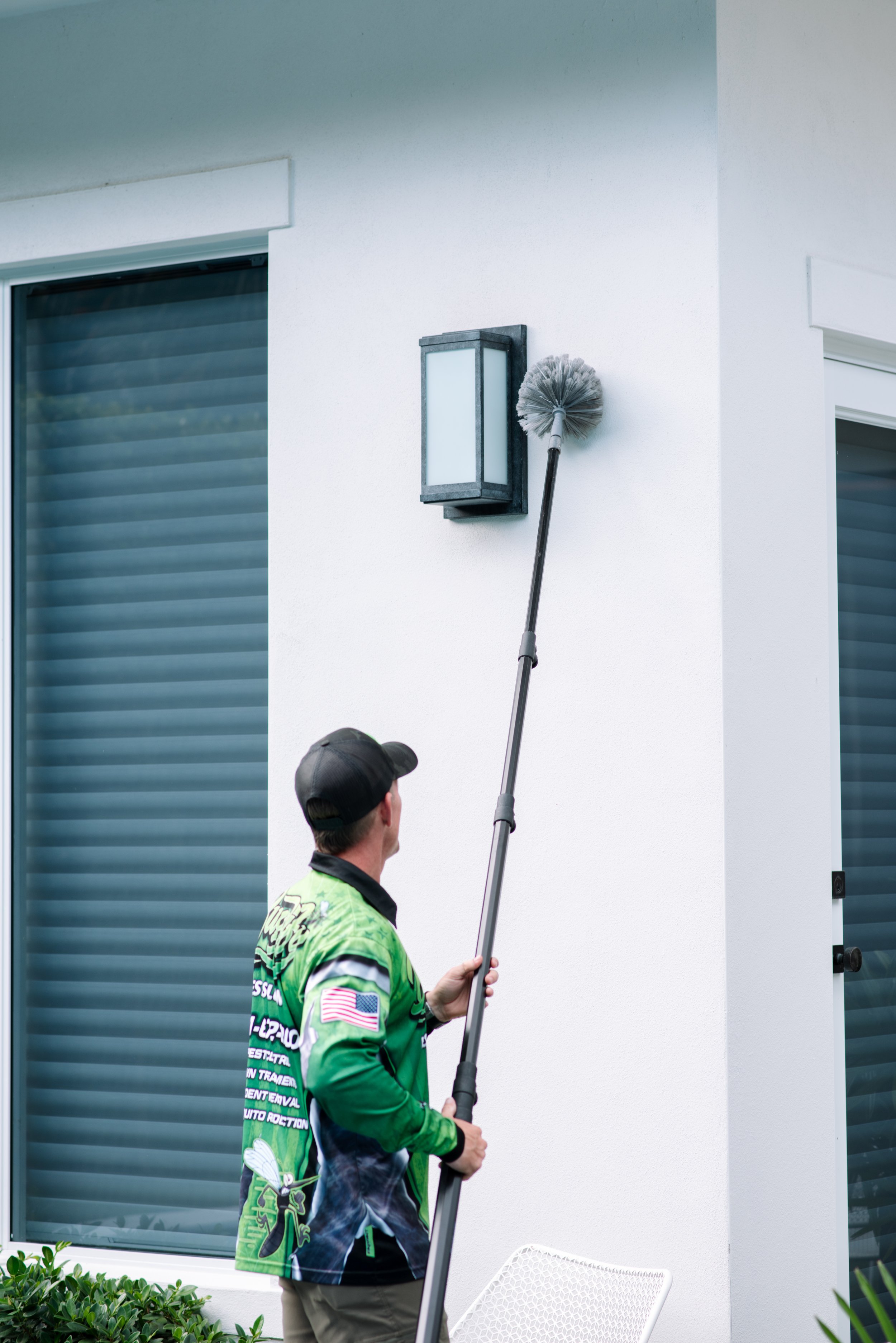
Playground climbing frames, treehouse overhangs, and covered patio undersides are prime paper-wasp umbrella-nest habitat. A kid-height inspection perspective is standard for Parkland walkthroughs.
Why Parkland stinging-insect work runs a walk-the-perimeter audit before the summer cycle
Parkland's residential demographics and lot scale change the stinging-insect exposure profile from most South Florida service areas. The median household age skews younger, with significant family-home concentration and young children and family dogs actively using pool cages, playgrounds, and shaded lanais throughout the spring and summer months. Home lots are estate-scale, and active-play zones are typically distributed across the lot rather than confined to a small backyard. This spatial distribution means a paper-wasp or hornet nest at a distant lanai corner or garden pergola may go unnoticed for weeks before a family member wanders into the defensive radius.
A reactive wait-until-someone-gets-stung workflow does not fit this exposure profile. The working standard on Parkland estate residential is a pre-summer walk-the-perimeter proactive audit, checking eaves, lanai frames, pool cages, playground structures, garden pergolas, shed and outbuilding overhangs, and tree canopy visible from the pool deck, before the peak May-August activity window. Active nests identified in the audit get treated preemptively; the treatment record and post-treatment safety windows are documented for the family record.
Parent Parkland hub covers estate-lot inspection methodology, tile-roof multi-story rodent work, fire ant yard protocol, and equestrian/barn integration. This Tier 3 page focuses on the kid-and-pet-safe stinging-insect and walk-the-perimeter audit dimensions.
Every Parkland wasp, bee and hornet issue Buggify handles
Three work profiles across estate-lot residential.
Kid-and-pet-active-zone paper-wasp and hornet removal
Playground structures, pool cage frames, lanai ceiling corners, patio-furniture undersides, garden pergolas, shed and outbuilding overhangs. Treatment with kid-and-pet re-entry safety windows documented in condition-of-treatment note.
Estate-lot walk-the-perimeter pre-summer audit
Full perimeter walkthrough before the May-August activity peak. Active nest identification and preemptive treatment; documentation of any structural cavity conditions creating recurring nest establishment.
Honey bee cavity finds on tile-roof soffit voids
Standard species-identification protocol. European colonies get live-relocation coordination; Africanized colonies get controlled treatment with kid-and-pet-active-zone safety protocol.
Estate-lot walk-the-perimeter case: 7 active nests identified before summer, no family stings that season
The setting
A Parkland estate-lot family with three young children and two family dogs scheduled a pre-summer perimeter audit in early May. The family had experienced two paper-wasp stings on kids the prior summer at the pool cage and requested a proactive audit path for the current year.
The audit
Tyler walked the estate perimeter over 2 hours: pool cage frame (2 active paper-wasp nests), lanai ceiling corners (1 active nest), garden pergola on the east side of the property (1 bald-faced hornet aerial nest), guest cottage overhang (2 mud dauber mud tubes, non-defensive), and tree canopy visible from the pool deck (1 paper-wasp umbrella nest in a lower oak branch).
The treatment sequence
Seven active stinging-insect sites treated over a single 3-hour access window: 5 paper-wasp with direct nest application, 1 bald-faced hornet with extended-reach applicator, 1 tree canopy nest treated at dusk to reduce dispersal risk. Mud dauber mud tubes removed manually; no chemical application (non-defensive solitary species).
The documentation and follow-up
Site-by-site treatment documentation recorded, product selection, and post-treatment re-entry safety windows. Family scheduled a mid-summer follow-up walkthrough to address any post-audit re-establishment issues.
The season outcome
No family stings that summer season. The pre-summer perimeter audit became an annual standing arrangement.
Four Parkland conditions that shape stinging-insect work
Family-home demographics, estate-lot scale, active-play-zone distribution, and 12-18-minute dispatch time each shape the wasp and hornet protocol.
Family-Home Demographic Concentration
Median household age skews younger than Broward as a whole. Young children and family dogs actively use pool cages, playgrounds, and lanais throughout the warm season.
Estate-Lot Residential Scale
Three-quarter acre and up on much of the residential stock. Active-play zones are distributed across the lot, extending the effective inspection perimeter.
Peak May-August Paper-Wasp Activity Window
Paper-wasp and hornet nest establishment concentrates in April-May, with peak defensive activity in June-August. Pre-summer audit times to the establishment window.
12-18 Minute Dispatch Window
Parkland is the closest Broward city to the West Boca shop. Same-day emergency response is the standard on active-swarm calls received before mid-afternoon.
What Parkland wasp, bee and hornet removal costs
Firm stinging-insect pricing follows an on-site inspection because access, nest location, hive size, and species drive the work required. A phone conversation gives a range and confirms whether emergency dispatch is appropriate.
Phone estimate
Free, Tyler gives a treatment range on the first call after confirming access, nest location, and suspected species. On-site inspection sets firm pricing.
Emergency dispatch note
Stinging-insect calls involving allergic occupants, children, pets, or aggressive swarm behavior get priority scheduling. Standard scheduling runs same-week.
Included in every job
Species identification (paper wasp, mud dauber, yellow jacket, hornet, honey bee, carpenter bee), nest removal, treatment residual, and a written condition-of-treatment note.
21-day return
If the nest re-establishes at the treated location within 21 days, Tyler returns at no additional charge.
Buggify vs. National Pest Chains
Seven-point comparison. Every row verifiable from how Buggify operates.
| Feature | Buggify in Parkland | National Pest Chains |
|---|---|---|
| Who answers when you call? | Tyler Craig, the licensed operator | Call center or booking bot |
| Same technician every visit | Yes, Tyler runs every job | Different rotating techs |
| Live-bee relocation policy | Coordinated with a beekeeper before removal for honey bee finds | Kill-and-remove default |
| Africanized-bee protocol | Bee identification before treatment; DNA-testing referral available | Standard chemical treatment regardless |
| Allergy notification | Written allergy-aware protocol for occupants before treatment | Not standard |
| Return-visit policy on stinging insects | Included when a nest re-establishes within 21 days at no charge | Extra visit fee typical |
| Contract lock-in | None. Bills per visit; cancel anytime. | Annual contracts common |
Read what Parkland customers say on Google directly
Real Google reviews from Parkland residents drive most of Buggify's new stinging-insect calls. Tyler answers, talks through the situation, and quotes a range on the first phone call. The live widget below pulls current reviews directly from Google, with a five-star average across all pest categories, with wasp and bee removal jobs mentioned frequently by name.
Three things Buggify will never do to you
Three things Buggify will never do to you (full list of seven on Why Choose Buggify):
Quote a real treatment price without inspecting the property first. Phone gives a range; firm pricing comes after an on-site walkthrough.
Indoor spraying when the source is outside. Most Parkland pest pressure is driven by outdoor harborage; indoor-only work is a short-term cover-up.
Long-term contracts that lock you in. Bi-monthly plans bill per visit and can be canceled anytime, no fees.
Call (561) 672-0200. Tyler answers, gives you a price range on the first call, and (in most cases) gets you on the Parkland schedule the same day or the next morning.
Parkland wasp, bee and hornet FAQ
When is the best time to schedule a pre-summer perimeter audit?
April to early May, before peak May-August defensive paper-wasp and hornet activity begins. This catches nests during the establishment window when colonies are smaller, and treatment is straightforward.
How long is a pre-summer perimeter audit on an estate-lot Parkland property?
1.5-3 hours depending on lot size and structure inventory (pool cage, lanai, playground, pergola, outbuildings, tree canopy). Documented nest identification and treatment recommendation per site.
What's the post-treatment safety window for pool cage or lanai treatments where the kids play?
Standard windows: 4 hours for direct nest application on pool cage and lanai zones. Documented in the written condition-of-treatment note per specific treatment site. Family can plan around the specified re-entry timing.
Do you handle honey bee finds in Parkland?
Yes, with the standard species-identification protocol. European colonies emerging from accessible cavities receive live-relocation coordination with a partner beekeeper. Africanized colonies or cavity-access-blocked situations get controlled treatment with kid-and-pet-active-zone safety protocol.
Can Tyler get here fast if we find an active swarm and the kids are outside?
Parkland is the closest Broward city to Tyler's West Boca shop, 12-18 minute dispatch. Same-day emergency response is the standard on active-swarm calls received before mid-afternoon. Immediate-area control instructions available by phone while dispatch is en route.
Direct line to the technician serving Parkland
Phone: (561) 672-0200 (Tyler answers) · Mon–Fri 8 am – 5 pm
Email: Getbuggify@gmail.com
Address: 22617 Middletown Dr., Boca Raton, FL 33428 (West Boca shop, primary dispatch)
License: FL DACS #JB268060 · Certified Operator: Tyler Craig
Call (561) 672-0200 or submit the form below for a free phone estimate. Tyler answers directly and gets you on the Parkland schedule the same day or next morning.