

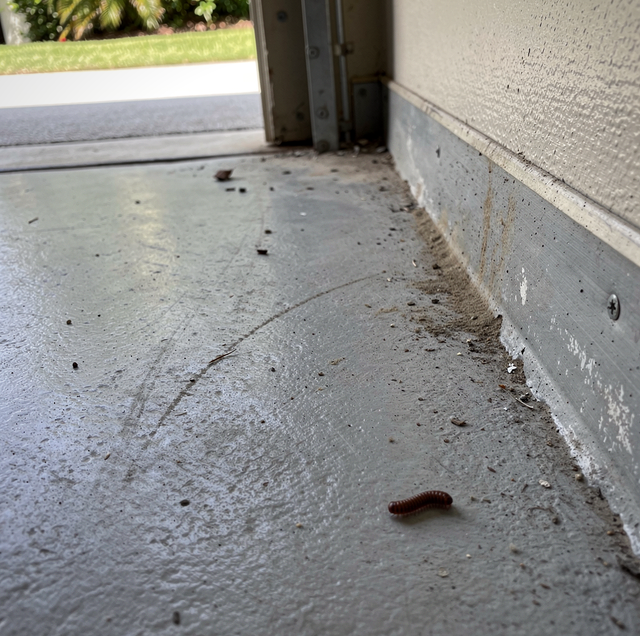
A millipede curled on the garage slab is already dying. It has no waterproof coating on its shell, so water continuously leaves it in a room built to stay dry, and the tight coil is the animal slowing that loss for as long as it can.
The rest of the answer follows from that fact. The animal did not come out of your house; it cannot feed on anything in it, and stepping on the one you found does not change how many you see next week.
What the sighting does carry is a statement about the ground outside, right at the line where the wall meets it, and about what the layer sitting against that wall has been doing for the last several days.
An Animal That Eats the Layer It Lives In
A millipede is a diplopod, a group name earned by its legs: two pairs on nearly every body segment, against the single pair per segment carried by the faster hunters it gets mistaken for. Experts describe that arrangement, with the first three segments excepted. The legs move in a slow traveling wave, and the animal is built to push through material rather than to run across it.
What it pushes through is also its food. Experts put the diet at rotting leaves, rotting wood, and other moist, decaying plant matter, and add grass thatch and pet food left out on a lawn. None of that describes your kitchen. The animal is a decomposer working the top of the soil layer, and its whole life happens in material halfway to becoming soil.
Under stones, flower pots, boards or similar debris, wherever there is abundant moisture. That is a description of the first few feet of ground around your house, and of the bed that runs along your wall.
What Kills the Ones That Come Inside?
Nothing in your house has to act on a millipede for it to die there. The air does it, and the clock is short.
Millipedes do not have an exterior coating of waterproofing wax as insects do, and normal indoor humidity that is comfortable for people is too dry for them, so they desiccate. The same guidance puts a number on the same situation, stating that millipedes that have come indoors die in two to three days due to lack of moisture. That places the animal on your floor, on a countdown that starts at the threshold, and places the population producing it entirely outside the building. It names the other half of the indoor problem, which is food: a dry room holds nothing a decomposer can eat.
Water Balance Moves Them in Both Directions
A millipede leaves the layer it lives in when that layer no longer holds the water it needs, and the layer can fail in either direction. Extension guidance describes large numbers of millipedes migrating, often uphill, when their food supply dwindles, or their habitats become either too wet or too dry. Each ends the same way for an animal that cannot regulate what it loses.
The dry direction is the one people notice least. Hot, dry weather moves millipedes in search of moister areas, and shade at the base of your wall slows evaporation there, so that strip holds moisture after your open beds have dried. The animal keeps going until the surface under it stops drying out, and the wall base is where that happens first.
Saturated ground pushes the other way, and the same guidance describes heavy rain sending millipedes to higher ground. That direction is short-lived, because it ends on its own: the ground drains, the layer resettles, and the movement stops without you doing anything to it.
Food supply is the condition that persists year-round. A bed loses what feeds the animals as the material in it finishes breaking down, and a bed topped up every season keeps a deep, damp layer under a dry surface. Either way, they concentrate where the layer stays workable, and against your wall it stays workable longest, because the wall shades it and the roof line above keeps sun off the ground beside it.
Reading the Perimeter Where the Layer Meets the Wall
Mulch should be only 2 to 4 inches deep so it remains dry most of the time, and separate guidance likewise calls for a level no thicker than 2 to 4 inches. One source gives the reason: surface drying between waterings. A layer at that depth loses its top inch to sun and air; a layer twice that deep keeps a permanently damp floor underneath, and that floor is the habitat.
Depth also determines where in the bed the animals sit. Experts make the point regarding coverage, noting that deep mulch near a foundation prevents surface-applied material from reaching the zone below, where millipedes are more likely to be found. The useful part of that observation is geometry. The animals are under the layer, so whatever changes your count has to change the layer, and thinning a deep bed does more to the population than anything that lands on top of it.
The rest of your walk is the material. Anything lying flat on damp ground belongs on the same list, because it holds the moisture the bed holds, and the underside of a board that has not moved in a season is the same address as the underside of the bed. Move the material first, because a bed thinned to depth with a compost pile still stacked against your wall has only shifted the habitat a few feet.
Successive Days Are the Only Count Worth Taking
Three feet up the wall and six feet out from it is the band given for a perimeter treatment aimed at these animals. The shape of that band is worth more to you than the fact of it, because it puts the working area on the ground and on the lowest part of the wall, which is where an animal that lives under a damp layer and climbs a foundation has to be.
One millipede on a Tuesday, and none after, means the layer outside your wall is doing what it should. Three on Tuesday, two on Wednesday, and four on Thursday suggest that something at the perimeter is producing them continuously, and a perimeter check gets scheduled based on the difference between those two weeks.
So write down the date and the number each time, in the same place, for a week. A week that produces nothing after one animal means the layer outside dried on its own. A week that keeps producing them means it has not, and the material holding that moisture is still sitting against your wall.
Frequently Asked Questions
Millipedes shelter during daylight in the damp material they feed on and travel after dark. Experts describe them seeking moist, sheltered sites during daylight hours. So the one on your floor at breakfast walked in while you slept, and indoor air has been pulling water out of it since.
Sweep or vacuum them up. The same guidance states that millipedes do not damage furnishings, homes, or food, so there is nothing in your house for them to have ruined. If you are finding them daily, what changes when they sit outside your door?
They climb. Millipedes climb foundation walls and enter through any small opening, and they name gaps around door and window frames plus the line where they crawl up under siding. A weather seal that stops a draft does not stop something that flat under your threshold.
Start at your wall and look for moisture that is not the bed. Leaky faucets and broken downspouts are among the high-moisture sites to cut, and keeping a crawl space ventilated and dry. If your downspout empties against your wall instead of away from it, that is where your count is coming from.
Some species release a defensive liquid when handled. Experts describe it as capable of irritating the skin or burning the eyes, and note a lingering odor and fluid that may be harmful if rubbed into the eyes. If you pick one up, wash your hands on the same trip that puts it outside.
Yes. Guidance from extension services states that millipedes mature in two to five years and live for several years after that, so the layer against your foundation holds a population that persists across seasons rather than one renewed by a single event. A change you make to that layer this year still shows in your count next year.
Schedule a perimeter inspection — the foundation line gets checked before anything is treated because millipedes that come in live on the damp outside of the wall, not the dry inside. Buggify Pest Solutions serves Boca Raton, West Boca, and communities across Palm Beach and northern Broward. Call Tyler: (561) 672-0200.