

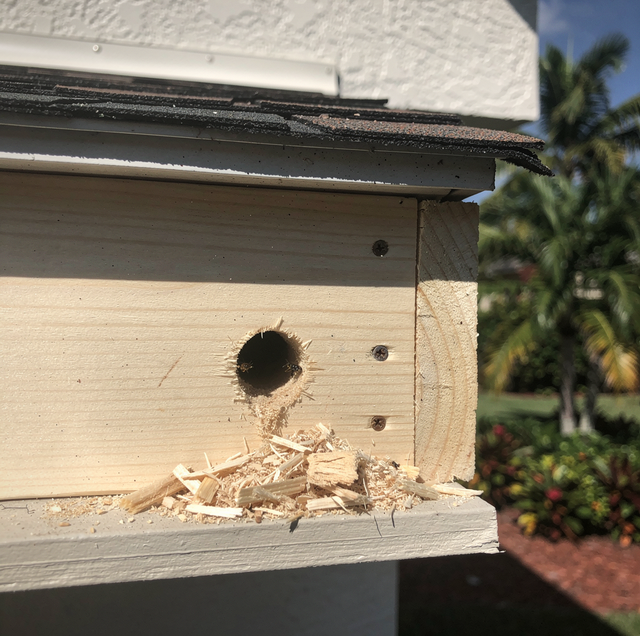
You caulk over last year's hole in the fascia, repaint the trim, and move on. A few months later, a new, round hole shows up a few inches from the old one, or sawdust starts collecting on the deck below the exact spot you just patched. The wood is not attracting bees at random, and a return doesn't by itself mean the last treatment failed. A carpenter bee returns to a board it has already worked once, and understanding why turns a losing patch-and-repeat cycle into knowing when a piece of wood is done drawing it back.
Why an Old Tunnel Keeps Drawing Bees Back
A female carpenter bee doesn't pick a spot because it looks like wood in general. She tests the surface, chews a short entrance hole straight into it, then turns to follow the grain, because a board's fibers split apart lengthwise long before they give way across the grain, and that difference is what steers her path once she's a short way in. That turn is why a gallery runs parallel to a board's length instead of straight through it. Once that tunnel exists, extending it a few more inches asks less of her than boring a brand-new entrance through undisturbed wood, so the existing tunnel gets longer, and a new hole a few inches from an old one can be a second bee starting her own tunnel in a board that has already proven workable.
An empty gallery is also there for a bee that hasn't excavated one of her own. A female investigating the area can choose an existing hole rather than cut a new one, since reusing a tunnel that's already there skips the work of chewing fresh wood. That's a real part of why one spot on a piece of trim can end up hosting bees for more than one season: the tunnel is already there, and reusing it saves the time of cutting a new one from scratch.
Reading the Entrance and the Gallery Behind It
Up close, the entrance is round and about half an inch across, and a few inches in the tunnel angles off to follow the grain. As a gallery lengthens, or as a second female adds her own branch off the main shaft, shavings fall onto whatever lies below, and their color says a lot about how recently that pile was cut.
| Signal | Active gallery | Old or vacated gallery |
|---|---|---|
| Frass color and texture | Pale, coarse, freshly cut | Grayed, weathered, packed down |
| Entrance edge | Clean, sharply cut circle | Worn, slightly rounded rim |
| Activity around it | Bees entering and exiting | No traffic |
A gallery that's been reused across seasons runs longer and branches more than a first-year tunnel, since each return adds length instead of starting over. That branching pattern is also what a technician follows to judge how far a gallery extends before deciding whether it needs treatment or only filling.
The Damage That Builds Across Seasons
One season's worth of tunnel in a stretch of trim does only limited damage by itself. What compounds it is that a cut gallery remains a candidate for the next bee rather than being abandoned for good: each return adds more length instead of starting over, and a board can wind up carrying a spread of branching galleries built over several seasons.
Woodpeckers add a separate kind of damage on top of that. A woodpecker that finds larvae in an active tunnel can tear the wood open to reach them, turning a clean, contained hole into a torn-open patch of fascia or trim, damage the bee itself never caused.
Why Paint and Sealant Change the Odds
The preferred target is bare, weathered softwood, whether that's an exposed deck rail, an unpainted fascia board, or trim that's simply been left to gray outdoors. A solid, intact coat of paint or stain makes that same board a less attractive target, since the finish adds a layer she has to chew through before reaching bare fiber. Paint on exposed wood works for exactly that reason: it takes away the easy first bite.
That protection lasts only as long as the coating stays unbroken. Once a finish thins out, cracks, or chips away at a joint or a cut end, the bare fiber underneath is exposed again, and that patch reads as bare wood no matter what finish surrounds it. A board painted years ago can quietly stop being protected once a crack opens at a joint: the wood right there is bare again, before anyone notices the finish has failed elsewhere.
Timing Treatment and Closing the Holes
Where a real winter sets in, activity at the entrance goes quiet for months, but the quiet is misleading: the bees riding it out are dormant inside the old galleries, not gone from the board, so a hole closed during that stretch can still have live bees behind it that chew their way out once the weather turns. Where winters stay mild, there's no quiet stretch to wait on, and the board stays open to new occupants year-round. Either way, a silent entrance in cold weather is not proof the gallery is empty.
The sequence that protects the repair is to treat the gallery while it's still in use, wait until traffic at the hole stops, and only then fill and refinish it. Sealing an entrance while a bee is still working it doesn't end the problem: she doesn't leave; she chews a new exit somewhere else on the same board, so the same cycle just starts again a few inches away.
When a Professional Treatment Is the Right Call
A gallery low enough to reach from the ground, on a porch rail or a garden trellis, is one thing to check yourself. A gallery on a soffit, a high fascia board, or an eave is another matter, and that's where the real risk sits.
A gallery on a fascia board, soffit, or high eave means working overhead from a ladder with both hands busy, which is how falls happen. Leave the high ones to a technician with the right ladder setup and application tools.
Pesticide products used on an active gallery need to be applied at the label's rate and depth to reach a bee that may already be well down the tunnel rather than sitting at the entrance, which is why getting the product to the right depth is a technician's job. A female carpenter bee can sting if she's handled, but she spends her time working the gallery, not guarding it; the male that hovers and dives near a face has no stinger at all. Neither of those behaviors is a reason to put off figuring out whether a gallery still needs attention, and neither is a reason to treat the situation as more dangerous than it is.
Sweep the sawdust away from under a hole and check the spot again two days later. Fresh coarse shavings on the swept surface mean the gallery is in use now, whatever the old pile looked like.
A gallery that's confirmed active, that's been reused across multiple seasons, or that sits somewhere a ladder can't safely reach is a reasonable point to bring in a professional rather than keep patching the same board alone.
Frequently Asked Questions
Each provisioned chamber is capped off with a partition the female builds from chewed wood pulp, sealing it before she starts excavating the next one down the tunnel. That partition also keeps one larva's food supply separate from another's in a gallery with more than one occupant working the same shaft.
Development runs several weeks, depending on temperature. Each egg is sealed into its own chamber with a single ball of pollen and nectar sized to carry that one larva through to adulthood, so a gallery with several chambers is really running several separate broods rather than one batch on a shared clock.
They are adults, both males and females, including that season's newly emerged bees. A female can live into a second year, so the one that dug the tunnel may be wintering in it alongside the new generation.
It's unlikely. A gallery follows the grain along the board it started in, and while reuse can stretch it a long way over the years, it stays in wood; the damage it does is to that board and anything fastened through it, not to wiring or pipe behind the wall.
A snug wood dowel, set with glue, sanded flush, and painted over, holds up better through weather changes than caulk alone. Caulk can shrink as it cures and pull loose at the seam with each temperature swing, while a wood plug moves with the board around it rather than against it.
Not necessarily. Two entrances close together can be two branches of the same reused gallery that each broke through to the surface independently, rather than two galleries started from scratch. Opening the wood, or following each hole's sawdust trail back, is what tells the two situations apart from outside.
Book a gallery check before repainting the board — find out whether it's active and what treating it takes. Buggify Pest Solutions serves Boca Raton, West Boca, and communities across Palm Beach and northern Broward. Call Tyler: (561) 672-0200.