

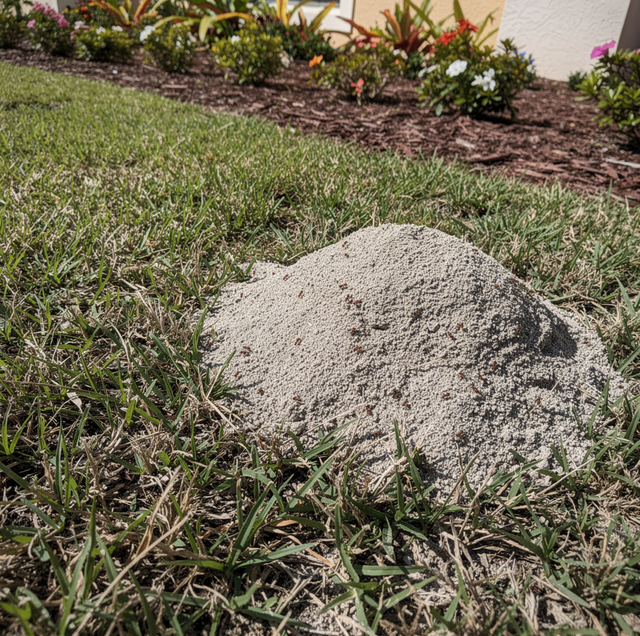
You are pulling weeds along the flower bed when your knee hits a patch of loose, fluffy soil you hadn't noticed. Within seconds, ants are on your leg, and by the time you're standing, they've bitten in a tight cluster and stung you a dozen times in the same few square inches. That pattern alone makes most people say "fire ants" out loud. But a mound in the yard and an aggressive reaction to being bumped can both come from more than one ant. Big-headed ants pile soil in similar spots, and a startled trail of many species will swarm a hand pressed into it. Guessing wrong changes what you should actually do next, because the mound in front of you calls for a different response depending on which ant actually built it.
Read the Mound First
A fire ant mound is a loose, fluffy dome of excavated soil, usually six inches to a foot or more across and several inches tall, sitting in full sun rather than in shade. What sets it apart from most other ant mounds is what's missing: there's no single obvious entrance hole punched through the top or side. The colony's tunnels run underground and surface away from the dome itself, so the mound looks almost sealed even while it's fully active underneath.
That absence of a visible opening is the first useful sign, because several of the ants people mistake for fire ants build mounds with a clear central hole (some sugar ants and pavement ants) or don't build a surface mound at all (ghost ants nest in wall voids, mulch, and potted soil; carpenter ants nest inside wood). Soil piled around one obvious hole, or no mound at all with ants trailing along a baseboard or a door threshold instead, points away from fire ants.
A mound that shows no traffic on a cool morning is not a dead mound. Where the climate never really gives pests an off-season, a colony stays viable in the soil straight through the year, so a quiet dome is likely just waiting on warmer soil, not gone. Where winters bite, that same quiet mound can still hold a live colony underneath; it simply doesn't forage through the entire cold stretch.
Read the Workers Up Close
Fire ant workers run reddish-brown to black and, unlike ants that all look the same size on a trail, a single fire ant colony produces workers of noticeably different sizes at once, from barely visible to nearly a quarter inch. Seeing small and large workers moving together on the same trail is itself a useful sign, because many nuisance ants, ghost ants among them, maintain a uniform worker size throughout the colony.
A closer look under a hand lens adds a second confirming detail: the narrow segment joining the thorax to the gaster carries two small raised nodes on a fire ant, where several common look-alikes carry only one. Big-headed ants share that two-node waist, so against them the node count proves nothing; the antennal club is the tell instead, ending in two segments on a fire ant and three on a big-headed ant. Pair the node count with the club, and you've confirmed the anatomy rather than just the color.
None of this needs catching a live ant. A phone camera held close to a slow-moving worker, then zoomed in afterward, usually shows the node count and antennal club clearly enough to match against a reference photo.
How They React the Instant the Mound Gets Bumped
Reaction speed is what sets fire ants apart from almost every other ant a homeowner encounters. A mower wheel, a dropped tool, or a knee in the wrong spot sends dozens to hundreds of workers surging out of the mound within seconds, not the scatter-and-hide response most ants give when their nest is jarred. Their first move is straight up whatever they're on, not away from it, which is why bites cluster on ankles, shins, and knees rather than spreading wherever contact happened. This is a sign to recognize after an accident, not a test to run.
The bite-then-sting sequence is also distinctive. A fire ant first grips the skin with its mandibles to anchor itself, then pivots around that anchor, stinging as it turns, which is why the marks form a small arc or circle rather than scattered pinpricks. A raised, itching welt that develops into a small fluid-filled bump over the following day is the typical result of that alkaloid venom, and it's a pattern worth recognizing precisely because it points back to the mound you may not have seen before you knelt.
Fire ants sting in numbers, and stings on someone allergic, or dozens on a small child, need medical attention. A technician checks a mound with a probe, not a boot; keep kids and pets off a suspected mound until it is identified.
Where the Trails Run
Fire ants forage aboveground, in the open, favoring sunny lawns, garden beds, and the edges of pavement over shaded or damp corners of the yard. That's a meaningful contrast with ghost ants and sugar ants, which mostly show up indoors along counters and baseboards, and with carpenter ants, which keep to wood and bark, moving along siding, deck framing, and low-hanging branches rather than open turf.
A Side-by-Side Look at the Common Look-Alikes
Seen together, the mound, the worker size, and the reaction to disturbance rarely leave real doubt. The trouble is that most people only get one of the three at a time, a mound with no ants visible, or a handful of ants with no mound nearby, and that partial view is where the guessing starts.
| Fire Ants | Carpenter Ants | Ghost Ants | Big-Headed Ants | |
|---|---|---|---|---|
| Nest | Loose soil dome, no visible entry hole | Inside wood; no surface mound | Wall voids, mulch, potted soil | Small, flat soil piles near cracks |
| Worker Size | Same colony, clearly mixed sizes | Same colony, clearly mixed sizes | Uniform, very small | Two distinct castes: tiny minors, large-headed majors |
| Color | Reddish-brown to black | Black to dark brown | Dark head and thorax; pale legs and abdomen | Pale to reddish-brown |
| Reaction When Disturbed | Swarms and stings within seconds | Scatters; does not sting | Scatters; does not bite or sting | Scatters; majors may pinch |
Big-headed ants are the closest visual trap, since both species pile soil near turf edges and pavement cracks. The tell is the pile itself: a big-headed ant pile stays small and flat, and it lacks the extensive tunnel network that lets a fire ant mound get rebuilt to full height within a day of being leveled by a mower.
Frequently Asked Questions
A freshly built mound sits noticeably darker and looser than an older one, because it's made of subsoil the colony just pulled up from several inches down. Rain and sun weather that surface over the following weeks, so an older, undisturbed mound crusts over and lightens in color even though the colony underneath hasn't gone anywhere.
Yes. A colony under a paver, a garden timber, or a tree base often shows no dome at all, just a flush pile of loose soil against the object's edge. Fire ants also tend to pack into outdoor electrical housings and air-conditioning units, a pattern that extension entomologists have described for years, and it is a known reason a colony can turn up flush against a utility box or a slab, with nothing visible above ground to warn you first.
Workers travel out through shallow tunnels just under the soil that usually surface within about five to twenty feet of the mound, so ants foraging on bare turf can belong to a mound you haven't spotted.
Often, yes, and it's a strong sign on its own. When rising water threatens the nest, workers link legs and bodies into a floating raft with the queen and brood held above the waterline, then break apart and rebuild a mound once the ground drains. Ghost ants and carpenter ants have no comparable flood response.
It shifts with the weather rather than staying fixed. During hot, dry stretches, workers mostly forage in the early morning or after dark, because midday surface heat can kill them outright.
No. The species has no functional sting at all; the large-headed majors deliver a strong pinch instead, which is why a tight cluster of sting marks on the skin points back to fire ants, not big-headed ants.
Have the mound identified before anyone treats it — a technician checks the workers, the mound, and the foraging tunnels to name the species and what that means for the bait. Buggify Pest Solutions serves Boca Raton, West Boca, and communities across Palm Beach and northern Broward. Call Tyler: (561) 672-0200.